Why Ethereum Gas Fees Spike During High Demand
By David Turner
Senior Crypto Markets Reporter at CryptoCoinBeat. · June 13, 2026
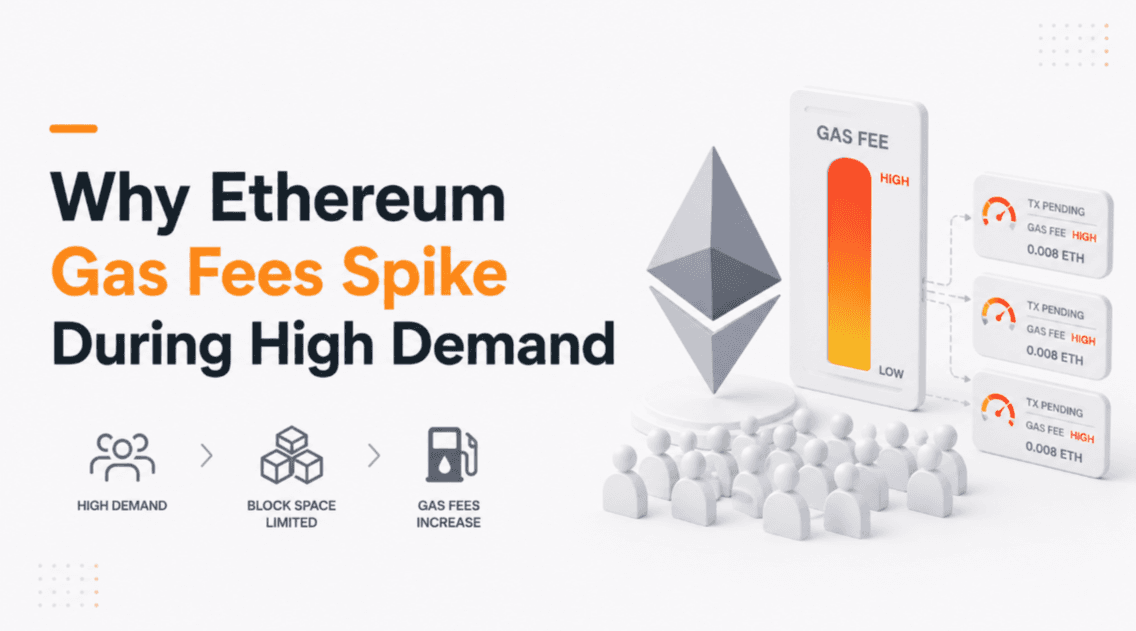
Ethereum gas fees spike during high demand because every block holds a limited amount of space, and when more people want to transact at once they effectively bid against each other for it. The fee is the price of that competition, so the busier the network, the higher it climbs.
What gas actually measures
Gas is a unit for the computational effort a transaction requires. Sending ETH costs little; interacting with a complex contract costs more because it asks the network to do more work. The total fee is the amount of gas used multiplied by the price paid per unit, and it is that price that swings with demand.
Crucially, block space is finite by design. Capping how much can fit in each block keeps the network manageable for the many nodes that run it, but it also means space is a scarce resource that must be rationed somehow.
The fee market as an auction
Ethereum rations space through a fee market. A base fee adjusts automatically: it rises when recent blocks are full and falls when they are not. On top of that, users can add a priority tip to encourage faster inclusion. When demand surges, the base fee ratchets up block by block and tips grow as people compete to get in sooner.
- Block space is capped, so it cannot simply expand to meet demand.
- A base fee rises and falls automatically with how full blocks are.
- Priority tips let urgent transactions jump ahead in the queue.
- Bursts of popular activity can fill blocks faster than the fee can settle.
Why spikes arrive in bursts
Demand is rarely smooth. A sought-after token launch, sharp market moves, or a wave of activity in one application can flood the network in minutes. Because the base fee reacts to recent blocks, a sudden rush sends it climbing quickly, then it eases once the crowd thins. That is why fees can look calm for stretches and then jump without warning.
Gas fees are not a fixed toll; they are a live auction for a seat in the next block. — CryptoCoinBeat analysis
What relieves the pressure
Two things help. Over time, scaling efforts move much activity onto layer-2 networks, draining demand from the base layer so its fees stay calmer. In the moment, users can wait for quieter periods, since fees often fall outside peak hours, or route routine transactions through cheaper layer-2 options designed for exactly this.
None of this removes spikes entirely. As long as block space is limited and interest in Ethereum is uneven, busy moments will cost more than quiet ones. The fee market is doing its job — allocating a scarce resource — even when the result feels uncomfortable.
This article is for general information only and is not financial advice. Network conditions change quickly, so check current fees before sending a transaction.
CryptoCoinBeat Newsroom · Published June 13, 2026 · Informational, not financial advice.
More from the wire
- MarketsSEC Greenlights Tokenized Stock Trading as Fed Rate Hike Tests Crypto Market Resilience
- RegulationUS Crypto Regulation and Market Structure Advance: CFTC Rulemaking Meets Coinbase's Stock-Perps Push
- RegulationUS Regulators Advance Tokenized Stocks Pathway and Bitcoin Reserve Bill in Landmark Week
- RegulationBitcoin and Ether Hold Steady as Fed Delivers First Rate Hike in Three Years, US Lawmakers Advance Crypto Bills
- MarketsUS Crypto Markets Face Double Test as CLARITY Act Stalls and Fed Decision Looms