Bitcoin ETFs Explained: How Spot Bitcoin ETFs Work
DeFi Protocols & RWA On-Chain AnalystDeFi Protocols & RWA On-Chain Analyst · May 3, 2026 · 11 min read
Published May 3, 2026 · Reviewed to our editorial standards. This article is informational and not financial advice.
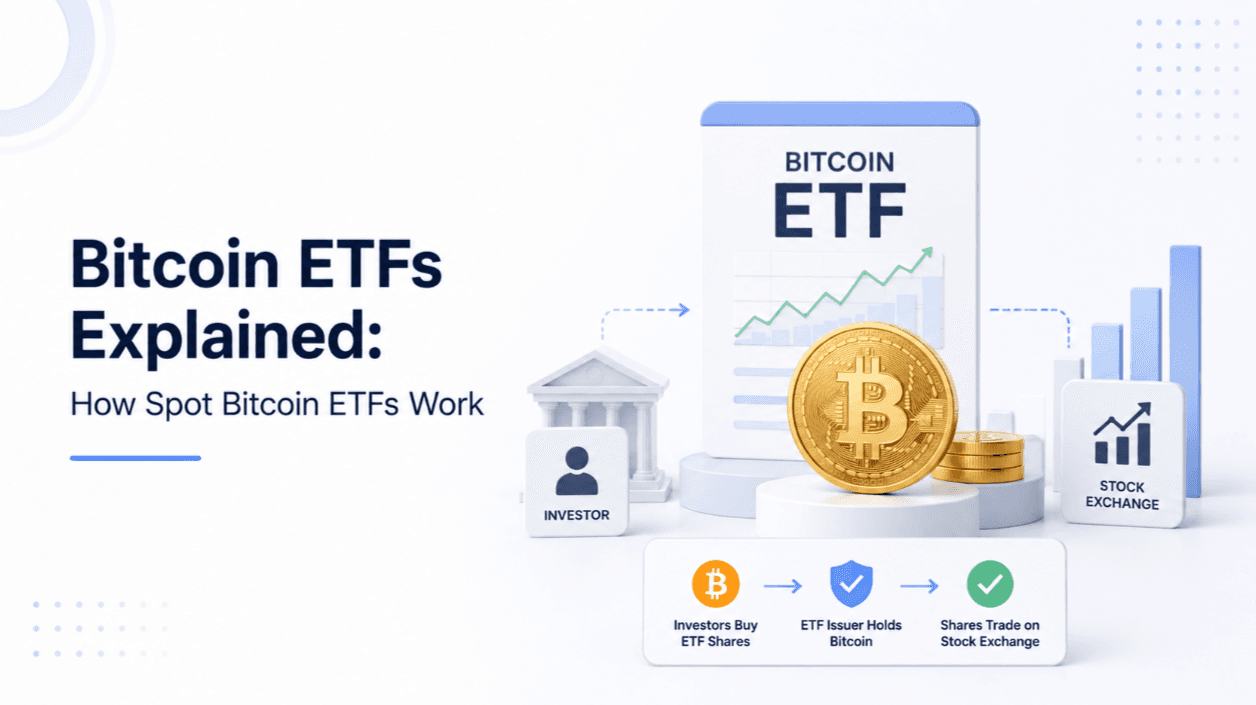
A spot Bitcoin ETF is an exchange-traded fund that holds actual bitcoin and issues shares tracking its price, letting investors gain exposure through an ordinary brokerage account without managing wallets or keys. US regulators approved the first spot Bitcoin ETFs in January 2024, and they quickly became some of the fastest-growing funds in history. They differ from earlier futures-based products, which track bitcoin indirectly through derivatives contracts.
Key takeaways
- A spot Bitcoin ETF holds real bitcoin and tracks its market price.
- The US approved spot Bitcoin ETFs in January 2024 after years of rejections.
- ETFs offer exposure without self-custody, but you do not hold the underlying coins.
- Futures ETFs hold derivatives, not bitcoin, and can drift from the spot price over time.
- Trade-offs include management fees, custodial risk, and the loss of Bitcoin’s native features.
What an ETF is, briefly
An exchange-traded fund pools investor money to hold an underlying asset and issues shares that trade on a stock exchange throughout the day. A spot Bitcoin ETF applies that structure to bitcoin: the fund buys and stores bitcoin with a regulated custodian, and each share represents a claim on a slice of those holdings. Buying a share is, economically, buying exposure to that bitcoin.
How shares stay tied to the bitcoin price
ETFs keep their share price aligned with the underlying asset through a creation-and-redemption mechanism run by large firms called authorized participants. When demand pushes the share price above the value of the bitcoin behind it, authorized participants create new shares and the gap closes; when shares trade below, they redeem shares and the gap closes the other way. This arbitrage keeps the ETF’s price tracking bitcoin closely.
Cash versus in-kind creation
The US spot Bitcoin ETFs initially launched with a cash-creation model, meaning authorized participants deliver cash and the fund handles the bitcoin buying and selling itself, rather than exchanging bitcoin directly. This was a structural compromise with regulators. The distinction is mostly a back-office detail for ordinary investors, but it affects tax efficiency and how the funds interact with the underlying market.
Spot ETFs versus futures ETFs
Before spot funds were approved, the only US-listed Bitcoin ETFs were futures-based, holding regulated futures contracts rather than bitcoin itself. Futures ETFs can track the spot price loosely, but they carry “roll costs” — the expense of replacing expiring contracts with later-dated ones — which can erode returns over time in certain market conditions. Spot ETFs avoid this by simply holding the asset.
- Spot ETF: holds actual bitcoin; tracks price directly; no roll costs.
- Futures ETF: holds derivatives contracts; can drift from spot; subject to roll costs.
What an authorized participant actually does
Authorized participants are the plumbing that keeps an ETF priced correctly, and they are worth understanding because they explain why a spot ETF rarely strays far from bitcoin’s value. These are large trading firms with the right to create or redeem big blocks of shares directly with the fund. When shares trade richly relative to the bitcoin backing them, an authorized participant can profit by creating new shares and selling them, which adds supply and pushes the price back down.
The same loop runs in reverse when shares trade cheaply: the firm buys discounted shares, redeems them with the fund, and pockets the difference, which removes supply and lifts the price back toward fair value. None of this requires the fund manager to intervene; ordinary profit-seeking by these firms does the work, which is why well-run ETFs track their underlying asset within a narrow band most of the time.
Why the approval mattered
For more than a decade, US regulators rejected spot Bitcoin ETF applications, citing concerns about market manipulation and investor protection. A 2023 federal court ruling against the regulator’s reasoning cleared the path, and approval followed in January 2024. The significance was access: pension funds, financial advisers, and retail investors could now hold bitcoin exposure inside familiar, regulated accounts, drawing in capital that had stayed on the sidelines.
The spot ETF did not change what bitcoin is. It changed who can own it and how easily. — CryptoCoinBeat analysis
The trade-offs of owning an ETF
Convenience comes at a cost. ETFs charge an annual management fee, deducted from returns, and you are trusting the fund and its custodian to hold the bitcoin securely — a different risk profile from self-custody. You also forgo Bitcoin’s native properties: you cannot move ETF shares peer-to-peer, spend them, use them outside market hours, or withdraw the underlying coins. In effect, you own a regulated wrapper around bitcoin, not bitcoin itself.
Who each option suits
- ETFs suit investors who want exposure inside a brokerage or retirement account and prefer not to manage keys.
- Direct ownership suits those who want to self-custody, transact on-chain, or hold the asset outside the traditional financial system.
- Many holders use both — an ETF for tax-advantaged accounts and self-custody for long-term savings.
Fees, custody, and what to check
Spot Bitcoin ETFs compete largely on cost, and the issuers launched with low headline fees, some temporarily waived to win market share. Over a long holding period, even small annual fees compound, so the expense ratio is worth comparing across funds. Equally important is custody: the bitcoin behind the shares sits with a regulated custodian, and a small number of custodians hold a large share of ETF assets, which concentrates operational risk behind the scenes.
- Expense ratio: the annual fee deducted from the fund’s value.
- Custodian: which firm safeguards the underlying bitcoin and how it is insured.
- Tracking and liquidity: how closely the share price follows bitcoin and how easily shares trade.
- Tax treatment: how the fund is taxed in your jurisdiction and account type.
ETFs beyond the United States
The US approval drew the most attention, but Bitcoin exchange-traded products existed earlier elsewhere. Canada listed a spot Bitcoin ETF in 2021, and Europe has offered exchange-traded products tracking bitcoin for years, though they are often structured as exchange-traded notes rather than funds. The structures and protections vary by jurisdiction, so a product’s label matters less than how it actually holds the asset and what claim investors have on it.
The broader market impact
The spot ETFs absorbed large amounts of bitcoin in their first years, and their daily flows became a closely watched gauge of institutional demand. By routing more activity through regulated venues, they have tightened the link between bitcoin and traditional markets. That deeper integration cuts both ways: it adds legitimacy and liquidity, but it can also pull bitcoin’s price more closely in step with broader risk-asset sentiment.
This article is for general information only and is not financial, investment, or tax advice. ETFs carry fees and risks, and bitcoin is volatile; consult a licensed professional and read each fund’s prospectus before investing.
Frequently asked questions
What is a spot Bitcoin ETF?+
A spot Bitcoin ETF is a fund that holds actual bitcoin and issues shares tracking its price, traded on a regular stock exchange. It lets investors gain bitcoin exposure through a standard brokerage account without setting up a wallet or managing private keys themselves.
How is a spot ETF different from a futures ETF?+
A spot ETF holds real bitcoin, so its price tracks the asset directly. A futures ETF holds derivatives contracts instead, which can drift from the spot price and incur roll costs when contracts are replaced. Spot funds generally track bitcoin more closely over time.
Do I own actual bitcoin if I buy a Bitcoin ETF?+
No. You own shares of a fund that holds bitcoin on your behalf through a custodian. You cannot withdraw the underlying coins, send them peer-to-peer, or spend them. You gain price exposure and convenience but give up the native features of holding bitcoin directly.
Are Bitcoin ETFs safer than holding bitcoin?+
They remove the risk of losing your own private keys and operate within regulated markets, which some investors prefer. But they introduce custodial and counterparty risk and charge fees, and the bitcoin price itself remains just as volatile. Safer is relative to which risks concern you most.
Written by
Maria FernandezDeFi Protocols, Real-World Assets, On-Chain Analytics, Stablecoins, Spanish-Language Coverage
Maria Fernandez is an On-Chain Research Analyst at **CRYPTO·COINBEAT**, specializing in real-world asset (RWA) tokenization, decentralized finance, and stablecoin ecosystems. Originally from Mexico City and now based in Miami, Maria brings a unique Latin American perspective to blockchain research, combining deep technical analysis with insights into emerging digital asset markets across the Americas. Before joining **CRYPTO·COINBEAT**, Maria spent several years researching decentralized finance protocols, producing in-depth analysis on lending platforms, governance systems, and the growing adoption of tokenized real-world assets. Her early research into institutional RWA integration and decentralized collateral models helped explain one of the fastest-growing sectors within the blockchain industry. Maria's analytical approach combines on-chain transaction analysis, protocol revenue metrics, liquidity monitoring, and governance activity to evaluate the long-term health of DeFi ecosystems. She works extensively with blockchain analytics platforms, including Dune Analytics, Nansen, and Flipside Crypto, and has created numerous public dashboards that simplify complex blockchain data for investors and researchers alike. Her coverage of stablecoin market events and liquidity shifts has helped readers better understand risk during periods of heightened market volatility. She holds a B.Sc. in Industrial Engineering from ITAM (Instituto Tecnológico Autónomo de México) and a Graduate Certificate in FinTech from MIT Sloan. Passionate about blockchain education, Maria regularly contributes both English- and Spanish-language research, helping make advanced on-chain analysis more accessible to a global audience while supporting the continued growth of crypto adoption throughout Latin America.
Keep Reading
How to Store Bitcoin Safely: Wallets and Best Practices
Storing bitcoin safely comes down to protecting your private keys. Here is how wallet types compare and the habits that keep funds secure.
David Turner · May 17, 2026→

Bitcoin Halving Explained: What It Is and Why It Matters
Every four years Bitcoin cuts its issuance rate in half. Here is how the halving works, what history shows, and why it shapes supply.
Maria Fernandez · May 28, 2026→

How Bitcoin Mining Works: Hardware, Rewards, and Energy
Mining secures the Bitcoin network and issues new coins. Here is how proof of work, ASIC machines, and difficulty adjustment fit together.
David Turner · June 7, 2026→