How to Store Bitcoin Safely: Wallets and Best Practices
By David Turner
Senior Crypto Markets Reporter at CryptoGrows. · May 17, 2026 · 10 min read
Published May 17, 2026 · Reviewed to our editorial standards. This article is informational and not financial advice.
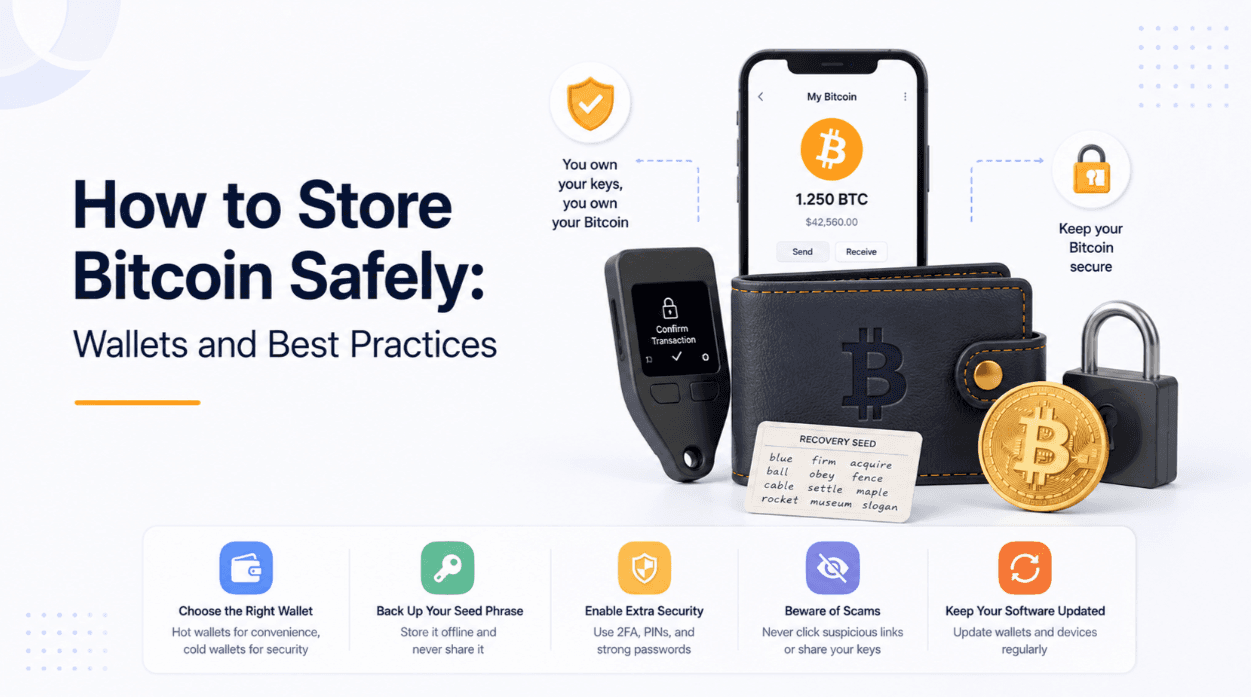
To store bitcoin safely, keep your private keys in a wallet you control — ideally a hardware wallet for larger amounts — and back up your recovery phrase offline in a secure place. Whoever holds the keys holds the bitcoin, so the goal is to protect those keys from theft, loss, and online attacks. For most people, a reputable hardware wallet plus a carefully stored seed phrase covers the realistic risks.
Key takeaways
- Bitcoin security is key security: control the keys and you control the coins.
- Hot wallets stay online and suit small, spendable amounts; cold wallets stay offline for savings.
- A hardware wallet keeps keys off internet-connected devices, blocking most remote attacks.
- Your recovery seed phrase is the master backup — guard it like the funds themselves.
- Leaving large balances on an exchange means trusting a third party with your keys.
Custodial versus self-custody
The first decision is whether you hold your own keys. With a custodial setup — typically an exchange account — the platform holds the keys and you hold a balance, much like a bank. It is convenient and easy to recover if you forget a password, but you depend on the platform staying solvent, secure, and accessible. The collapses of several custodians in recent years are the reason the phrase “not your keys, not your coins” caught on.
Self-custody means you hold the keys directly. You take on full responsibility, but no company can freeze, lose, or block access to your funds. For meaningful amounts, self-custody is the standard recommendation.
Hot wallets versus cold wallets
Wallets split into two broad categories based on whether they touch the internet.
Hot wallets
A hot wallet runs on an internet-connected device — a phone or desktop app, or a browser extension. Hot wallets are fast and convenient for spending and frequent transactions, but because the keys live on a device that is online, they are more exposed to malware and phishing. Treat a hot wallet like the cash in your pocket: handy, but not where you keep your savings.
Cold wallets
A cold wallet keeps keys completely offline. The most common form is a hardware wallet, a small dedicated device that signs transactions internally and never exposes the private key to your computer. Even if your laptop is infected, the keys stay isolated. For long-term holdings, cold storage is the safer choice.
The safest bitcoin is bitcoin whose keys have never touched an internet-connected computer. — CryptoCoinBeat analysis
The seed phrase: your real backup
When you set up a self-custody wallet, it generates a recovery phrase — usually 12 or 24 words. This seed is a human-readable version of your keys, and it can restore your entire wallet on a new device if the original breaks or is lost. Anyone who reads it can also take your coins, which makes it the single most sensitive thing to protect.
- Write the seed on paper or stamp it into metal; never store it as a plain photo or text file.
- Keep at least one backup in a separate physical location to survive fire or flood.
- Never type your seed into a website, and never share it with “support” — that is always a scam.
- Consider a passphrase (a 25th word) for an extra layer, but only if you can remember it.
How a hardware wallet protects you
A hardware wallet works by keeping the private key sealed inside the device and signing transactions internally. When you want to send bitcoin, your computer or phone prepares the transaction and passes it to the device; the device signs it and returns only the signature, so the key never leaves. You confirm the destination address and amount on the device’s own screen, which defeats malware that tampers with what your computer displays.
That design closes the most common attack paths at once. A keylogger cannot capture a key that is never typed, and remote malware cannot extract a key that never reaches the connected computer. The remaining risks are physical theft of the device combined with its PIN, and tricking you into approving a malicious transaction, both of which the on-device confirmation screen and a strong PIN are built to reduce.
Common ways people lose bitcoin
Most losses are avoidable and rarely involve breaking Bitcoin itself. The recurring causes are phishing sites that trick users into entering a seed, fake wallet apps, malware that swaps a copied address, exchange failures, and simple human error like losing the only backup. A second category is loss through death or incapacity, where heirs cannot find or use the keys.
Verifying addresses and apps
Two habits prevent a large share of theft. First, always download wallet software from the official source and confirm it is genuine. Second, check the first and last several characters of any address before sending, since clipboard-hijacking malware can silently replace a pasted address with the attacker’s.
Planning for inheritance and emergencies
A risk people overlook is what happens to their bitcoin if they die or become incapacitated. Because self-custody has no help desk, coins are lost forever if heirs cannot locate and use the keys. The fix is a clear, secure inheritance plan: written instructions stored with your estate documents, explaining where backups are and how to recover the wallet, without exposing the seed itself in plain sight.
Some holders split a seed phrase across trusted parties or use multi-signature arrangements so no single person can act alone but a quorum can recover the funds. Whatever the method, test the recovery process at least once. A backup you have never restored from is a backup you cannot trust.
A simple security checklist
- Confirm you can restore your wallet from the seed before adding significant funds.
- Store seed backups offline, in more than one location, protected from fire and water.
- Keep wallet software and hardware firmware updated from official sources only.
- Never enter a seed phrase online, and treat anyone asking for it as an attacker.
A practical setup for most people
A balanced approach works for the majority of holders: keep a small, spendable amount in a mobile hot wallet, and move long-term savings to a hardware wallet with the seed phrase backed up offline in two separate locations. If you hold a large amount, a multi-signature setup — which requires several keys to approve a transaction — removes any single point of failure, at the cost of added complexity.
This article is for general information only and is not financial, security, or legal advice. Self-custody carries real risks, including permanent loss; evaluate your own situation and consider professional guidance for significant holdings.
Choosing the device itself
Everything above is about method. The device is the other half, and the honest summary is that the differences between reputable hardware wallets matter less than people expect — and in two specific places, they matter enormously.
The first place is the screen. A wallet's real job is to show you, on hardware your computer cannot alter, exactly what you are about to authorise. A device that displays an unreadable hash has kept your key offline and still let you approve the wrong thing. The second is what can be independently reviewed: firmware published under an open licence can be checked by researchers, and closed firmware asks you to trust the vendor's description of its own product.
Our best hardware wallets table scores exactly those axes, along with recovery design and everyday usability. If you want the short version: open firmware with a secure element covers most holders, air-gapped signing suits Bitcoin-only savings, and the widest chain coverage comes with closed firmware — a trade worth making consciously rather than by default.
The failure people plan for least
Devices break, and it does not matter: the recovery phrase reproduces the same wallet on any compatible device from any manufacturer. What cannot be replaced is the phrase itself, which is why the backup — not the hardware — is the thing to protect. We cover the trade-offs between paper, metal and share-based schemes in seed phrase backup.
Frequently asked questions
What is the safest way to store Bitcoin?+
For most people, a hardware wallet with the recovery seed phrase backed up offline in two secure locations is the safest practical option. It keeps private keys off internet-connected devices, blocking the malware and phishing attacks that cause the majority of cryptocurrency thefts.
Is it safe to keep Bitcoin on an exchange?+
Keeping small, actively traded amounts on a reputable exchange is common, but it means trusting a third party with your keys. For meaningful or long-term holdings, withdrawing to self-custody is safer, since exchanges can be hacked, freeze withdrawals, or become insolvent.
What happens if I lose my seed phrase?+
If you lose your seed phrase and also lose access to the wallet, your bitcoin is gone permanently — there is no password reset or support line that can recover it. That is why multiple secure, offline backups of the seed phrase are essential before funding a wallet.
Do I need a hardware wallet for small amounts?+
Not necessarily. For small, spendable amounts, a reputable mobile hot wallet is fine and more convenient. A hardware wallet becomes worthwhile once your holdings reach a value you would be genuinely upset to lose to a phone hack or phishing attack.
Written by
David TurnerCryptocurrency Markets, Blockchain Technology, Tokenomics Analysis, Digital Asset Regulation, DeFi, Web3 Industry Cover
David Turner is a U.S.-based Markets Reporter at CRYPTO·COINBEAT, covering cryptocurrency markets, blockchain innovation, and the rapidly evolving digital asset ecosystem across North America. Raised in California and educated in economics and digital media, David combines strong analytical skills with years of experience reporting on financial markets and emerging technologies. He began his journalism career covering equity markets, Federal Reserve policy, and fintech developments for several financial news outlets before specializing in cryptocurrency. As blockchain technology gained mainstream adoption, David shifted his focus to Bitcoin, Ethereum, decentralized finance, and digital asset regulation. Prior to joining CRYPTO·COINBEAT, he reported extensively on crypto exchanges, institutional investment, stablecoins, and the expanding Web3 economy. At **CRYPTO·COINBEAT**, David delivers data-driven reporting designed to help readers understand the fast-moving digital asset industry. His coverage frequently explores U.S. crypto legislation, tokenomics, blockchain adoption, market sentiment, and the impact of macroeconomic events on cryptocurrency markets. He is particularly recognized for his in-depth analysis of token supply models, vesting schedules, liquidity trends, and the long-term sustainability of blockchain projects. David earned a B.A. in Economics from the University of California, Los Angeles (UCLA), and completed additional coursework in data journalism and financial analysis. He also authors the daily market briefing, **"Opening Bell Crypto,"** providing traders and investors with concise analysis of overnight market activity, key industry developments, and emerging investment trends.
Keep Reading

Bitcoin ETFs Explained: How Spot Bitcoin ETFs Work
Spot Bitcoin ETFs let investors hold bitcoin exposure in a brokerage account. Here is how they work and how they differ from owning coins.
Maria Fernandez · May 3, 2026→

Bitcoin Halving Explained: What It Is and Why It Matters
Every four years Bitcoin cuts its issuance rate in half. Here is how the halving works, what history shows, and why it shapes supply.
Maria Fernandez · May 28, 2026→

How Bitcoin Mining Works: Hardware, Rewards, and Energy
Mining secures the Bitcoin network and issues new coins. Here is how proof of work, ASIC machines, and difficulty adjustment fit together.
David Turner · June 7, 2026→