Seed Phrase Backup: What Actually Fails, and What Survives
Staff · August 28, 2026 · 8 min read
Published August 28, 2026 · Reviewed to our editorial standards. This article is informational and not financial advice.
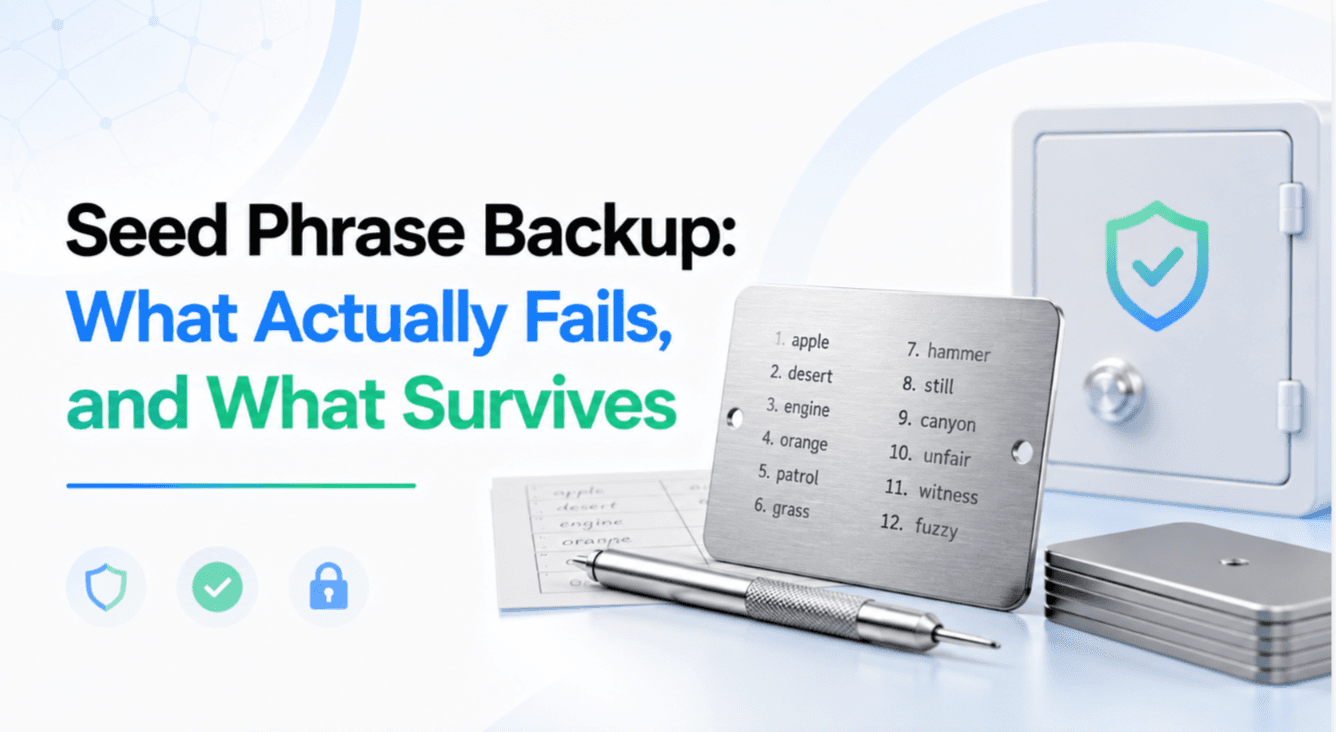
A recovery phrase is not a password. It is the wallet — twelve or twenty-four words from which every key, every address and every coin is derived. Lose it and no vendor, no support desk and no court can restore access. Leak it and the theft is instant and irreversible.
That asymmetry makes backups uniquely unforgiving: you must protect against loss and against exposure at the same time, and the obvious defence against one usually worsens the other. Making more copies protects against fire and floods; each copy is another thing that can be found. This is the whole problem, and it is worth solving deliberately once.
The six ways backups actually fail
- Transcription: a word written illegibly or in the wrong order. Discovered years later, when the device has already failed and there is nothing to check against.
- Single location: one house, one safe, one drawer. Fire, flood and burglary each take the whole thing.
- Digital drift: a photo "just until I write it out properly", a note in a password manager, a text to yourself. Every one of those syncs somewhere.
- Household risk: a partner, a cleaner, a builder or a curious teenager finds a card that says "recovery phrase" and understands exactly what it is.
- Death and incapacity: nobody else knows the backup exists or how to use it, so the coins are lost even though the words survive.
- Passphrase amnesia: an optional passphrase remembered at setup and forgotten a year later, which makes a perfectly good seed useless.
Notice how few of these involve an attacker. The dominant failure in self-custody is not theft; it is an owner who cannot reconstruct their own wallet.
Paper, metal and the fire question
The card in the box works and it is the weakest option: paper burns at temperatures a domestic fire reaches easily, and it degrades in damp. Stamped or engraved metal survives both, which is why it is the default recommendation for any holding worth more than the plate costs.
The practical advice is unglamorous. Buy a plate that stamps or engraves rather than one that relies on adhesive letters. Record the words in order and number them. Then store it somewhere that is not the same room, ideally not the same building, as the device it backs up.
Splitting the backup: SLIP-39 and multiple cards
Some devices support SLIP-39, which splits a backup into shares where a defined subset — say two of three — reconstructs the wallet. That solves the geography problem elegantly: no single location holds a complete secret, and losing one share is survivable.
It also adds a procedure you must still be able to execute under stress, years later, possibly by someone who is not you. If you use it, write down where the shares are and how many are needed, and store that note separately from the shares themselves.
A different answer to the same problem is the card model used by devices like Tangem, where backup means holding two or three identical cards rather than words. It removes transcription error entirely, at the cost of a very different threat model — you are protecting physical objects rather than a secret.
The passphrase decision
An optional passphrase produces a completely different wallet from the same seed. Its defence is precise: someone who finds your metal plate gets nothing, because the plate alone is not the wallet.
Its cost is equally precise: forget the passphrase and the funds are unreachable forever, and there is no partial credit. Two rules make it workable. Never store the passphrase with the seed, because that recreates a single point of compromise. And write it down somewhere, because human memory of a string you use twice a year is worse than people believe.
What to do about inheritance
The uncomfortable case is the most likely one. If you were hit by a bus tomorrow, could anyone you trust reconstruct your holdings? For most self-custody users the honest answer is no, and the coins are then lost as thoroughly as if they had been stolen.
Solving it does not require a lawyer. It requires a sealed letter with a trusted person or in a deposit box that says what exists, where the backup is and what to do with it — deliberately without the words themselves. For larger holdings, a multisig arrangement where a family member or professional holds one key is the cleaner answer; our self-custody wallet table covers the tooling.
Where not to put it
A bank deposit box is better than a drawer and worse than people assume: access depends on the bank's hours, its solvency and, in an estate, on probate. It is a reasonable second location and a poor only location.
A home safe protects against opportunist theft and does very little against fire unless it is rated for it — most domestic safes are not. And anywhere that a photograph might be taken casually, such as a desk drawer or a bookshelf, is worse than it looks: the phrase does not have to be stolen deliberately to end up in someone's camera roll.
A backup that actually works
- Words stamped into metal, numbered and in order, never photographed or typed anywhere.
- Two locations, far enough apart that one fire or one burglary cannot take both.
- Recovery tested on the device before any meaningful amount was sent, as described in our hardware wallet setup guide.
- A passphrase only if it is recorded separately, with a plan for who can find it.
- A note for whoever will need it if you cannot act — stating that it exists and where, not what it says.
Then check it once a year. Read the plate, confirm the words are legible, confirm you still know where the second copy is. Ten minutes annually is the entire maintenance cost of not losing everything, which is the cheapest insurance in this sector.
Frequently asked questions
What is the safest way to store a seed phrase?+
Stamped or engraved metal, in order and numbered, kept in two geographically separate locations, never photographed or typed into any device. Paper works but fails to fire and damp; digital copies fail to anything that later compromises the device holding them.
Should I split my seed phrase into parts?+
Splitting words arbitrarily across locations is a bad idea — it reduces the search space for anyone who finds one part. Use a designed scheme such as SLIP-39, where a defined subset of shares reconstructs the wallet and a single share reveals nothing.
Can I store my seed phrase in a password manager?+
It is a meaningful downgrade. The phrase then depends on that account's security, its recovery flow and its cloud sync, any of which can be compromised without your device being touched. Keep the phrase offline and physical.
What happens to my crypto if I die?+
Without a plan, it is lost as completely as if stolen. Leave a sealed note stating that a backup exists and where it is, without the words themselves, or use a multisig arrangement where a trusted party holds one key.
Written by
CryptoCoinBeatKeep Reading

Bitcoin ETFs Explained: How Spot Bitcoin ETFs Work
Spot Bitcoin ETFs let investors hold bitcoin exposure in a brokerage account. Here is how they work and how they differ from owning coins.
Maria Fernandez · May 3, 2026→
How to Store Bitcoin Safely: Wallets and Best Practices
Storing bitcoin safely comes down to protecting your private keys. Here is how wallet types compare and the habits that keep funds secure.
David Turner · May 17, 2026→

Bitcoin Halving Explained: What It Is and Why It Matters
Every four years Bitcoin cuts its issuance rate in half. Here is how the halving works, what history shows, and why it shapes supply.
Maria Fernandez · May 28, 2026→