How Bitcoin Mining Works: Hardware, Rewards, and Energy
By David Turner
Senior Crypto Markets Reporter at CryptoGrows. · June 7, 2026 · 11 min read
Published June 7, 2026 · Reviewed to our editorial standards. This article is informational and not financial advice.
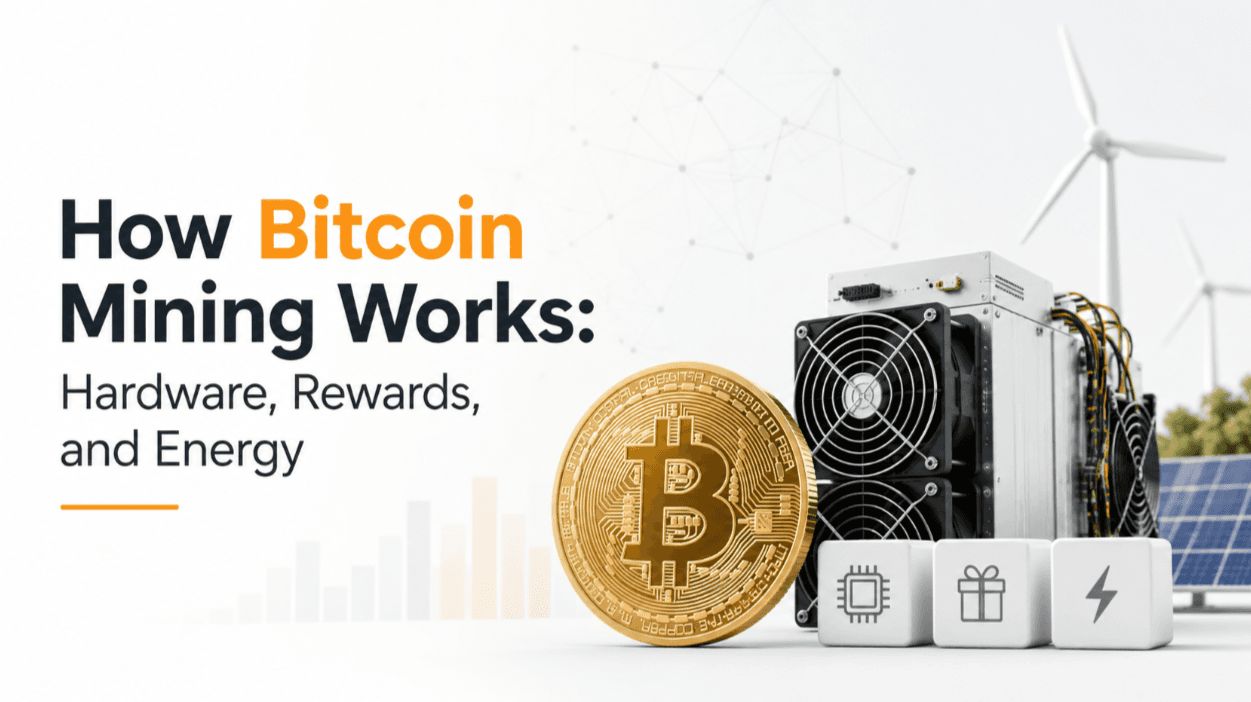
Bitcoin mining is the process of validating transactions and adding them to the blockchain by solving a computational puzzle. Specialized machines compete to find a number that produces a valid block hash, and the first to succeed earns newly issued bitcoin plus transaction fees. This work, called proof of work, secures the network and is also the only way new bitcoin enters circulation.
Key takeaways
- Miners bundle pending transactions into a block and race to find a valid proof of work.
- The reward in 2026 is 3.125 BTC per block plus fees, halving roughly every four years.
- Modern mining requires ASICs — chips built solely to compute Bitcoin’s hash function.
- Difficulty adjusts every 2,016 blocks to keep block times near ten minutes.
- Mining is energy-intensive, and operators increasingly chase the cheapest power available.
What miners are really competing for
Every block header contains a field called the nonce. Miners repeatedly change the nonce and run the block header through the SHA-256 hash function, looking for an output below a target value set by the network. There is no shortcut — the only way to find a valid hash is to try trillions of combinations. The machine that finds one first wins the right to publish the block.
Because the puzzle is hard to solve but trivial to verify, every other node can instantly confirm the winner did the work. That asymmetry is the heart of proof of work: expensive to produce, cheap to check.
Block rewards and the halving schedule
Miners are paid in two ways: the block subsidy (freshly minted bitcoin) and the fees attached to the transactions they include. The subsidy halves on a fixed schedule. It began at 50 BTC in 2009, dropped to 6.25 BTC in 2020, and fell to 3.125 BTC at the April 2024 halving. As the subsidy shrinks over the coming decades, transaction fees are expected to make up a larger share of miner income.
Why difficulty adjustment matters
Bitcoin targets one block roughly every ten minutes. If more miners join and blocks start arriving faster, the network raises the difficulty so the puzzle takes longer; if miners leave, difficulty falls. This recalibration happens every 2,016 blocks, about once every two weeks, and it is what keeps issuance on schedule regardless of how much computing power is online.
The hardware arms race
Early miners used ordinary CPUs, then graphics cards. Today competitive mining runs almost entirely on ASICs — application-specific integrated circuits designed to do nothing but compute SHA-256 hashes as efficiently as possible. A modern unit performs in the range of hundreds of terahashes per second, and operators measure success in hashes per joule, because electricity is the dominant ongoing cost.
- CPU mining (2009–2010): possible on a laptop, long obsolete.
- GPU mining (2010–2013): faster, but inefficient compared with purpose-built chips.
- ASIC mining (2013–present): the only viable option at scale today.
The economics of a mining operation
Running a profitable mine is an exercise in margins. The two costs that dominate are the upfront price of ASIC hardware, which loses value as newer, more efficient models arrive, and the ongoing electricity bill, which never stops. Against those, a miner earns the block subsidy and fees, valued in bitcoin. Because revenue is paid in a volatile asset while many costs are fixed in local currency, operators live or die by the spread between their power price and the bitcoin price.
This is why mining concentrates in places with electricity well below the global average, and why operators obsess over machine efficiency measured in joules per terahash. A site that is profitable at one bitcoin price can turn unprofitable after a halving or a price drop, forcing older machines offline until conditions improve.
- Capital cost: ASIC purchase price, which depreciates as newer models ship.
- Operating cost: electricity, cooling, maintenance, and facility overhead.
- Revenue: block subsidy plus transaction fees, denominated in volatile bitcoin.
Mining pools
A single machine has almost no chance of finding a block alone, so most miners join pools. A pool combines the hashing power of thousands of participants and distributes rewards in proportion to the work each contributed. This smooths income into steady, smaller payments instead of rare jackpots. The trade-off is concentration: a handful of large pools coordinate a big share of total hash power, which raises ongoing questions about decentralization.
Mining turns electricity into security. The more it costs to produce a block, the more it costs to attack one. — CryptoCoinBeat analysis
The energy debate
Bitcoin mining consumes a meaningful amount of electricity worldwide — comparable to a mid-sized country by some estimates. Critics see that as waste; defenders argue the energy buys an open, tamper-resistant monetary network and increasingly uses power that would otherwise be stranded or curtailed. Miners are mobile and price-sensitive, so they cluster where electricity is cheapest, including hydro-rich regions, flared natural gas sites, and grids with surplus renewable capacity.
Where the industry is heading
Since 2021, mining has spread out geographically after China’s ban pushed operations toward North America, Central Asia, and the Gulf. Several operators now market their use of renewable or otherwise wasted energy, and some grid operators use large miners as flexible loads that can shut off within seconds during peak demand. Whether mining is a net negative or a useful grid tool remains genuinely contested.
How mining secures the network against attack
The phrase “51% attack” describes the main theoretical threat: if a single party controlled the majority of hash power, it could reorder or reverse its own recent transactions, enabling double-spends. Even then it could not create coins out of thin air, steal balances it lacks keys for, or rewrite deep history without redoing an impossible amount of work. The deeper a transaction is buried under later blocks, the more secure it becomes, which is why merchants wait for several confirmations on large payments.
The defense is economic. Acquiring majority hash power would cost enormous sums in hardware and electricity, and a visible attack would likely crash the value of the very coins the attacker hoped to gain. As the total hash rate has climbed to record highs, the cost of mounting such an attack has risen with it.
Confirmations in practice
- Zero confirmations: broadcast but not yet in a block; reversible.
- One confirmation: included in the latest block; suitable for small amounts.
- Three to six confirmations: standard for larger payments, making reversal impractical.
Can you still mine at home?
Profitable home mining is difficult in 2026. Between ASIC prices, electricity costs, heat, and noise, most individuals cannot compete with industrial operations that buy power at wholesale rates. Some hobbyists run small rigs to support the network or as a learning exercise, and a niche of low-power lottery miners exists for those willing to gamble on a rare solo block, but neither is a reliable income strategy.
This article is for general information only and is not financial or investment advice. Mining profitability depends on hardware, electricity prices, and the bitcoin price, all of which can change quickly; assess your own situation before committing capital.
Frequently asked questions
How long does it take to mine one bitcoin?+
There is no fixed time to mine exactly one bitcoin. The network produces one block roughly every ten minutes, currently rewarding 3.125 BTC. A solo miner’s odds of winning any block depend on its share of total hash power, which for most individuals is vanishingly small.
Is Bitcoin mining still profitable in 2026?+
It can be, but mainly for operators with cheap electricity and efficient ASICs at scale. After the 2024 halving cut rewards to 3.125 BTC, margins tightened. Home miners usually struggle to profit once hardware depreciation and power costs are counted.
What happens when all 21 million bitcoin are mined?+
After the last bitcoin is issued around 2140, miners will earn only transaction fees rather than new coins. The network is designed to keep running on fee revenue alone, though whether fees will be high enough to fund strong security is an open question.
Does mining waste energy?+
Bitcoin mining uses significant electricity, which critics call wasteful. Supporters argue it secures an independent monetary network and increasingly taps stranded, flared, or surplus renewable energy. The honest answer is that the environmental impact depends heavily on the power source each operation uses.
Written by
David TurnerCryptocurrency Markets, Blockchain Technology, Tokenomics Analysis, Digital Asset Regulation, DeFi, Web3 Industry Cover
David Turner is a U.S.-based Markets Reporter at CRYPTO·COINBEAT, covering cryptocurrency markets, blockchain innovation, and the rapidly evolving digital asset ecosystem across North America. Raised in California and educated in economics and digital media, David combines strong analytical skills with years of experience reporting on financial markets and emerging technologies. He began his journalism career covering equity markets, Federal Reserve policy, and fintech developments for several financial news outlets before specializing in cryptocurrency. As blockchain technology gained mainstream adoption, David shifted his focus to Bitcoin, Ethereum, decentralized finance, and digital asset regulation. Prior to joining CRYPTO·COINBEAT, he reported extensively on crypto exchanges, institutional investment, stablecoins, and the expanding Web3 economy. At **CRYPTO·COINBEAT**, David delivers data-driven reporting designed to help readers understand the fast-moving digital asset industry. His coverage frequently explores U.S. crypto legislation, tokenomics, blockchain adoption, market sentiment, and the impact of macroeconomic events on cryptocurrency markets. He is particularly recognized for his in-depth analysis of token supply models, vesting schedules, liquidity trends, and the long-term sustainability of blockchain projects. David earned a B.A. in Economics from the University of California, Los Angeles (UCLA), and completed additional coursework in data journalism and financial analysis. He also authors the daily market briefing, **"Opening Bell Crypto,"** providing traders and investors with concise analysis of overnight market activity, key industry developments, and emerging investment trends.
Keep Reading
Bitcoin ETFs Explained: How Spot Bitcoin ETFs Work
Spot Bitcoin ETFs let investors hold bitcoin exposure in a brokerage account. Here is how they work and how they differ from owning coins.
Maria Fernandez · May 3, 2026→
How to Store Bitcoin Safely: Wallets and Best Practices
Storing bitcoin safely comes down to protecting your private keys. Here is how wallet types compare and the habits that keep funds secure.
David Turner · May 17, 2026→
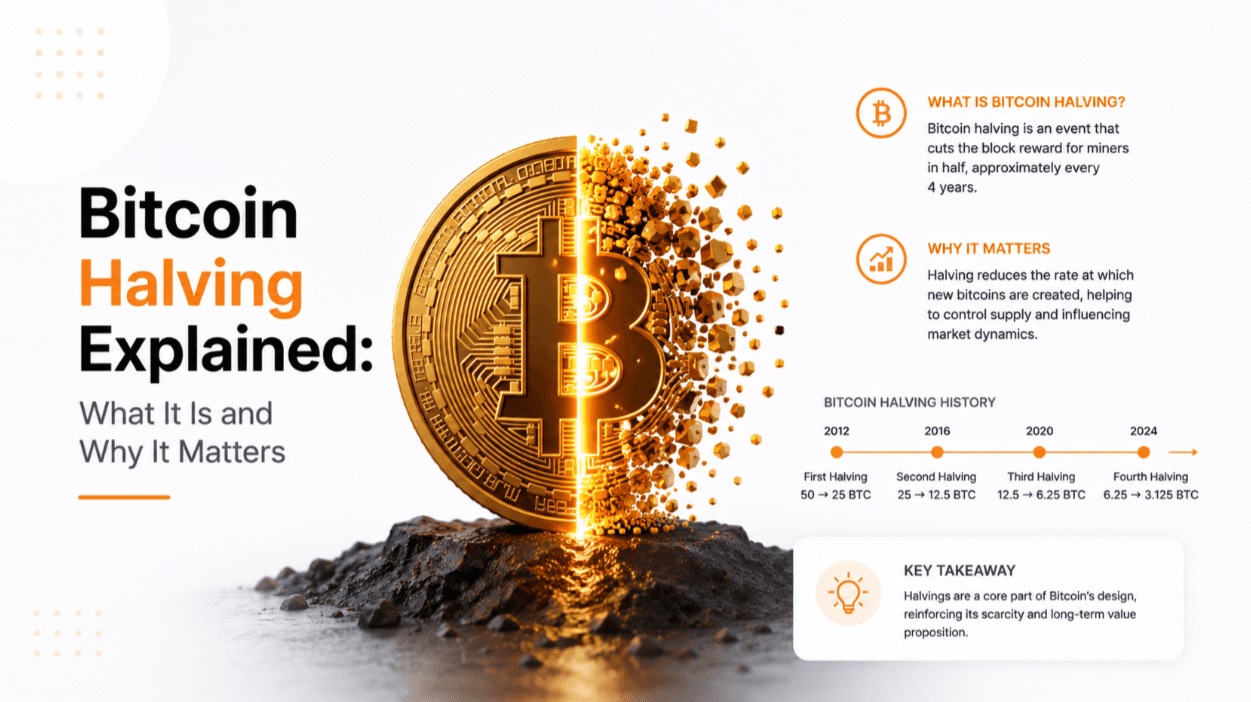
Bitcoin Halving Explained: What It Is and Why It Matters
Every four years Bitcoin cuts its issuance rate in half. Here is how the halving works, what history shows, and why it shapes supply.
Maria Fernandez · May 28, 2026→