Crypto Market Cap Explained: What It Means and Why It Matters
DeFi Protocols & RWA On-Chain AnalystDeFi Protocols & RWA On-Chain Analyst · May 31, 2026 · 8 min read
Published May 31, 2026 · Reviewed to our editorial standards. This article is informational and not financial advice.
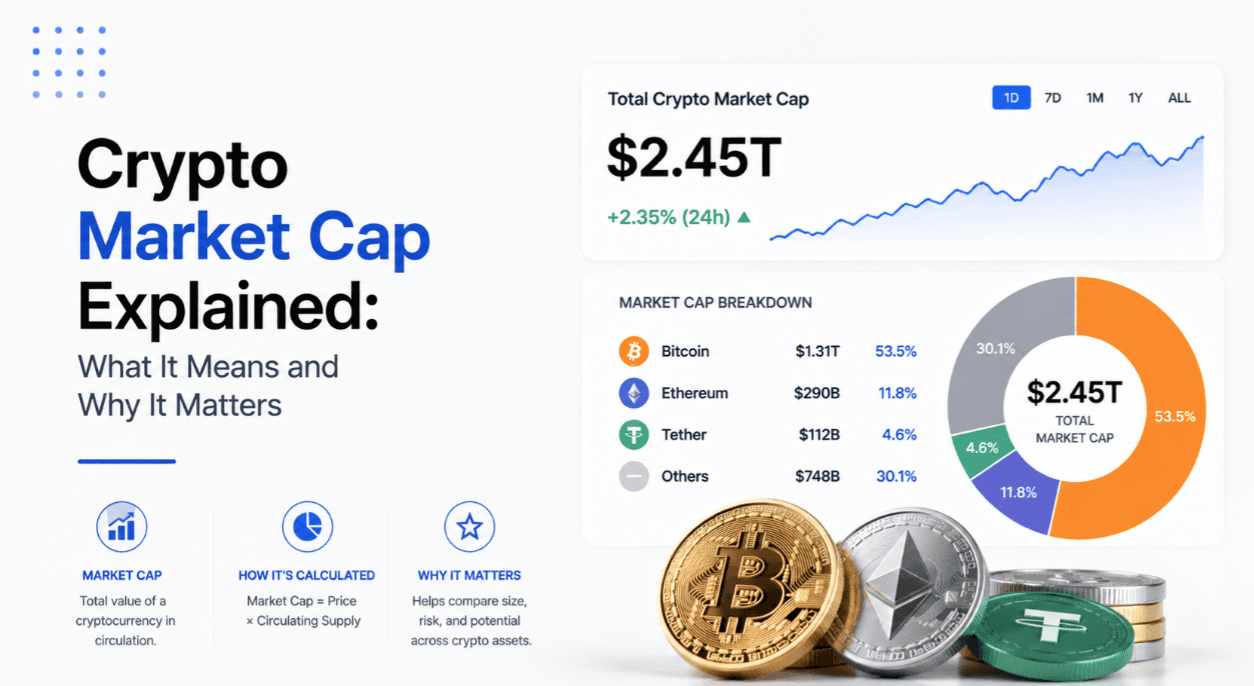
Crypto market capitalization, or market cap, is the total value of all coins currently in circulation. You calculate it by multiplying the current price of one coin by the number of coins available. It is a measure of a network’s relative size, not the amount of money invested in it, and a low per-coin price tells you nothing about whether an asset is cheap.
Key takeaways
- Market cap = current price × circulating supply.
- It measures relative size, not how much money has flowed into an asset.
- A low unit price does not make a coin cheap; supply matters.
- Fully diluted valuation counts coins that do not yet exist.
- Cap is only meaningful alongside liquidity and trading volume.
How market cap is calculated
The formula is deliberately simple. If a coin trades at 2 dollars and 100 million units are circulating, its market cap is 200 million dollars. Change either number and the cap changes. This is why two coins with very different prices per unit can have similar market caps — one simply has more units in circulation.
That point trips up new buyers constantly. A coin priced at a fraction of a cent is not “cheaper” than one priced in the thousands. If the low-priced coin has trillions of units, its total value can exceed that of the expensive-looking one. Always compare market caps, never unit prices.
Circulating supply vs total and max supply
Supply comes in three flavors, and the difference matters. Circulating supply is the number of coins available and trading right now. Total supply includes coins that exist but are locked, reserved or not yet released. Max supply is the hard cap a protocol will ever create, if one exists.
- Circulating supply: coins live and tradable today.
- Total supply: existing coins, including locked or reserved ones.
- Max supply: the absolute ceiling, where the protocol sets one.
Fully diluted valuation (FDV)
Fully diluted valuation multiplies the current price by the maximum supply rather than the circulating supply. It estimates what the market cap would be if every coin that will ever exist were already trading. A large gap between market cap and FDV is a warning that many tokens are still scheduled to enter circulation.
A token with a small market cap and a vast fully diluted valuation is selling you a small slice of a much larger future supply. — CryptoCoinBeat analysis
Future unlocks can dilute existing holders, much like a company issuing new shares. Checking the emission schedule — how and when new tokens are released — tells you whether today’s scarcity is real or temporary.
Why market cap alone can mislead
Market cap assumes every coin could be sold at the current price. In practice it cannot. If most of a token’s supply is held by a few wallets, or if daily trading volume is thin, the headline cap overstates how much value could actually be realized. A nine-figure market cap with five-figure daily volume is a red flag.
This is where liquidity enters. Liquidity is how easily an asset can be bought or sold without moving its price. A high market cap paired with low liquidity means even modest selling can crater the price, because there are few buyers to absorb it.
Large, mid and small caps
Traders loosely sort assets by size. The categories are informal and the thresholds shift with the overall market, but the framing is useful for thinking about risk.
- Large caps: the biggest, most liquid assets, generally less volatile.
- Mid caps: established but smaller, with more room to move in both directions.
- Small caps: tiny, often illiquid, higher potential swings and higher risk.
Total crypto market cap and dominance
Add every coin’s market cap together and you get the total crypto market cap, a gauge of the whole asset class. “Dominance” expresses one asset’s share of that total. Watching how dominance shifts can hint at whether capital is rotating toward larger assets or out along the risk curve, though it is a coarse signal, not a forecast.
Using market cap sensibly
Treat market cap as a starting filter, not a verdict. Pair it with circulating versus total supply, the emission schedule, trading volume and liquidity before drawing conclusions. A number this easy to calculate is also this easy to misread.
This article is educational and is not financial advice. Market cap is a descriptive metric, not a measure of quality, safety or future return. Crypto assets are volatile and your capital is at risk. Do your own research and consider consulting a licensed financial professional before making any investment decision.
Frequently asked questions
Does a high market cap mean a coin is safe?+
No. A high market cap signals relative size, not safety, quality or future performance. Large assets tend to be more liquid and somewhat less volatile, but they can still fall sharply. Market cap is one descriptive metric and should be weighed alongside liquidity, supply schedule and the project itself.
Why is a cheap coin not actually cheap?+
Unit price reflects supply as well as value. A coin priced at a fraction of a cent may have trillions of units, giving it a huge total market cap. Comparing per-coin prices is meaningless; only market cap lets you compare the relative size of two crypto assets fairly.
What is the difference between market cap and FDV?+
Market cap uses circulating supply — coins trading today. Fully diluted valuation uses maximum supply, estimating the cap if every future coin already existed. A wide gap between the two warns that many tokens are still scheduled to unlock, which can dilute existing holders as new supply reaches the market.
How does liquidity relate to market cap?+
Market cap assumes every coin could sell at the current price, which is rarely true. Liquidity measures how easily an asset trades without moving price. A high market cap with thin liquidity is fragile, because small amounts of selling can push the price down sharply when few buyers are present.
Written by
Maria FernandezDeFi Protocols, Real-World Assets, On-Chain Analytics, Stablecoins, Spanish-Language Coverage
Maria Fernandez is an On-Chain Research Analyst at **CRYPTO·COINBEAT**, specializing in real-world asset (RWA) tokenization, decentralized finance, and stablecoin ecosystems. Originally from Mexico City and now based in Miami, Maria brings a unique Latin American perspective to blockchain research, combining deep technical analysis with insights into emerging digital asset markets across the Americas. Before joining **CRYPTO·COINBEAT**, Maria spent several years researching decentralized finance protocols, producing in-depth analysis on lending platforms, governance systems, and the growing adoption of tokenized real-world assets. Her early research into institutional RWA integration and decentralized collateral models helped explain one of the fastest-growing sectors within the blockchain industry. Maria's analytical approach combines on-chain transaction analysis, protocol revenue metrics, liquidity monitoring, and governance activity to evaluate the long-term health of DeFi ecosystems. She works extensively with blockchain analytics platforms, including Dune Analytics, Nansen, and Flipside Crypto, and has created numerous public dashboards that simplify complex blockchain data for investors and researchers alike. Her coverage of stablecoin market events and liquidity shifts has helped readers better understand risk during periods of heightened market volatility. She holds a B.Sc. in Industrial Engineering from ITAM (Instituto Tecnológico Autónomo de México) and a Graduate Certificate in FinTech from MIT Sloan. Passionate about blockchain education, Maria regularly contributes both English- and Spanish-language research, helping make advanced on-chain analysis more accessible to a global audience while supporting the continued growth of crypto adoption throughout Latin America.
Keep Reading

Crypto Volatility and Risk Management: A Practical Framework
Volatility is the price of admission to crypto. Managing it — rather than fearing it — is what separates survivors from casualties.
Maria Fernandez · April 25, 2026→

Dollar-Cost Averaging in Crypto: A Practical Guide
Buying fixed amounts on a fixed schedule removes the pressure of timing the market. Here is how DCA works in crypto.
David Turner · May 5, 2026→

Crypto Market Cycles: What Drives Bull and Bear Markets
Crypto moves in cycles of expansion and contraction. Understanding the forces behind them beats trying to time them.
Maria Fernandez · May 23, 2026→