Dollar-Cost Averaging in Crypto: A Practical Guide
By David Turner
Senior Crypto Markets Reporter at CryptoGrows. · May 5, 2026 · 8 min read
Published May 5, 2026 · Reviewed to our editorial standards. This article is informational and not financial advice.
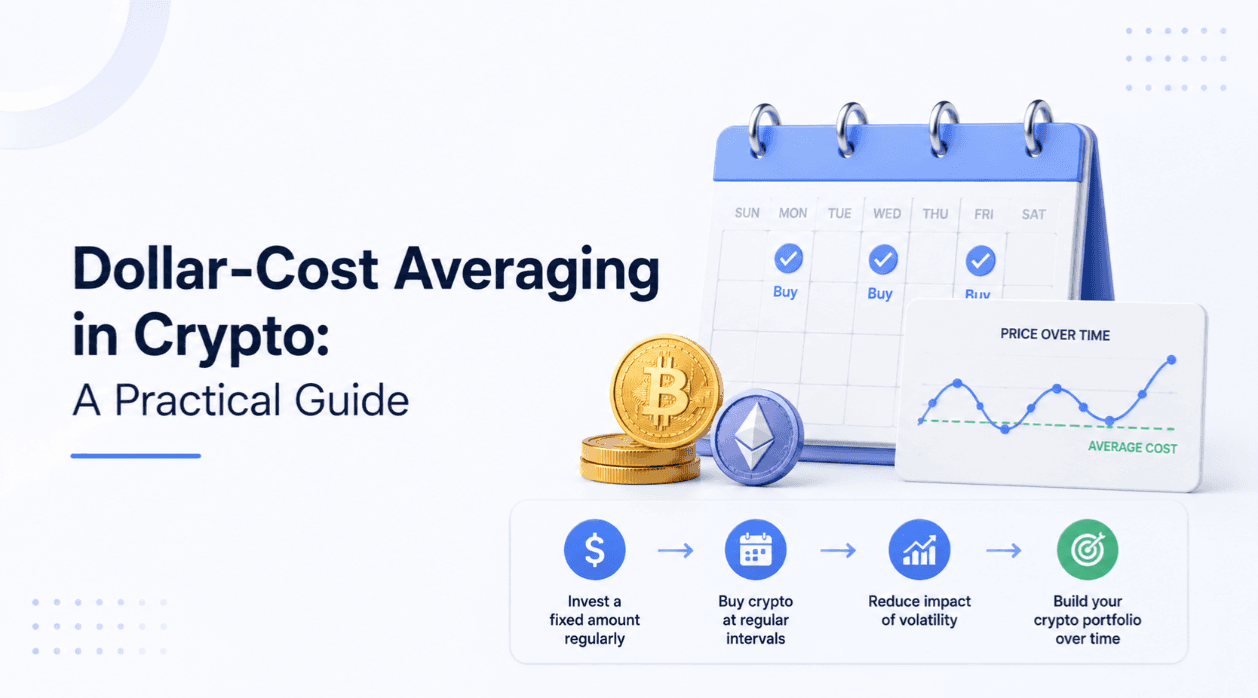
Dollar-cost averaging (DCA) is the practice of investing a fixed amount of money at regular intervals, regardless of price. Instead of trying to buy at the perfect moment, you spread purchases over time — say a set amount every week or month. In volatile markets like crypto, this smooths out your average entry price and removes much of the emotion from buying decisions.
Key takeaways
- DCA means buying a fixed amount on a fixed schedule, whatever the price.
- It reduces the impact of timing and short-term volatility.
- You buy more units when prices are low and fewer when high.
- It trades the chance of a perfect entry for consistency and discipline.
- DCA manages emotion and timing risk, not the underlying asset’s risk.
How dollar-cost averaging works
Suppose you commit 100 dollars every Monday. Some weeks the price is high and your 100 dollars buys fewer units; other weeks it is low and the same amount buys more. Over time your average cost per unit settles somewhere between the highs and lows, weighted toward the periods when prices were lower. You never have to decide whether today is a good day to buy.
That mechanical quality is the point. DCA replaces a series of hard timing judgments with a single decision made once: how much, how often, and for how long.
Why people use DCA
- It removes the stress of trying to time volatile markets.
- It enforces discipline and a regular saving habit.
- It reduces the regret of buying everything just before a drop.
- It is simple to automate and easy to stick with.
The emotional benefit is easy to underrate. Many people freeze when prices are falling and pile in when prices are rising — the opposite of what they intend. A schedule keeps you buying through both, which is where most of DCA’s real-world value comes from.
Dollar-cost averaging does not promise better returns. It promises a process you can actually follow. — CryptoCoinBeat analysis
DCA versus lump-sum investing
If you already hold the full amount in cash, you face a choice: deploy it all at once (lump sum) or spread it out (DCA). In markets that rise over long stretches, investing a lump sum earlier has often captured more upside, simply because the money was exposed sooner. DCA gives up some of that potential in exchange for a smoother ride and lower risk of buying right before a sharp fall.
Neither is universally correct. Lump sum optimizes for expected return; DCA optimizes for reduced timing risk and emotional comfort. For money you earn and invest gradually over time, DCA is the natural default because there is no lump to deploy.
Setting up a DCA plan
A workable plan answers a few questions in advance, so you are not improvising under pressure.
- Amount: a sum you can commit comfortably without straining your finances.
- Frequency: weekly, biweekly or monthly are all reasonable.
- Duration: a horizon long enough to span market ups and downs.
- Assets: decide what you are buying before you start, not mid-stream.
Many exchanges offer recurring-buy features that automate this. Automation helps, but check the fees on each small purchase — frequent tiny buys can carry proportionally higher costs on some platforms, which quietly erodes your average over time.
Limits and misconceptions
DCA is a method for entering a position, not a shield against loss. If an asset declines over your entire horizon, averaging in simply means you bought the decline in installments. It manages timing and emotion; it does not make a risky asset safe or guarantee a profit.
It also does not relieve you of research. Choosing what to accumulate still matters. DCA only addresses the when and how much, not the what or the why.
Is DCA right for you?
DCA suits people who want a low-stress, hands-off way to build exposure over time and who value consistency over the slim chance of a perfectly timed entry. If that describes you, the hardest part is usually starting — and then leaving the plan alone.
This article is educational and is not financial advice. Dollar-cost averaging does not guarantee a profit or protect against loss in a falling market. Crypto assets are highly volatile and your capital is at risk. Do your own research and consider consulting a licensed financial professional before committing to any investment strategy.
Frequently asked questions
Does dollar-cost averaging guarantee a profit?+
No. DCA manages timing and emotional risk, not the risk of the asset itself. If the price falls over your entire investment horizon, averaging in simply spreads your losses across multiple purchases. It is a disciplined way to enter a position, not a guarantee of any particular outcome or return.
Is DCA better than buying all at once?+
It depends on your goal. Over long rising periods, deploying a lump sum earlier has often captured more upside because money is exposed sooner. DCA gives up some of that potential to reduce timing risk and emotional stress. For income invested gradually over time, DCA is the natural approach.
How often should I buy when dollar-cost averaging?+
Weekly, biweekly or monthly intervals all work; consistency matters more than frequency. Be mindful of fees, since very frequent small purchases can carry proportionally higher costs on some platforms. Choose a schedule you can automate and sustain through both rising and falling markets without second-guessing each purchase.
Can I dollar-cost average out of a position?+
Yes. The same logic applies in reverse: selling fixed amounts on a schedule spreads your exits and reduces the pressure of timing a top. This can ease the emotional difficulty of selling, though, like buying, it does not guarantee a better average price than a single well-timed transaction.
Written by
David TurnerCryptocurrency Markets, Blockchain Technology, Tokenomics Analysis, Digital Asset Regulation, DeFi, Web3 Industry Cover
David Turner is a U.S.-based Markets Reporter at CRYPTO·COINBEAT, covering cryptocurrency markets, blockchain innovation, and the rapidly evolving digital asset ecosystem across North America. Raised in California and educated in economics and digital media, David combines strong analytical skills with years of experience reporting on financial markets and emerging technologies. He began his journalism career covering equity markets, Federal Reserve policy, and fintech developments for several financial news outlets before specializing in cryptocurrency. As blockchain technology gained mainstream adoption, David shifted his focus to Bitcoin, Ethereum, decentralized finance, and digital asset regulation. Prior to joining CRYPTO·COINBEAT, he reported extensively on crypto exchanges, institutional investment, stablecoins, and the expanding Web3 economy. At **CRYPTO·COINBEAT**, David delivers data-driven reporting designed to help readers understand the fast-moving digital asset industry. His coverage frequently explores U.S. crypto legislation, tokenomics, blockchain adoption, market sentiment, and the impact of macroeconomic events on cryptocurrency markets. He is particularly recognized for his in-depth analysis of token supply models, vesting schedules, liquidity trends, and the long-term sustainability of blockchain projects. David earned a B.A. in Economics from the University of California, Los Angeles (UCLA), and completed additional coursework in data journalism and financial analysis. He also authors the daily market briefing, **"Opening Bell Crypto,"** providing traders and investors with concise analysis of overnight market activity, key industry developments, and emerging investment trends.
Keep Reading
Crypto Volatility and Risk Management: A Practical Framework
Volatility is the price of admission to crypto. Managing it — rather than fearing it — is what separates survivors from casualties.
Maria Fernandez · April 25, 2026→
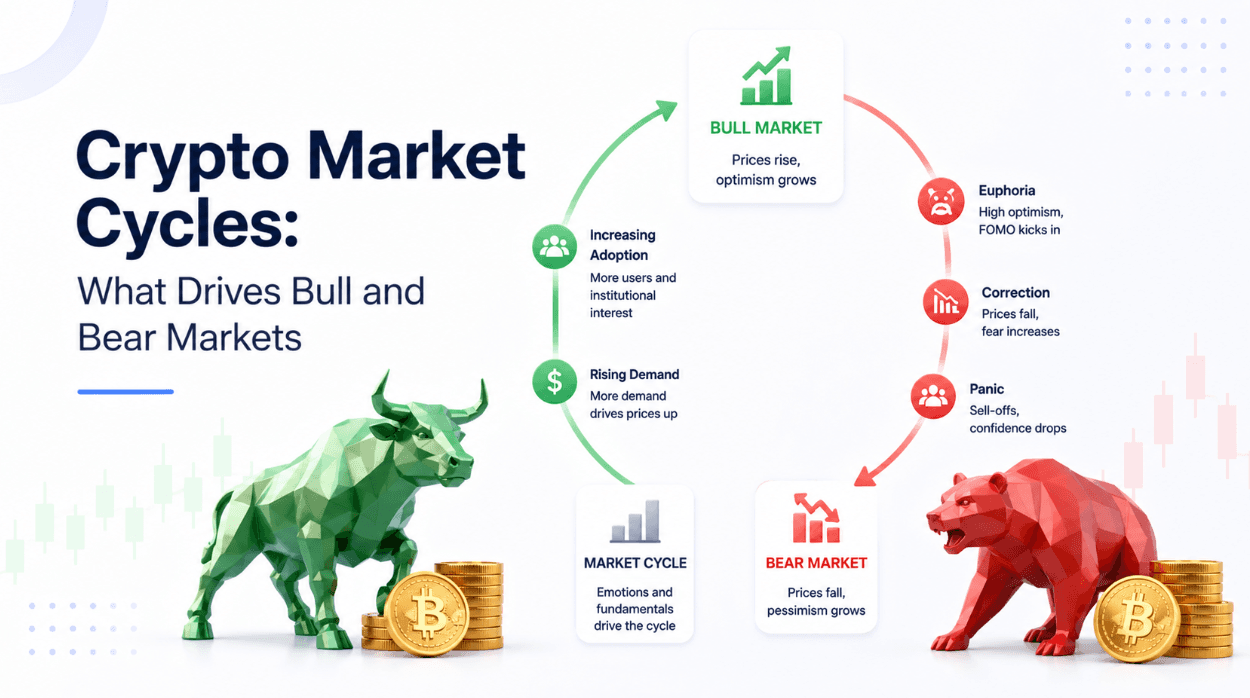
Crypto Market Cycles: What Drives Bull and Bear Markets
Crypto moves in cycles of expansion and contraction. Understanding the forces behind them beats trying to time them.
Maria Fernandez · May 23, 2026→
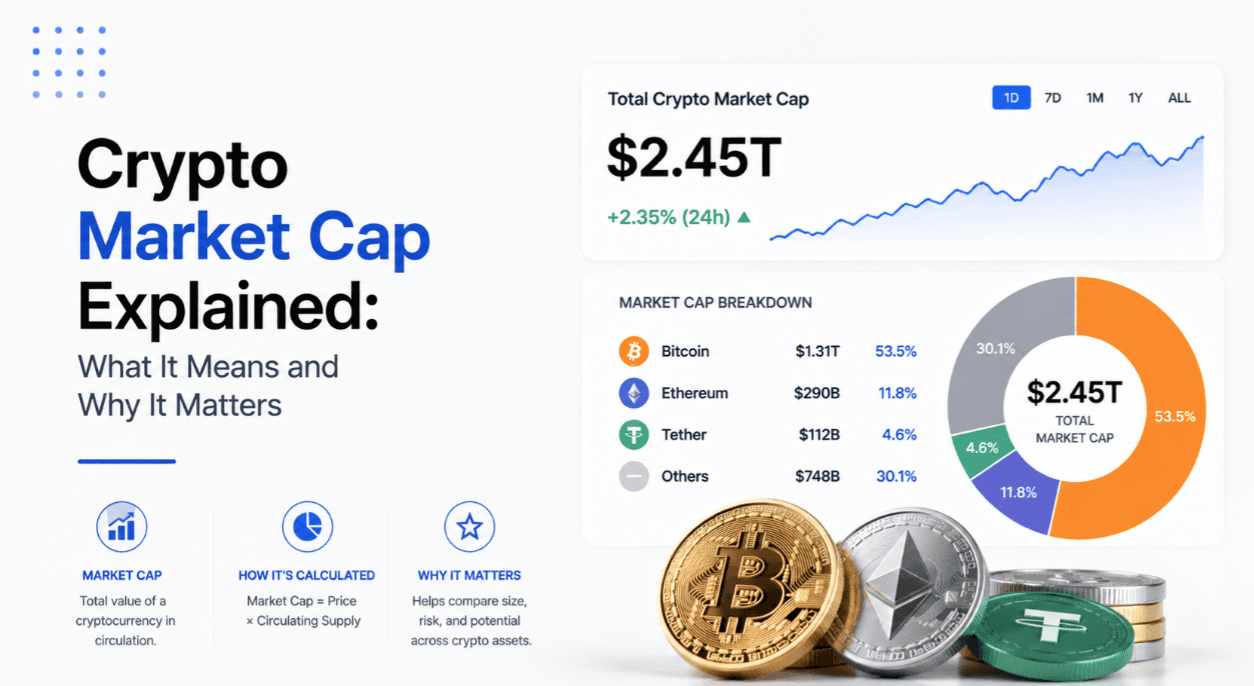
Crypto Market Cap Explained: What It Means and Why It Matters
Market cap is the most quoted and most misunderstood number in crypto. Here is what it actually measures.
Maria Fernandez · May 31, 2026→