Custodial vs Non-Custodial Wallets, in Plain Terms
By David Turner
Senior Crypto Markets Reporter at CryptoCoinBeat. · August 30, 2026 · 7 min read
Published August 30, 2026 · Reviewed to our editorial standards. This article is informational and not financial advice.
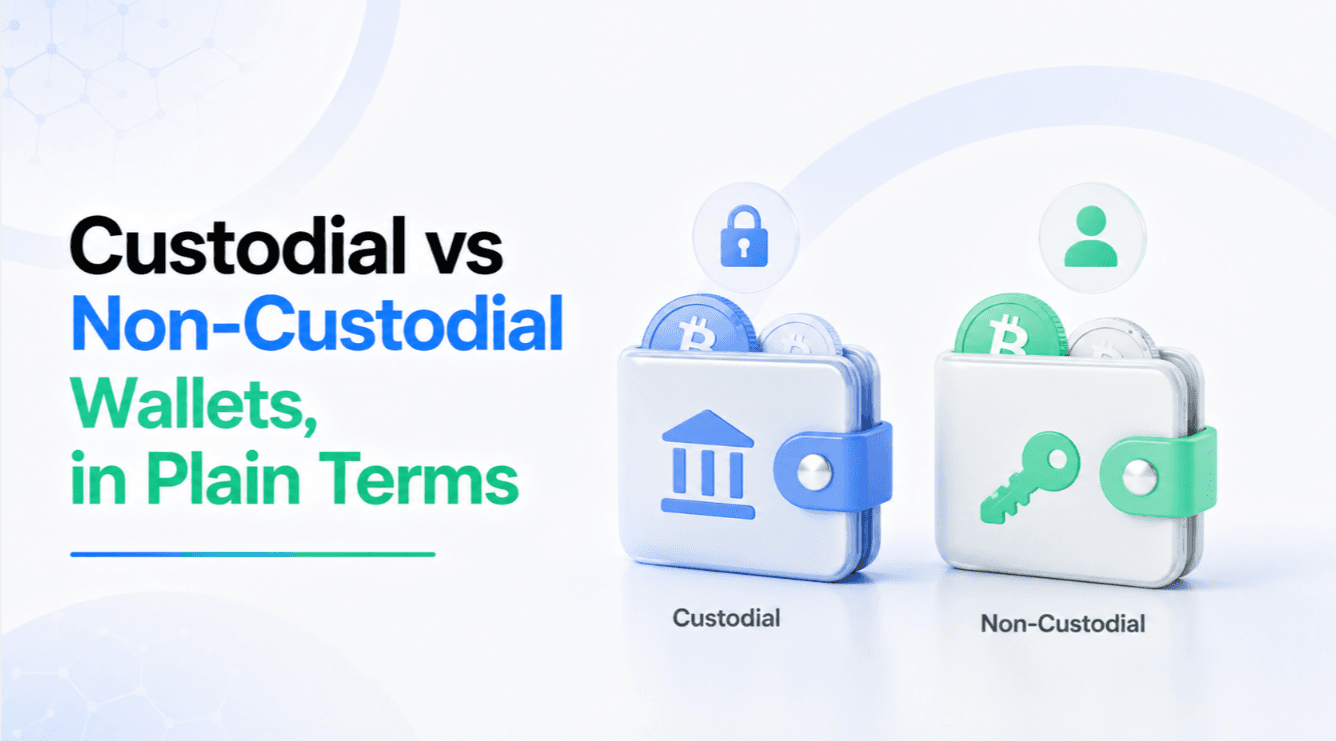
Every crypto wallet answers one question: who holds the private key. If a company holds it, the wallet is custodial and you have a claim on that company. If you hold it, the wallet is non-custodial and you have the asset itself. Everything else — the interface, the app, the branding — is decoration on top of that single fact.
The slogan version of this debate is "not your keys, not your coins", which is true and unhelpfully absolute. The useful version asks what each arrangement actually costs you in the situations that occur.
What custodial actually means
An exchange account is the common example. The company controls the keys, executes withdrawals on your instruction, and records your balance in its own ledger. In practice that gives you real conveniences: password recovery, customer support, no responsibility for backups, and instant trading against the venue's order book.
It also gives you a counterparty. If the company fails, your position depends on what its terms say about client assets and on how that survives an insolvency process. This is why our best crypto exchanges table weights custody and reserve disclosure above every other axis: the fee schedule is irrelevant if the balance is not really yours.
What non-custodial actually means
You hold a private key, usually derived from a recovery phrase. No company can freeze your funds, deny a withdrawal or lose them in a bankruptcy — and equally, nobody can restore access if you lose the phrase, and no support desk can reverse a transaction you signed.
That trade is straightforwardly good for long-term holdings and straightforwardly demanding for beginners, because it moves the entire failure surface onto your own procedures. The realistic risks become the ones in our crypto security guide: a malicious signature, a phishing site, an untested backup.
The middle ground people actually use
Most experienced holders do not choose one. They run both, deliberately, with different money in each.
- An exchange account for what is actively traded, sized so that a venue failure would be painful rather than catastrophic.
- A software wallet for everyday on-chain activity — swaps, applications, small balances. See our self-custody wallet table.
- A hardware wallet for savings, which never connects to a decentralised application at all. Our hardware wallet table covers the devices.
That split is the actual answer to the custodial question, and it removes most of the argument. You are not deciding which philosophy is right; you are deciding which bucket a given amount belongs in.
The confusing cases
Several products sit between the two and describe themselves ambiguously. A wallet with cloud backup is non-custodial in the sense that keys are on your device, and its security now depends on an account protected by a password and a phone number — a meaningful change to your threat model, made by tapping through a setup screen.
Smart-contract wallets with social recovery are non-custodial with a committee: no single party holds your key, but a defined group can restore access. Instant swap services are custodial for a few minutes, which sounds trivial until a compliance review freezes the transaction and you discover you have no account and no recourse — the risk our instant exchanger table scores directly.
How to tell which one you actually have
The marketing rarely says plainly. Two tests settle it. First: were you shown a recovery phrase at setup, and would the provider be unable to restore your funds if you lost it? If yes, it is non-custodial. Second: can the provider freeze your balance or refuse a withdrawal? If yes, it is custodial, whatever the interface calls itself.
Apply both, because some products pass one and fail the other. A wallet that shows you a phrase but routes every transaction through a company's servers is non-custodial for ownership and dependent for availability — worth knowing before the servers go down.
What 2022 taught, and why it still applies
In 2022 several large custodial platforms halted withdrawals within weeks of each other, and customers who believed they held crypto discovered they held unsecured claims in a bankruptcy. The balances shown in the apps had been real numbers describing an obligation, not an asset sitting in a segregated account.
The lesson is not that all custodians fail — several licensed venues honoured every withdrawal through the same period, which is a fact worth crediting. The lesson is that the difference between a good custodian and a bad one is invisible from the interface and visible in the terms, the licensing and the reserve disclosure. That is precisely what a ratings table is for, and why we score custody above cost.
How to decide, in one question
Ask what you would do if the company holding your crypto stopped answering emails tomorrow. If the answer is "I would be annoyed", custodial is fine for that amount. If the answer is "my plans change", the amount belongs behind a key you hold.
That question has been answered the hard way many times in this sector, by people who assumed a balance shown in an app was the same thing as an asset they owned. It usually is. The distinction only becomes visible on the day it matters, which is exactly why it is worth settling in advance.
One practical note for anyone moving from custodial to self-custody for the first time: do it in two steps. Withdraw a small amount, confirm it arrives and that you can send it back out, and only then move the balance. The most common loss during that transition is not theft but a mistyped address or an unsupported network, and a test transaction costs a network fee to rule both out.
Frequently asked questions
Is a custodial wallet safe?+
It can be, for money you are actively trading, if the venue segregates client assets in its terms and publishes verifiable reserves. What it cannot do is give you ownership: you hold a claim on a company, which is a different thing from holding the asset.
What is the main advantage of a non-custodial wallet?+
Nobody can freeze, lend out or lose your funds in an insolvency, and no permission is needed to move them. The cost is that recovery is entirely your responsibility — a lost recovery phrase cannot be restored by anyone.
Is MetaMask custodial or non-custodial?+
Non-custodial: keys are generated and stored on your device, and the company cannot move your funds. Optional cloud backup changes where the recovery risk sits, so treat that setting as a deliberate decision rather than a default.
Should beginners use custodial or non-custodial wallets?+
Both, split by amount. Start with a reputable exchange for small trading balances while you learn, and move savings to a hardware wallet as the holding grows past what you would be comfortable losing to a platform failure.
Written by
David TurnerCryptocurrency Markets, Blockchain Technology, Tokenomics Analysis, Digital Asset Regulation, DeFi, Web3 Industry Cover
David Turner is a U.S.-based Markets Reporter at CRYPTO·COINBEAT, covering cryptocurrency markets, blockchain innovation, and the rapidly evolving digital asset ecosystem across North America. Raised in California and educated in economics and digital media, David combines strong analytical skills with years of experience reporting on financial markets and emerging technologies. He began his journalism career covering equity markets, Federal Reserve policy, and fintech developments for several financial news outlets before specializing in cryptocurrency. As blockchain technology gained mainstream adoption, David shifted his focus to Bitcoin, Ethereum, decentralized finance, and digital asset regulation. Prior to joining CRYPTO·COINBEAT, he reported extensively on crypto exchanges, institutional investment, stablecoins, and the expanding Web3 economy. At **CRYPTO·COINBEAT**, David delivers data-driven reporting designed to help readers understand the fast-moving digital asset industry. His coverage frequently explores U.S. crypto legislation, tokenomics, blockchain adoption, market sentiment, and the impact of macroeconomic events on cryptocurrency markets. He is particularly recognized for his in-depth analysis of token supply models, vesting schedules, liquidity trends, and the long-term sustainability of blockchain projects. David earned a B.A. in Economics from the University of California, Los Angeles (UCLA), and completed additional coursework in data journalism and financial analysis. He also authors the daily market briefing, **"Opening Bell Crypto,"** providing traders and investors with concise analysis of overnight market activity, key industry developments, and emerging investment trends.
Keep Reading
Bitcoin ETFs Explained: How Spot Bitcoin ETFs Work
Spot Bitcoin ETFs let investors hold bitcoin exposure in a brokerage account. Here is how they work and how they differ from owning coins.
Maria Fernandez · May 3, 2026→
How to Store Bitcoin Safely: Wallets and Best Practices
Storing bitcoin safely comes down to protecting your private keys. Here is how wallet types compare and the habits that keep funds secure.
David Turner · May 17, 2026→

Bitcoin Halving Explained: What It Is and Why It Matters
Every four years Bitcoin cuts its issuance rate in half. Here is how the halving works, what history shows, and why it shapes supply.
Maria Fernandez · May 28, 2026→