Kraken vs Coinbase: Custody, Licences and the Fee Gap
By David Turner
Senior Crypto Markets Reporter at CryptoGrows. · September 19, 2026 · 8 min read
Published September 19, 2026 · Reviewed to our editorial standards. This article is informational and not financial advice.
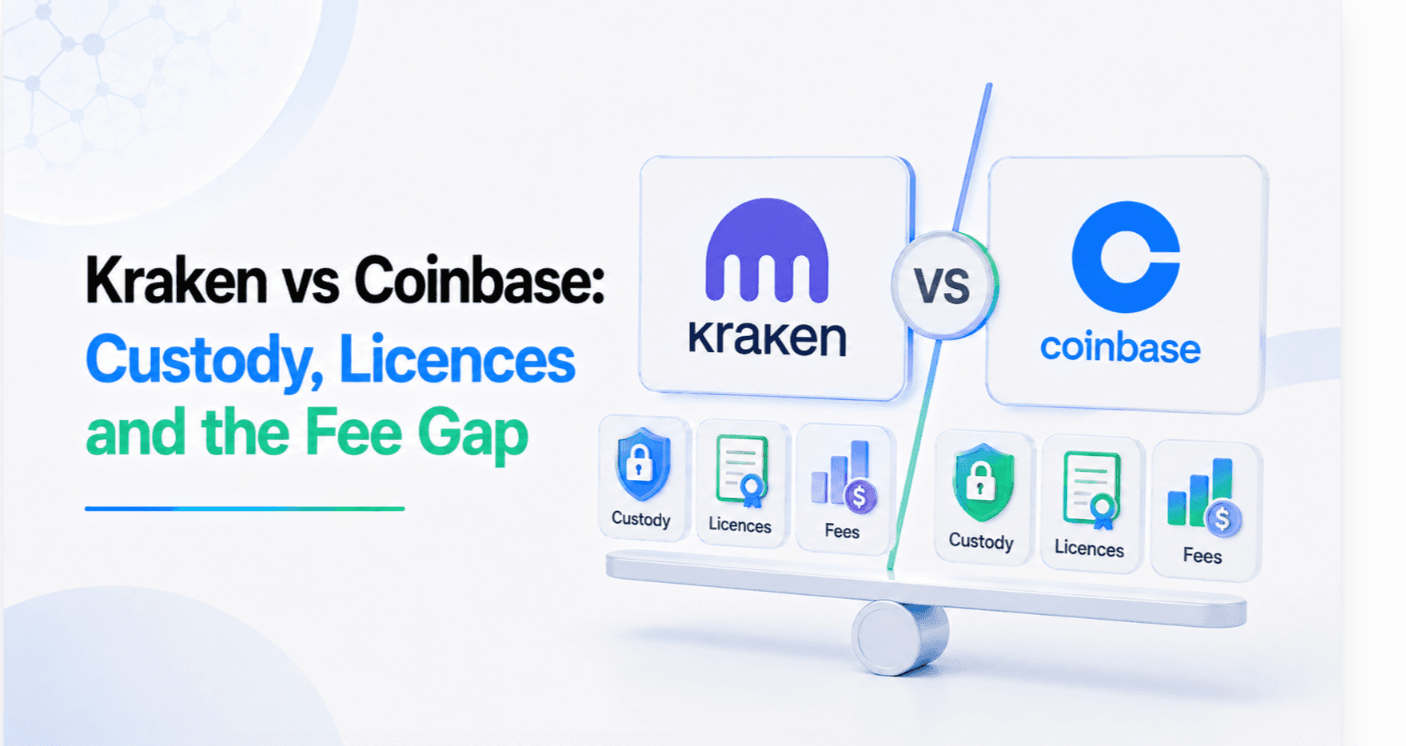
Kraken and Coinbase occupy the top two positions in our best crypto exchanges table, and they get there by different routes. One is a private company with a bank charter and the longest clean operating record in the industry; the other is a listed company whose accounts are examined by an outside auditor every year.
For most users the choice comes down to jurisdiction and interface discipline rather than any deep difference in safety.
Custody: two strong answers
Kraken's terms state client assets are segregated and held for the customer, and it holds a Wyoming special purpose depository institution charter granted in September 2020 — the first issued to a crypto exchange, which subjects it to supervision most competitors do not face. No loss of customer funds appears on its record since it launched in 2011.
Coinbase's user agreement is equally clear that customer crypto is held for the customer and not commingled with corporate assets, and its institutional custody sits in a separately chartered trust entity. What it adds is the disclosure that comes with being listed: audited financial statements, filed on a schedule, examined by a firm with professional liability.
Reserves and reporting
Kraken publishes a Merkle-tree proof of reserves attested by an independent accounting firm, and customers can verify their own balance is included. Coinbase does not publish that style of proof and does not need to in the same way — its audited accounts cover the whole business, including liabilities a wallet snapshot cannot show.
Both approaches are stronger than the self-attested dashboards common elsewhere. If you want to verify your own balance yourself, Kraken's approach is the one that lets you.
Regulatory record
Kraken settled an SEC action over its US staking programme in February 2023 for $30m and discontinued that product for US customers. Coinbase faced a 2023 SEC action over exchange registration which the agency dismissed with prejudice in February 2025, with no fine paid.
Neither matter concerned the safekeeping of customer assets, which is the distinction worth holding on to when these headlines resurface. On custody specifically, both records are clean.
The fee gap, and how to avoid it
This is where real money changes hands. Coinbase's simple buy interface applies a spread plus a flat fee and is the most expensive way to buy crypto among major venues. The identical trade placed on Advanced Trade uses a conventional maker/taker schedule that is dramatically cheaper.
Kraken publishes one maker/taker schedule with volume tiers and a separate lower-cost Pro interface, and sits mid-market overall. The practical advice for Coinbase users is unambiguous: never buy from the default interface, and the fee difference between the two venues largely disappears.
Coverage and rails
Coinbase lists several hundred assets with strong US rails including ACH and wire, plus local rails in supported markets. Kraken lists a comparable range with direct bank rails in USD, EUR, GBP, CHF, CAD and AUD, and offers derivatives only where locally authorised.
Kraken's listing policy is deliberately slow, so newly launched assets often arrive late or not at all. If being early on new listings matters to you, neither venue is the right primary — that is a different table entirely.
Interfaces and who they suit
Coinbase is the most approachable major exchange, which is both its strength and the source of its cost problem: the friendly path is the expensive one. Kraken's basic interface is plainer and its advanced order types live in a separate Pro view, which newcomers find abrupt and experienced traders prefer.
If you are buying occasionally and want the process to be obvious, Coinbase wins on ergonomics as long as you use Advanced Trade for the actual purchase. If you intend to place limit orders and care about execution, Kraken's tooling gets you there with less friction.
Staking and extras
Coinbase offers staking in supported jurisdictions and issues a liquid staking token, cbETH, backed by its own validator operation. Kraken settled with the SEC over its US staking programme in 2023 and discontinued it for American customers, while continuing to offer staking elsewhere.
Treat exchange staking as a convenience product in either case: it is custodial, the commission is higher than running the position yourself, and in several jurisdictions the product has been restricted at short notice. Our liquid staking table covers the non-custodial alternatives.
Fiat rails, tested where it matters
For US customers, Coinbase's ACH and wire integration is the smoothest in the industry and the reason many people stay. For European and UK customers, Kraken's direct bank rails across EUR, GBP and CHF generally settle faster and with fewer intermediaries than the alternatives.
The test worth running before committing is a small deposit and an immediate withdrawal back to your bank. It costs a few pounds in fees and tells you what documentation, delays and limits actually apply to your account — information no comparison table can give you, because it depends on your bank as much as on the venue.
What neither of them is
Neither is a place to hold long-term savings, however strong the custody terms. Both are companies, both operate under licences that can change, and both have discontinued products for entire jurisdictions at short notice when a regulator required it.
That is not a criticism of either venue — it is the nature of a custodial relationship, and it is why the split between trading balances and self-custodied savings is the decision that outranks this whole comparison.
Which one
- US customers who want maximum disclosure and the clearest legal claim: Coinbase, using Advanced Trade. See the Coinbase review.
- Europe, the UK and multi-currency users wanting deep fiat rails and a long clean record: Kraken. See the Kraken review.
- Anyone whose priority is the cheapest execution at size: neither — that is Binance or OKX, with the regulatory trade-offs those carry.
One practical note for anyone holding accounts at both: keep the fiat rail where it works best for your currency and the trading where the book is deeper, rather than duplicating balances. Two half-funded accounts double your exposure to account takeover without improving execution anywhere.
Whichever you pick, apply the rule that outranks the comparison: keep on the exchange only what you are actively trading, and hold savings in self-custody. Both of these venues are reasonable places to trade. Neither is a savings account.
Frequently asked questions
Is Kraken or Coinbase safer?+
Both have clean custody records. Coinbase adds audited public accounts as a listed company; Kraken adds a Wyoming bank charter and a proof of reserves attested by an independent firm that lets you verify your own balance. The difference is in the form of assurance, not the level.
Why is Coinbase so expensive?+
Only its simple buy interface is. That bundles a spread with a flat fee; the same trade on Advanced Trade uses a normal maker/taker schedule and costs a fraction as much. The expensive route is the default rather than the only one.
Did Kraken and Coinbase have problems with the SEC?+
Kraken settled a February 2023 action over its US staking programme for $30m and closed that product for US users. Coinbase's 2023 registration case was dismissed with prejudice in February 2025 with no fine. Neither concerned safekeeping of customer assets.
Which is better for European users?+
Kraken generally, for its direct bank rails across EUR, GBP and CHF and a longer European operating history, though Coinbase's coverage in supported EU markets is solid and its disclosure is stronger.
Written by
David TurnerCryptocurrency Markets, Blockchain Technology, Tokenomics Analysis, Digital Asset Regulation, DeFi, Web3 Industry Cover
David Turner is a U.S.-based Markets Reporter at CRYPTO·COINBEAT, covering cryptocurrency markets, blockchain innovation, and the rapidly evolving digital asset ecosystem across North America. Raised in California and educated in economics and digital media, David combines strong analytical skills with years of experience reporting on financial markets and emerging technologies. He began his journalism career covering equity markets, Federal Reserve policy, and fintech developments for several financial news outlets before specializing in cryptocurrency. As blockchain technology gained mainstream adoption, David shifted his focus to Bitcoin, Ethereum, decentralized finance, and digital asset regulation. Prior to joining CRYPTO·COINBEAT, he reported extensively on crypto exchanges, institutional investment, stablecoins, and the expanding Web3 economy. At **CRYPTO·COINBEAT**, David delivers data-driven reporting designed to help readers understand the fast-moving digital asset industry. His coverage frequently explores U.S. crypto legislation, tokenomics, blockchain adoption, market sentiment, and the impact of macroeconomic events on cryptocurrency markets. He is particularly recognized for his in-depth analysis of token supply models, vesting schedules, liquidity trends, and the long-term sustainability of blockchain projects. David earned a B.A. in Economics from the University of California, Los Angeles (UCLA), and completed additional coursework in data journalism and financial analysis. He also authors the daily market briefing, **"Opening Bell Crypto,"** providing traders and investors with concise analysis of overnight market activity, key industry developments, and emerging investment trends.
Keep Reading
Crypto Volatility and Risk Management: A Practical Framework
Volatility is the price of admission to crypto. Managing it — rather than fearing it — is what separates survivors from casualties.
Maria Fernandez · April 25, 2026→
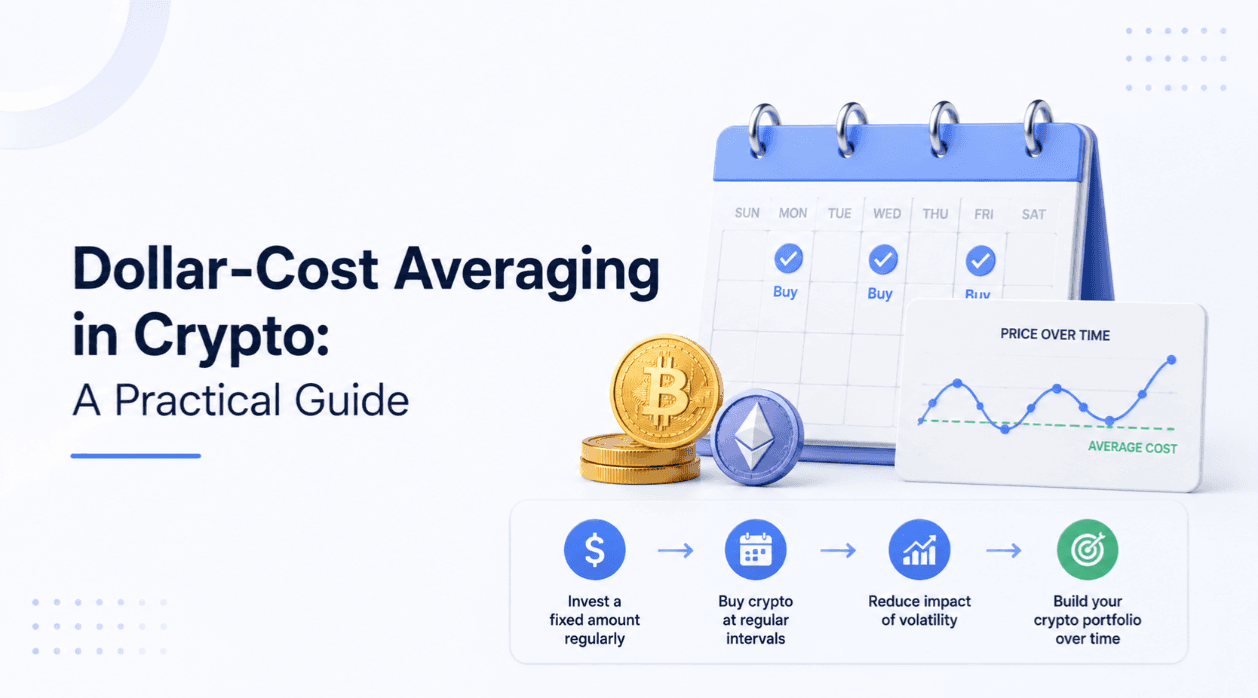
Dollar-Cost Averaging in Crypto: A Practical Guide
Buying fixed amounts on a fixed schedule removes the pressure of timing the market. Here is how DCA works in crypto.
David Turner · May 5, 2026→
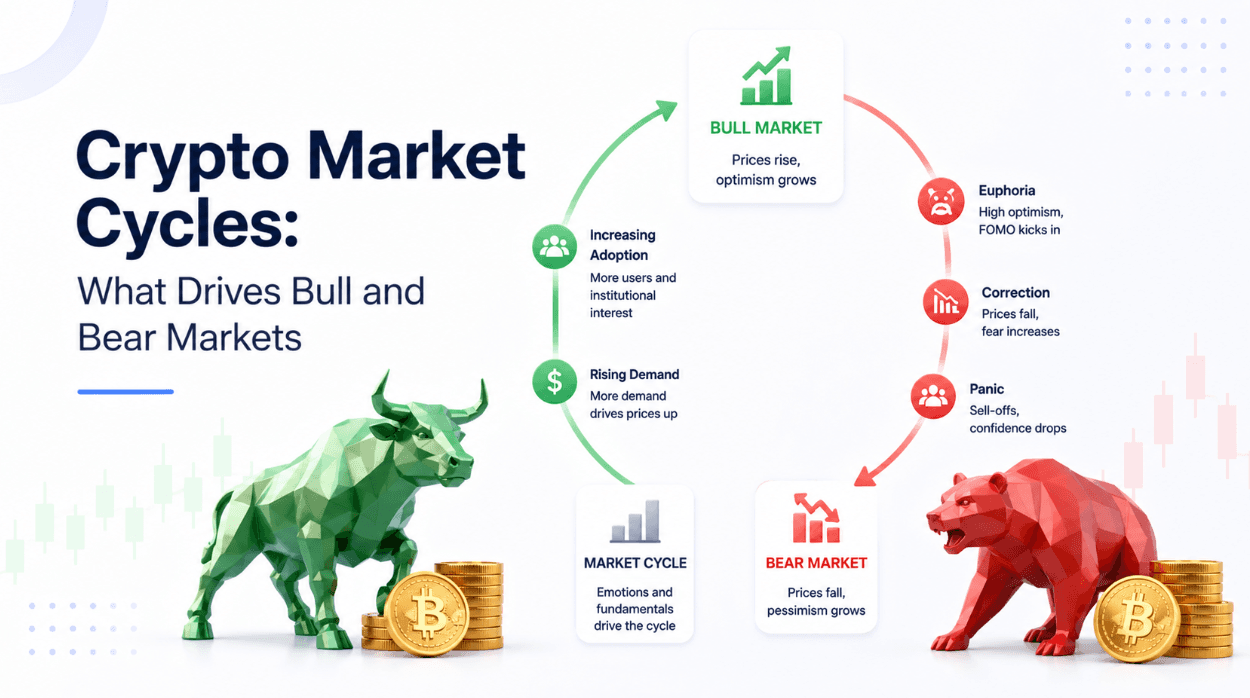
Crypto Market Cycles: What Drives Bull and Bear Markets
Crypto moves in cycles of expansion and contraction. Understanding the forces behind them beats trying to time them.
Maria Fernandez · May 23, 2026→