The Real Cost of a Crypto Card
DeFi Protocols & RWA On-Chain Analyst · October 3, 2026 · 8 min read
Published October 3, 2026 · Reviewed to our editorial standards. This article is informational and not financial advice.
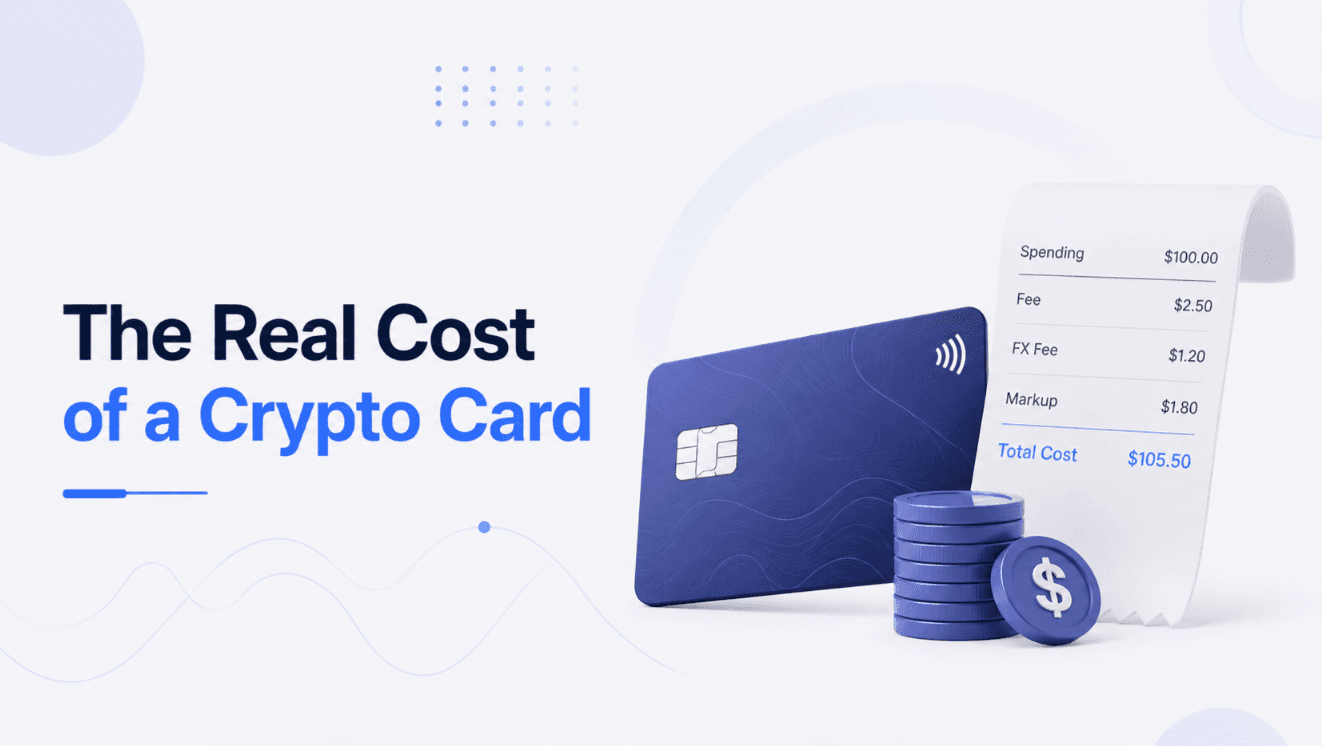
Crypto cards are marketed on a single number — the cashback rate — and priced on four. Working through the arithmetic once, on a realistic amount of spending, changes which card looks attractive and often changes whether any of them do.
The four components
- Conversion spread: the margin applied when your asset is sold at the point of sale. Largest component, least visible, frequently not itemised anywhere.
- FX markup: applied when you spend outside the card's base currency, on top of the network rate.
- Fixed fees: monthly charges, ATM withdrawal fees beyond a free allowance, sometimes an issuance fee.
- Opportunity cost: the value of any token you must lock to reach the reward tier, plus the market risk of holding it.
A worked example
Take £1,000 of monthly spending, all domestic, on a card advertising 3% cashback that requires a token stake to qualify. Cashback is £30. A conversion spread of 0.5% on the same spending costs £5, so the net is £25 — still good.
Now add the stake. If the tier requires locking the equivalent of £2,000 in a volatile token, a 20% fall over the year costs £400 — sixteen months of cashback, wiped out by a price move you had no control over. The reward was never the product; the token position was.
Run the same numbers on a card with no staking requirement paying 1% in a liquid asset: £10 a month, £120 a year, no market exposure, no lock-up. It is a smaller number attached to a much smaller risk, and for most people it is the better deal.
Where the spread hides
Some issuers publish it plainly. Others state a fee schedule that looks competitive and apply a margin during conversion that appears nowhere as a line item. The way to find it is empirical: spend a small amount, then compare the crypto debited against the market rate at that moment.
Do it once per card. The difference between a 0.2% spread and a 1.5% one is invisible in marketing and enormous over a year of spending — and the cards that publish their spread tend to be the ones charging less of it.
ATM withdrawals: the expensive habit
Most cards offer a monthly ATM allowance and charge meaningfully beyond it, often as a percentage rather than a flat fee. Combined with the conversion spread and any FX markup on a foreign machine, cash withdrawals are the most expensive way to use one of these products.
Check the published allowance before travelling, and treat the card as a payment instrument rather than a cash card.
Reward terms are not fixed
Across this category, reward rates attached to staking tiers have been reduced more than once, each time announced publicly and each time after customers had locked tokens on the old terms. That is not fraud — the terms permit it — and it is a risk to price when you commit capital to reach a tier.
The question to ask before locking anything: if the rate halved tomorrow, would I still want this position? If not, the position is a bet on the terms holding, which is a bet the issuer controls both sides of.
Comparing against an ordinary card
The honest benchmark is not another crypto card — it is the best cashback credit card available to you, which typically pays a modest rate with no conversion spread, no token position and consumer protections a crypto card does not offer. Against that baseline, a crypto card has to justify itself on utility rather than rewards.
The utility is real for some people: spending crypto directly without a manual sale and bank transfer, or having a working off-ramp in a market where crypto-to-bank rails are slow. If neither applies to you, the arithmetic rarely favours the crypto card, and that is worth knowing before locking anything.
The fee that is not on any schedule
Programme risk. Cards in this category have stopped working at short notice when an issuing partner or banking relationship ended, and while balances have generally been returned, the interruption is a genuine cost — particularly if you were relying on the card while travelling.
Price it by keeping only spending money on the card and carrying a conventional fallback. Both are free, and together they turn an outage from a crisis into an inconvenience.
What a good card looks like on cost
- Published conversion spread, or a stablecoin settlement model where the spread is near zero.
- No monthly fee on the base product.
- Rewards paid in a liquid asset you would hold anyway, with no staking requirement.
- Transparent FX handling, ideally at or near the interbank rate.
- An issuer whose licensing chain is stated in the terms, since a programme that stops has a cost no fee table shows.
One structural note: a card that settles from a stablecoin balance you top up deliberately sidesteps most of this arithmetic. There is no conversion spread on a dollar-for-dollar settlement, no volatile asset being sold at an arbitrary moment, and no gain realised on every purchase — three problems solved by a single habit.
Our best crypto cards table scores true all-in cost at 35% of the total and reward honesty separately, precisely because the advertised rate and the actual return diverge so often in this category. And whichever card you choose, the tax consequence of spending applies on top — see our tax guide before making it a daily habit.
Frequently asked questions
What do crypto cards actually cost?+
Four things: the conversion spread at the point of sale, FX markup abroad, fixed monthly and ATM fees, and the opportunity cost of any token you must lock to reach a reward tier. The spread is usually the largest and the least visible.
Is crypto card cashback worth it?+
Only when it does not require locking a volatile token. A 1% rate paid in a liquid asset with no stake usually beats a 3% rate that requires holding thousands in an issuer's token, once you price the market risk.
How do I find the conversion spread on my card?+
Spend a small amount and compare the crypto debited against the market rate at that moment. Many issuers do not itemise it, and the difference between cards is large enough to matter over a year.
Can crypto card rewards be reduced?+
Yes, and they have been across the category — usually announced publicly, and usually after customers locked tokens on the previous terms. Assume any rate attached to a staking tier can change.
Written by
Maria FernandezDeFi Protocols, Real-World Assets, On-Chain Analytics, Stablecoins, Spanish-Language Coverage
Maria Fernandez is an On-Chain Research Analyst at **CRYPTO·COINBEAT**, specializing in real-world asset (RWA) tokenization, decentralized finance, and stablecoin ecosystems. Originally from Mexico City and now based in Miami, Maria brings a unique Latin American perspective to blockchain research, combining deep technical analysis with insights into emerging digital asset markets across the Americas. Before joining **CRYPTO·COINBEAT**, Maria spent several years researching decentralized finance protocols, producing in-depth analysis on lending platforms, governance systems, and the growing adoption of tokenized real-world assets. Her early research into institutional RWA integration and decentralized collateral models helped explain one of the fastest-growing sectors within the blockchain industry. Maria's analytical approach combines on-chain transaction analysis, protocol revenue metrics, liquidity monitoring, and governance activity to evaluate the long-term health of DeFi ecosystems. She works extensively with blockchain analytics platforms, including Dune Analytics, Nansen, and Flipside Crypto, and has created numerous public dashboards that simplify complex blockchain data for investors and researchers alike. Her coverage of stablecoin market events and liquidity shifts has helped readers better understand risk during periods of heightened market volatility. She holds a B.Sc. in Industrial Engineering from ITAM (Instituto Tecnológico Autónomo de México) and a Graduate Certificate in FinTech from MIT Sloan. Passionate about blockchain education, Maria regularly contributes both English- and Spanish-language research, helping make advanced on-chain analysis more accessible to a global audience while supporting the continued growth of crypto adoption throughout Latin America.
Keep Reading
Crypto Volatility and Risk Management: A Practical Framework
Volatility is the price of admission to crypto. Managing it — rather than fearing it — is what separates survivors from casualties.
Maria Fernandez · April 25, 2026→
Dollar-Cost Averaging in Crypto: A Practical Guide
Buying fixed amounts on a fixed schedule removes the pressure of timing the market. Here is how DCA works in crypto.
David Turner · May 5, 2026→
Crypto Market Cycles: What Drives Bull and Bear Markets
Crypto moves in cycles of expansion and contraction. Understanding the forces behind them beats trying to time them.
Maria Fernandez · May 23, 2026→