What Trading Crypto Actually Costs
By Emily Carter
Policy Correspondent · November 20, 2026 · 12 min read
Published November 20, 2026 · Reviewed to our editorial standards. This article is informational and not financial advice.
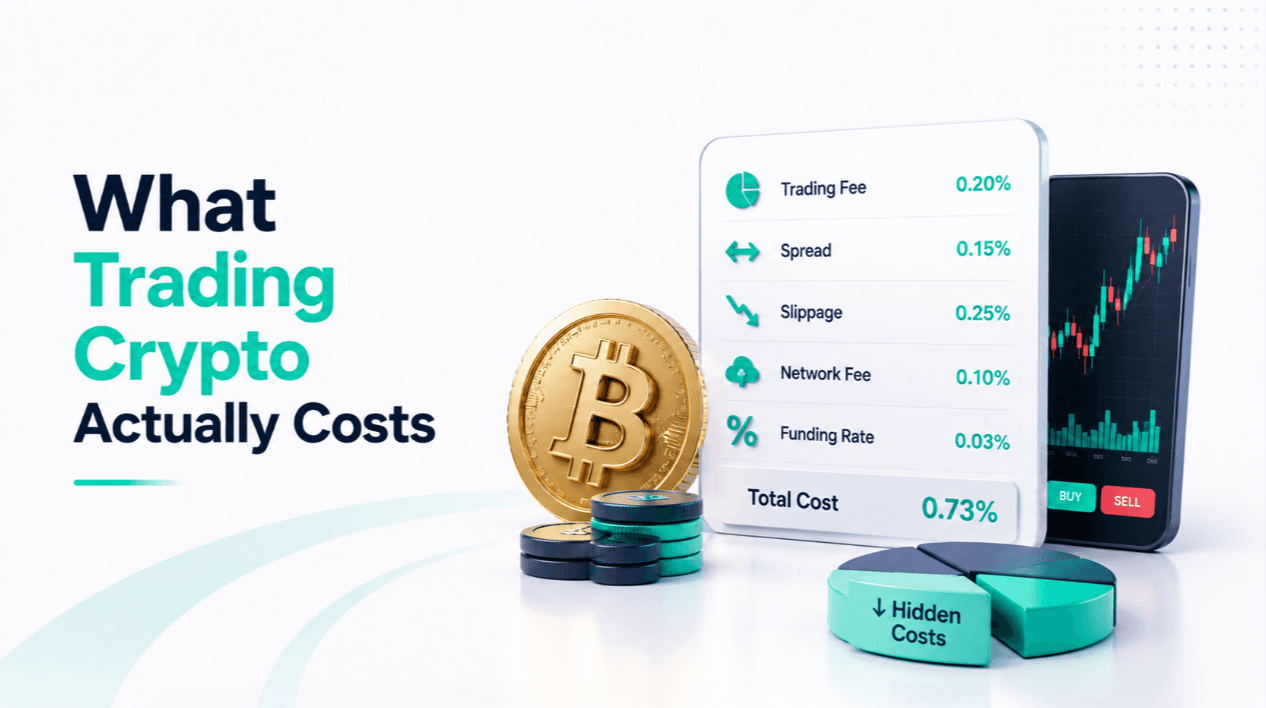
Ask what a trade costs and most people quote the fee schedule. That is one line of six, and for anyone trading meaningful size it is rarely the biggest.
Here is the full accounting, in the order they usually bite.
Cost one: the maker-taker fee
The explicit charge. Taker fees apply when you remove liquidity by hitting an existing order; maker fees apply when you add liquidity with a resting order and are lower, sometimes negative as a rebate for professional market makers.
The immediate lesson is that a limit order which rests before filling is cheaper than a market order that crosses the spread — twice over, since you avoid the taker rate and choose your price. Fee tiers then scale with volume, which is why headline rates advertised by exchanges apply to almost nobody.
Cost two: the spread
The gap between the best bid and the best offer. Buy at the offer and sell at the bid and you have paid the spread, whatever the fee schedule says. On a deep major pair it is negligible; on a thin one it can dwarf every other cost combined.
It is also the cost that consumer apps hide most effectively. A zero-fee interface that quotes you a price a full percentage point off the market is charging you more than an exchange with a visible 0.1% taker fee.
Cost three: slippage
The difference between the price you expected and the price you got, caused by your own order consuming depth. A small order rests inside the spread; a large one eats through several price levels and fills at the average of all of them.
This is the cost that scales with size, which makes it the dominant one for anyone trading beyond retail amounts. Splitting a large order into pieces over time reduces it, and so does routing across venues — which is the entire reason aggregators exist.
Cost four: gas and network fees
On-chain, every swap costs a network fee regardless of size, which makes small trades disproportionately expensive and can make very small ones uneconomic. This is a fixed cost in a list of variable ones, so it dominates at the bottom end and disappears at the top.
Layer twos have reduced it by orders of magnitude for ordinary swaps. Withdrawal fees on centralised venues are the equivalent charge and vary widely between platforms for the identical transfer — worth comparing, because they are pure margin for the venue.
Cost five: funding, for anyone holding derivatives
Perpetual futures have no expiry, so a periodic payment between longs and shorts keeps the contract near spot. Hold the crowded side of a trending market and you pay it continuously.
Over a few weeks that cost of carry can exceed the entire fee schedule for the position, which is why comparing venues on taker fees alone is misleading for derivatives. Compare average funding per market instead — the venues that publish it per market are the ones you can assess.
Cost six: what MEV takes
On public blockchains, your pending swap is visible before it settles, and searchers can trade around it — buying ahead of you and selling into your own price impact. The loss appears as a fill worse than quoted, and it looks exactly like ordinary slippage.
It is avoidable. Private order flow and auction-based fill modes remove most of the surface an attack needs, and cost nothing extra in the ordinary case — MEV explained covers which protections actually work.
Which cost dominates at which size
- Under $500 on-chain: gas dominates. Trade on a layer two or use a centralised venue.
- $500 to $10,000: fees and spread dominate. Use limit orders and compare venue rates.
- $10,000 to $500,000: slippage dominates. Split the order, use an aggregator, check depth first.
- Above that: market impact dominates entirely, and execution becomes the whole job.
- Any derivatives position held for weeks: funding usually exceeds everything else combined.
How to measure your own execution
Record the market price at the moment you submitted and the price you actually received, then express the gap as a percentage. Do it for twenty trades and you have a real number for what your trading costs — which is almost always larger than the fee schedule suggested.
That number is what to optimise. Moving from market orders to limit orders, or from a consumer app to an exchange with a visible fee, usually saves more than any amount of venue-shopping on headline rates.
The cost of being on the wrong venue entirely
Some costs are structural rather than per-trade. A venue with shallow books in the pairs you trade will cost you slippage on every order regardless of its fee schedule, and no amount of careful execution recovers that.
The same applies to withdrawal rails. A platform charging a flat fee for a network transfer that costs cents is charging a margin you pay every time you move money, which over a year of active trading can exceed the trading fees themselves.
The rules that survive every market
Use limit orders unless you specifically need immediacy. Check the depth of the book before sizing an order rather than after. Compare venues on all-in cost — fees plus spread plus withdrawal — rather than on the advertised rate.
And be sceptical of anything advertised as free. Execution costs somebody something; if the venue is not charging you a visible fee, the charge is in the price you are being quoted. Our best exchanges and best DEXs tables score all-in cost rather than headline rates, because the headline rate is the least informative number on the page.
Frequently asked questions
What is the difference between maker and taker fees?+
Taker fees apply when your order removes existing liquidity; maker fees apply when your order rests on the book and adds liquidity. Maker rates are lower, which is why limit orders cost less.
Why is zero-fee trading not free?+
The cost moves into the quoted price. A platform charging no visible fee but quoting a percentage away from market is more expensive than one charging a small explicit fee at a fair price.
What is slippage in crypto trading?+
The gap between the expected price and the executed price, caused by your order consuming available depth. It scales with order size and is the dominant cost for large trades.
Do funding rates count as a trading cost?+
Yes, and for positions held for weeks they usually exceed all other costs combined. Funding is paid periodically between longs and shorts to keep perpetuals near spot.
Written by
Emily CarterFormer regulatory analyst · J.D.
Emily Carter is a legal and regulatory writer specializing in cryptocurrency, blockchain policy, and digital asset compliance. Before joining CRYPTO·COINBEAT, she worked as a regulatory analyst in the United States, tracking developments in federal financial legislation, anti-money laundering (AML) requirements, and emerging policies shaping the digital asset industry. She earned her Juris Doctor (J.D.) degree and combines legal expertise with a talent for translating complex regulatory topics into clear, accessible language. Her work focuses on cryptocurrency taxation, DeFi regulation, exchange compliance, stablecoins, and the evolving role of U.S. agencies in overseeing digital assets. At CRYPTO·COINBEAT, Emily writes educational guides and policy explainers designed for both newcomers and experienced crypto users. She is committed to helping readers understand how regulatory changes affect investors, businesses, and the broader blockchain ecosystem.
Keep Reading
Crypto Volatility and Risk Management: A Practical Framework
Volatility is the price of admission to crypto. Managing it — rather than fearing it — is what separates survivors from casualties.
Maria Fernandez · April 25, 2026→
Dollar-Cost Averaging in Crypto: A Practical Guide
Buying fixed amounts on a fixed schedule removes the pressure of timing the market. Here is how DCA works in crypto.
David Turner · May 5, 2026→
Crypto Market Cycles: What Drives Bull and Bear Markets
Crypto moves in cycles of expansion and contraction. Understanding the forces behind them beats trying to time them.
Maria Fernandez · May 23, 2026→