Ethereum Layer-2 Scaling: How Rollups Make ETH Cheaper and Faster
DeFi Protocols & RWA On-Chain AnalystDeFi Protocols & RWA On-Chain Analyst · May 3, 2026 · 10 min read
Published May 3, 2026 · Reviewed to our editorial standards. This article is informational and not financial advice.
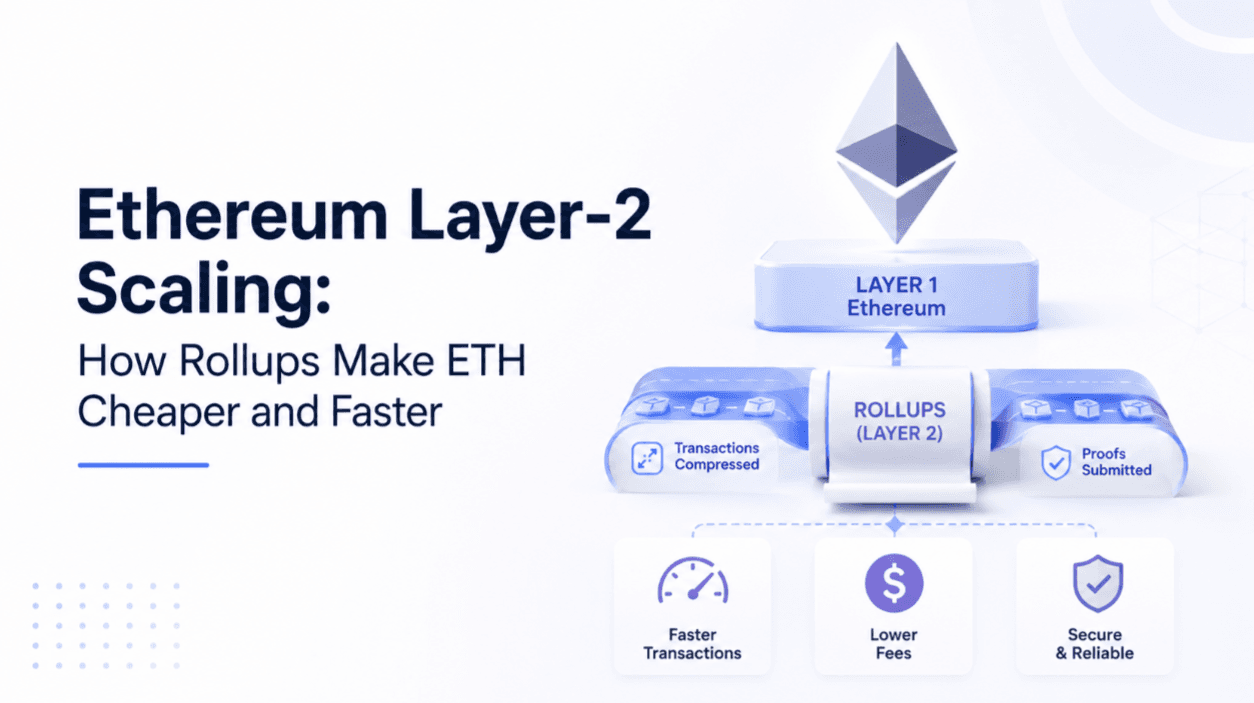
Layer-2 rollups are separate networks that process Ethereum transactions off the main chain, then post compressed proof of that activity back to it. By executing elsewhere but settling on Ethereum, they cut fees and raise throughput while inheriting the base layer’s security. Rollups are Ethereum’s primary scaling strategy through 2026.
Key takeaways
- Rollups execute transactions off-chain and post data and proofs to Ethereum.
- They inherit Ethereum’s security rather than running a separate trust model.
- Optimistic rollups assume validity and allow challenges; zk-rollups prove it with cryptography.
- Fees on rollups are a fraction of base-layer fees, often cents.
- Bridging, withdrawal delays and sequencer centralization are the main trade-offs.
Why Ethereum needs layer 2
The base layer deliberately limits how much it processes per block so that ordinary machines can verify the chain. That keeps Ethereum decentralized but caps throughput, and when demand surges, fees climb. Rather than loosen those limits and weaken decentralization, Ethereum’s roadmap pushes execution outward to rollups and keeps the base layer as a secure settlement and data layer.
How a rollup works
A rollup runs its own execution environment, usually EVM-compatible, and bundles many user transactions together. It posts the resulting data to Ethereum so the activity is publicly available, and it provides a way to prove the new state is correct. Because the heavy computation happens off-chain while the proof and data live on-chain, users get cheap transactions backed by Ethereum’s guarantees.
The role of data availability
A rollup is only as trustworthy as the availability of its data. If the underlying transaction data were hidden, no one could reconstruct the state or contest fraud. Ethereum’s 2024 introduction of dedicated, cheaper data space for rollups, often called blobs, sharply reduced posting costs and is the main reason layer-2 fees fell so far.
Optimistic rollups
Optimistic rollups assume submitted transactions are valid and post them without an immediate proof. A challenge window, typically about a week, lets anyone submit a fraud proof if they spot an invalid state. This design is simple and highly EVM-compatible, which is why Arbitrum and Optimism grew quickly. The cost is a delay: fully withdrawing to the base layer waits out the challenge period unless you use a third-party bridge.
Optimistic rollups trust first and verify on challenge. Zk-rollups verify first and trust nothing. Both end up anchored to Ethereum. — CryptoCoinBeat analysis
Zero-knowledge rollups
Zk-rollups generate a cryptographic validity proof for each batch, mathematically demonstrating that the new state follows the rules. Ethereum verifies the proof, so there is no need for a challenge window and withdrawals can finalize faster. The trade-off has been complexity: producing proofs is computationally demanding and full EVM compatibility took years. By 2026, mature zk-rollups have closed much of that gap.
Rollups compared
- Security: both inherit Ethereum’s, provided their data is available on-chain.
- Withdrawals: optimistic rollups impose a challenge delay; zk-rollups finalize faster.
- Compatibility: optimistic rollups matched the EVM first; zk-rollups have caught up.
- Cost: zk-rollups carry proving overhead but can be very efficient at scale.
The trade-offs users should know
Rollups are not risk-free. Most still rely on a centralized sequencer that orders transactions, a single point that teams are working to decentralize. Bridging assets between layers introduces its own risk, and bridge exploits have caused some of the largest losses in the industry. Withdrawal delays, differing fee tokens and fragmented liquidity across many rollups all add friction for users.
This article is educational and not financial advice. Layer-2 networks and bridges carry technical and financial risk; verify the maturity and security of any rollup before moving significant funds.
Frequently asked questions
Are funds on a layer-2 as safe as on Ethereum?+
A well-designed rollup inherits Ethereum’s security for its core settlement, but added components matter. Centralized sequencers, upgrade keys held by a team, and the bridge you use to move funds each introduce risk beyond the base layer. Maturity varies widely, so research a specific rollup before trusting it with large sums.
What is the difference between optimistic and zk-rollups?+
Optimistic rollups assume transactions are valid and allow a challenge period to catch fraud, which delays withdrawals. Zk-rollups attach a cryptographic proof that the batch is valid, so Ethereum verifies it immediately and withdrawals finalize faster. Optimistic rollups were easier to build; zk-rollups offer stronger, faster finality.
Why are layer-2 fees so much lower?+
A rollup spreads the cost of settling on Ethereum across hundreds of bundled transactions, so each user pays a small share. Cheaper dedicated data space added to Ethereum in 2024 lowered that cost further. The actual computation happens off the expensive base layer, which keeps per-transaction fees down.
Do I need a different wallet for layer-2?+
Usually no. Most rollups are EVM-compatible, so the same wallet works once you add the network and bridge some ETH for fees. Always confirm you are on the correct network and using an official bridge, since lookalike sites and unofficial bridges are common sources of loss.
Written by
Maria FernandezDeFi Protocols, Real-World Assets, On-Chain Analytics, Stablecoins, Spanish-Language Coverage
Maria Fernandez is an On-Chain Research Analyst at **CRYPTO·COINBEAT**, specializing in real-world asset (RWA) tokenization, decentralized finance, and stablecoin ecosystems. Originally from Mexico City and now based in Miami, Maria brings a unique Latin American perspective to blockchain research, combining deep technical analysis with insights into emerging digital asset markets across the Americas. Before joining **CRYPTO·COINBEAT**, Maria spent several years researching decentralized finance protocols, producing in-depth analysis on lending platforms, governance systems, and the growing adoption of tokenized real-world assets. Her early research into institutional RWA integration and decentralized collateral models helped explain one of the fastest-growing sectors within the blockchain industry. Maria's analytical approach combines on-chain transaction analysis, protocol revenue metrics, liquidity monitoring, and governance activity to evaluate the long-term health of DeFi ecosystems. She works extensively with blockchain analytics platforms, including Dune Analytics, Nansen, and Flipside Crypto, and has created numerous public dashboards that simplify complex blockchain data for investors and researchers alike. Her coverage of stablecoin market events and liquidity shifts has helped readers better understand risk during periods of heightened market volatility. She holds a B.Sc. in Industrial Engineering from ITAM (Instituto Tecnológico Autónomo de México) and a Graduate Certificate in FinTech from MIT Sloan. Passionate about blockchain education, Maria regularly contributes both English- and Spanish-language research, helping make advanced on-chain analysis more accessible to a global audience while supporting the continued growth of crypto adoption throughout Latin America.
Keep Reading
Proof of Stake and ETH Staking Explained
Ethereum secures itself with staked ETH instead of mining. Here is how validators, rewards and slashing work, and what staking really involves.
David Turner · May 16, 2026→
Ethereum Gas Fees Explained: Why Transactions Cost What They Do
Gas is how Ethereum prices computation. Here is what you are really paying for, why fees swing so hard, and how to keep them down.
David Turner · May 25, 2026→
Smart Contracts Explained: How Ethereum Code Runs Itself
Smart contracts let agreements enforce themselves on a blockchain. Here is how they work, where they shine, and why audits still matter.
David Turner · June 4, 2026→