Fiat On-Ramps and Off-Ramps: What They Really Cost
By David Turner
Senior Crypto Markets Reporter at CryptoCoinBeat. · October 13, 2026 · 9 min read
Published October 13, 2026 · Reviewed to our editorial standards. This article is informational and not financial advice.
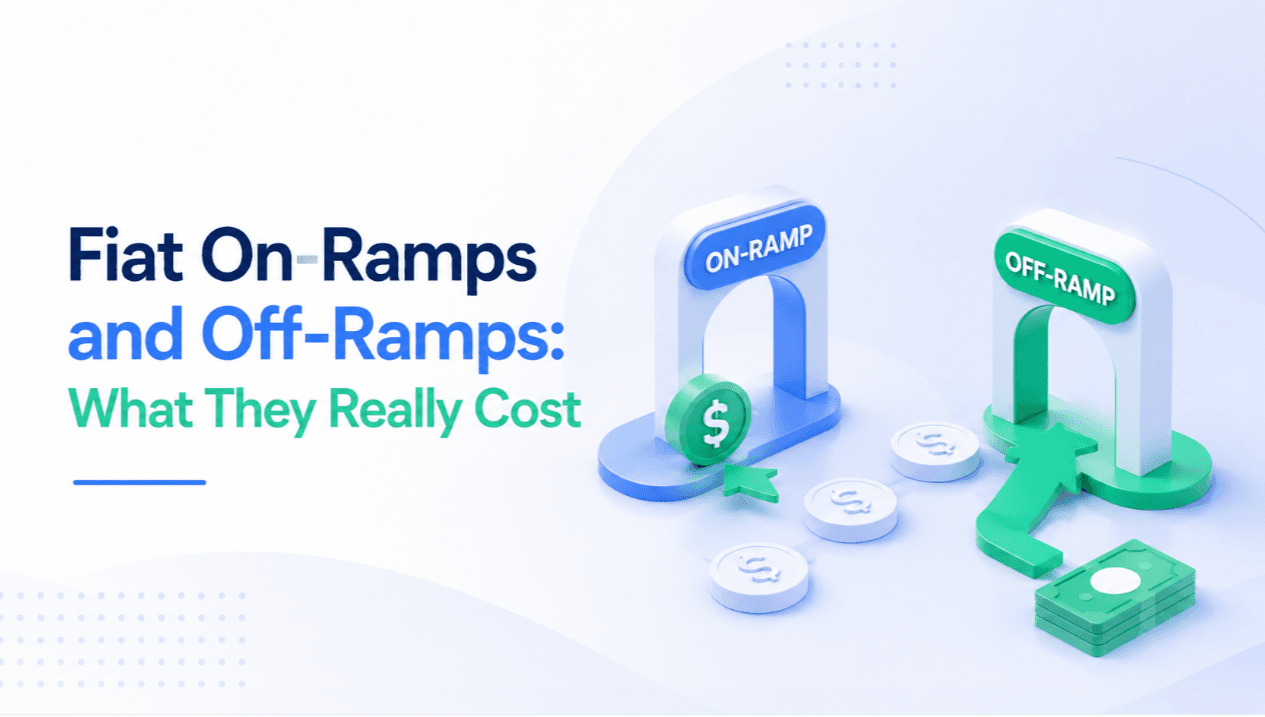
Buying £1,000 of bitcoin can cost you £5 or £45 depending on the route, for an identical outcome. The difference is not hidden in fine print exactly — it is in the exchange rate, which most people do not think to compare.
Here is how each route is priced, which is cheapest, and what to check before you rely on any of them for getting money back out.
The fee you see and the spread you do not
Every fiat purchase has two costs: an explicit fee and the difference between the rate you are given and the market rate. The second is invisible unless you check it, and on consumer routes it is usually the larger of the two.
Check it in ten seconds: note the price the app is quoting you, then compare against the market price on any exchange order book. If the app quotes 1.5% above market and charges a 2% fee, your real cost is 3.5%, not 2%.
Do this once per provider and you will not need to do it again — the spread is a policy, not a coincidence, and it stays roughly constant.
Route one: bank transfer to an exchange
Almost always the cheapest. Domestic transfer rails — SEPA in Europe, Faster Payments in the UK, ACH in the US — are free or near-free, and once the currency is on the exchange you trade on the order book at the spread the market sets rather than one the platform sets.
The catch is time: the first transfer requires verification and can take a day or two, and some banks are slow or hostile toward crypto exchanges. That makes it a poor choice for an urgent purchase and the obvious choice for a regular one.
Use limit orders rather than market orders if the amount is meaningful. On a liquid pair the difference is small; on a thin one it is not, and a market order simply accepts whatever the book offers.
Route two: debit or credit card
The most expensive route in almost every case. Card acquiring is costly for the provider and the risk of chargebacks is real, so the pricing reflects both — typically a few per cent in explicit fees plus a wider spread on top.
Credit cards add a further problem: many issuers treat crypto purchases as cash advances, which means interest from day one and an additional fee, turning an expensive purchase into a genuinely bad one.
It has a legitimate use — small amounts, immediately, when speed matters more than three per cent. As a habit for regular buying it is one of the most expensive habits available.
Route three: the in-app widget
Wallets and apps embed third-party providers to sell you crypto without leaving the interface. Convenient, and priced accordingly: the widget's margin sits on top of whatever the underlying provider charges.
The convenience is real for a first purchase, when creating and verifying an exchange account is a bigger obstacle than the fee. Past that first purchase the arithmetic stops favouring it.
Route four: peer-to-peer
In markets with limited banking access, P2P is often the only working route, and the escrow systems on major platforms make it workable. The risks are specific: payment reversal after release, and receiving funds that were stolen, which can freeze your bank account regardless of your own conduct.
If you use it, stay inside the platform's escrow, never release early, and keep the paper trail. It is a functioning market, not a shortcut around verification.
Limits, and why they bite at the wrong moment
Every route has caps: daily and monthly limits by verification tier, per-transaction ceilings on cards, and separate limits on fiat withdrawal that are often lower than the deposit limits. People discover them when they try to move a large amount quickly, which is the worst time.
Raise your verification tier before you need it, not during the transaction that hit the ceiling. Upgrades ask for documents and take days to review, and splitting a large transfer into pieces to stay under a threshold looks precisely like structuring, which is the one pattern compliance teams are specifically trained to flag.
The off-ramp is the half that fails
Getting in is easy because everyone wants your money. Getting out involves compliance review, source-of-funds questions and banks that may not want the transfer, and it is where people discover their route does not work.
Test the exit before you need it. Convert a small amount, withdraw it to your bank, confirm arrival and note the elapsed time. Then verify a second venue for the same route, because account reviews are triggered by exactly the kind of large withdrawal you will eventually want to make.
Keep the records that answer the obvious questions: where the funds came from, when you bought, what you paid. A clear history turns a review into a formality. How to choose a crypto exchange covers what to look for in a venue you intend to withdraw through.
The short version
- Regular buying: bank transfer to an exchange, limit orders, no exceptions.
- Urgent small purchase: a card is fine once you accept the cost.
- Never buy crypto on a credit card — many issuers price it as a cash advance.
- Compare the quoted rate against the market rate once per provider; the spread is the real fee.
- Test your off-ramp with a small withdrawal long before you need a large one.
Our best exchanges table scores fiat rails, regional coverage and withdrawal reliability, which are the three things that decide whether a route works for you specifically.
Frequently asked questions
What is the cheapest way to buy crypto?+
A domestic bank transfer to an exchange, then a limit order on the order book. The transfer is usually free and you trade at the market spread rather than a provider's marked-up rate.
Why is buying crypto with a card so expensive?+
Card acquiring costs the provider more and carries chargeback risk, so pricing includes a few per cent in fees plus a wider spread. Credit cards can add a cash-advance fee and immediate interest.
What is the spread on a crypto purchase?+
The gap between the rate you are quoted and the market rate. It is not usually itemised, and on consumer routes it often costs more than the visible fee.
Why do withdrawals to my bank get delayed?+
Compliance review. Large or unusual withdrawals trigger source-of-funds checks at the exchange and sometimes at the receiving bank. Clean records and a tested route shorten it considerably.
Written by
David TurnerCryptocurrency Markets, Blockchain Technology, Tokenomics Analysis, Digital Asset Regulation, DeFi, Web3 Industry Cover
David Turner is a U.S.-based Markets Reporter at CRYPTO·COINBEAT, covering cryptocurrency markets, blockchain innovation, and the rapidly evolving digital asset ecosystem across North America. Raised in California and educated in economics and digital media, David combines strong analytical skills with years of experience reporting on financial markets and emerging technologies. He began his journalism career covering equity markets, Federal Reserve policy, and fintech developments for several financial news outlets before specializing in cryptocurrency. As blockchain technology gained mainstream adoption, David shifted his focus to Bitcoin, Ethereum, decentralized finance, and digital asset regulation. Prior to joining CRYPTO·COINBEAT, he reported extensively on crypto exchanges, institutional investment, stablecoins, and the expanding Web3 economy. At **CRYPTO·COINBEAT**, David delivers data-driven reporting designed to help readers understand the fast-moving digital asset industry. His coverage frequently explores U.S. crypto legislation, tokenomics, blockchain adoption, market sentiment, and the impact of macroeconomic events on cryptocurrency markets. He is particularly recognized for his in-depth analysis of token supply models, vesting schedules, liquidity trends, and the long-term sustainability of blockchain projects. David earned a B.A. in Economics from the University of California, Los Angeles (UCLA), and completed additional coursework in data journalism and financial analysis. He also authors the daily market briefing, **"Opening Bell Crypto,"** providing traders and investors with concise analysis of overnight market activity, key industry developments, and emerging investment trends.
Keep Reading
Crypto Volatility and Risk Management: A Practical Framework
Volatility is the price of admission to crypto. Managing it — rather than fearing it — is what separates survivors from casualties.
Maria Fernandez · April 25, 2026→
Dollar-Cost Averaging in Crypto: A Practical Guide
Buying fixed amounts on a fixed schedule removes the pressure of timing the market. Here is how DCA works in crypto.
David Turner · May 5, 2026→
Crypto Market Cycles: What Drives Bull and Bear Markets
Crypto moves in cycles of expansion and contraction. Understanding the forces behind them beats trying to time them.
Maria Fernandez · May 23, 2026→