How to Choose a Crypto Exchange: A Ten-Point Checklist
By Emily Carter
Policy Correspondent · September 17, 2026 · 9 min read
Published September 17, 2026 · Reviewed to our editorial standards. This article is informational and not financial advice.
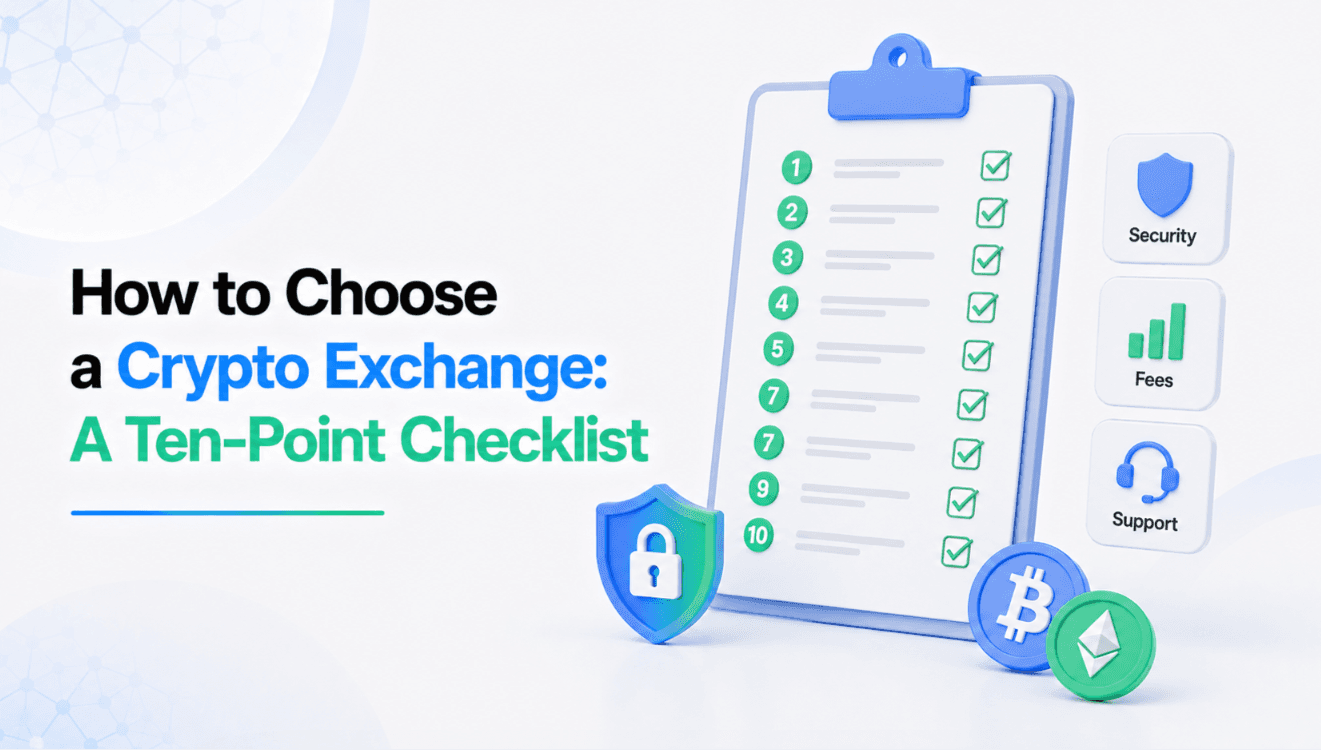
Most exchange comparisons start with fees, which is the wrong end of the problem. A venue that saves you two basis points and then delays a withdrawal for three days has cost you more than it saved; a venue that fails altogether has cost you everything.
These are the ten checks, in the order they matter, and each one is answerable in a few minutes before you deposit anything.
1. What the terms say about your assets
Find the section on client assets. Look for language stating they are segregated and held for the customer rather than mixed with company funds. This single paragraph decides where you stand if the company fails, and it is the reason it sits above everything else here.
2. Which licence, in which jurisdiction, for which entity
Check the specific entity that will hold your account against the regulator's own register, not the marketing page. Global brands operate through regional subsidiaries with very different permissions, and the protections you assume may belong to a company in another country.
3. Proof of reserves, and who attests it
A verifiable Merkle-tree proof with a named accounting firm behind it is meaningfully stronger than a self-published dashboard. Check the date and the cadence too — the mechanics are covered in proof of reserves explained.
4. The enforcement record
Search the venue's name alongside its regulator. What matters is not whether an action exists but what it concerned and how it ended: a settled matter about registration is a different signal from an open matter about customer funds.
5. What a round trip actually costs
Compare the total: maker and taker fees at your realistic volume, the spread on the pairs you trade, and withdrawal fees per rail. Beware simple-mode interfaces that bundle a spread into a headline price — the same trade on the venue's advanced interface is often several times cheaper.
6. Whether you can actually get money out
A working fiat rail in your country and currency is worth more than a long asset list. Check which withdrawal methods exist for your jurisdiction, what they cost, and what users report about processing times under load — the moment everyone wants out is the moment rails are tested.
7. Security controls on your account
Hardware security key support, withdrawal address allowlisting with a delay, and per-session device management. These are the controls that limit damage from a compromised password, and they are covered in two-factor authentication for crypto.
8. What happens when something goes wrong
Look for evidence of how the venue handled a real incident: a documented outage, a hack, a stuck withdrawal wave. An exchange that reimbursed customers and published a timeline has told you something no support page can.
9. Depth on the pairs you actually trade
Order-book depth decides your real execution cost at size, and it varies enormously between venues for the same asset. For anything beyond small retail amounts, slippage will dominate the fee schedule.
10. Whether the product pushes you somewhere
Interfaces that steer toward leverage, a house token or an in-app yield product are optimising for something other than your outcome. Rewards gated behind locking a platform token are a market position dressed as a discount.
Two checks people skip, and regret
First, look at how the venue behaves during volatility rather than on a calm afternoon. Outage histories, degraded order books and delayed withdrawals cluster in exactly the hours you most want access, and they are documented in status pages and user reports that predate your account.
Second, read the withdrawal terms before depositing. Daily limits, verification tiers and the conditions under which a withdrawal can be held are all published, and discovering them mid-transfer is a poor time to learn that a higher tier requires documents you do not have to hand.
Customer support is a security control
It reads like a soft criterion and behaves like a hard one. The moment that decides your experience is a stuck withdrawal, a locked account after a routine verification review, or a deposit that landed on the wrong network — and in each case the only variable is whether a competent human responds within hours or within weeks.
Check whether support is reachable before you need it: published channels, stated response windows, and evidence from users about escalation. Venues that answer only their highest-volume tiers are common, and that policy is invisible until you are the one waiting.
Read the incident history, not the marketing
Every venue that has operated for more than a few years has an incident history — an outage during a crash, a delayed withdrawal wave, a security event. What separates them is what they published afterwards and whether customers were made whole.
That record is public and it is the single most predictive thing you can read about future behaviour, because it shows how the company acts when the decision is expensive rather than when it is writing a landing page.
A shortlist beats a search
Answering ten questions for twenty venues is a project nobody completes. The efficient method is to shortlist two or three that already pass the custody and licensing checks for your country, then compare those on cost and rails — which is exactly the order our table applies, weighting custody and regulatory footing above everything else.
Putting it together
Two venues answer these questions well for different reasons, which is why our best crypto exchanges table scores custody and regulatory footing at 60% of the total and cost at 20%. If you want the short version: pick a licensed venue with segregated assets and a real fiat rail, keep only trading balances there, and move savings to self-custody.
One habit turns the checklist into a routine: write down your answers when you open the account, with the date. In a year the licensing, the fee schedule and the withdrawal terms may all have changed, and having the original answers makes the drift visible instead of invisible.
The exchange you choose matters less than the amount you leave on it. That is the uncomfortable conclusion of every failure this industry has produced, and it is still the cheapest protection available.
Frequently asked questions
What is the most important thing when choosing a crypto exchange?+
What the terms of service say about client assets. Segregation language decides your legal position if the company fails, and no fee advantage compensates for getting that wrong.
Are lower fees worth switching exchange for?+
Rarely. For most users, spread and withdrawal costs dominate the maker/taker schedule, and a venue that delays withdrawals or lacks a working fiat rail costs far more than the fee difference.
How do I check if an exchange is regulated?+
Identify the specific legal entity your account is with, then search it in the regulator's public register. Global brands use regional subsidiaries with different permissions, so the licence on the marketing page may not be the one covering you.
Should I use more than one exchange?+
It reduces single-venue failure risk and multiplies your exposure to account takeover and identity verification. A better split is one exchange for trading and self-custody for savings, rather than several exchanges holding the same risk.
Written by
Emily CarterFormer regulatory analyst · J.D.
Emily Carter is a legal and regulatory writer specializing in cryptocurrency, blockchain policy, and digital asset compliance. Before joining CRYPTO·COINBEAT, she worked as a regulatory analyst in the United States, tracking developments in federal financial legislation, anti-money laundering (AML) requirements, and emerging policies shaping the digital asset industry. She earned her Juris Doctor (J.D.) degree and combines legal expertise with a talent for translating complex regulatory topics into clear, accessible language. Her work focuses on cryptocurrency taxation, DeFi regulation, exchange compliance, stablecoins, and the evolving role of U.S. agencies in overseeing digital assets. At CRYPTO·COINBEAT, Emily writes educational guides and policy explainers designed for both newcomers and experienced crypto users. She is committed to helping readers understand how regulatory changes affect investors, businesses, and the broader blockchain ecosystem.
Keep Reading
Crypto Volatility and Risk Management: A Practical Framework
Volatility is the price of admission to crypto. Managing it — rather than fearing it — is what separates survivors from casualties.
Maria Fernandez · April 25, 2026→
Dollar-Cost Averaging in Crypto: A Practical Guide
Buying fixed amounts on a fixed schedule removes the pressure of timing the market. Here is how DCA works in crypto.
David Turner · May 5, 2026→
Crypto Market Cycles: What Drives Bull and Bear Markets
Crypto moves in cycles of expansion and contraction. Understanding the forces behind them beats trying to time them.
Maria Fernandez · May 23, 2026→