Proof of Reserves: What It Proves, and What It Hides
By David Turner
Senior Crypto Markets Reporter at CryptoGrows. · September 15, 2026 · 9 min read
Published September 15, 2026 · Reviewed to our editorial standards. This article is informational and not financial advice.
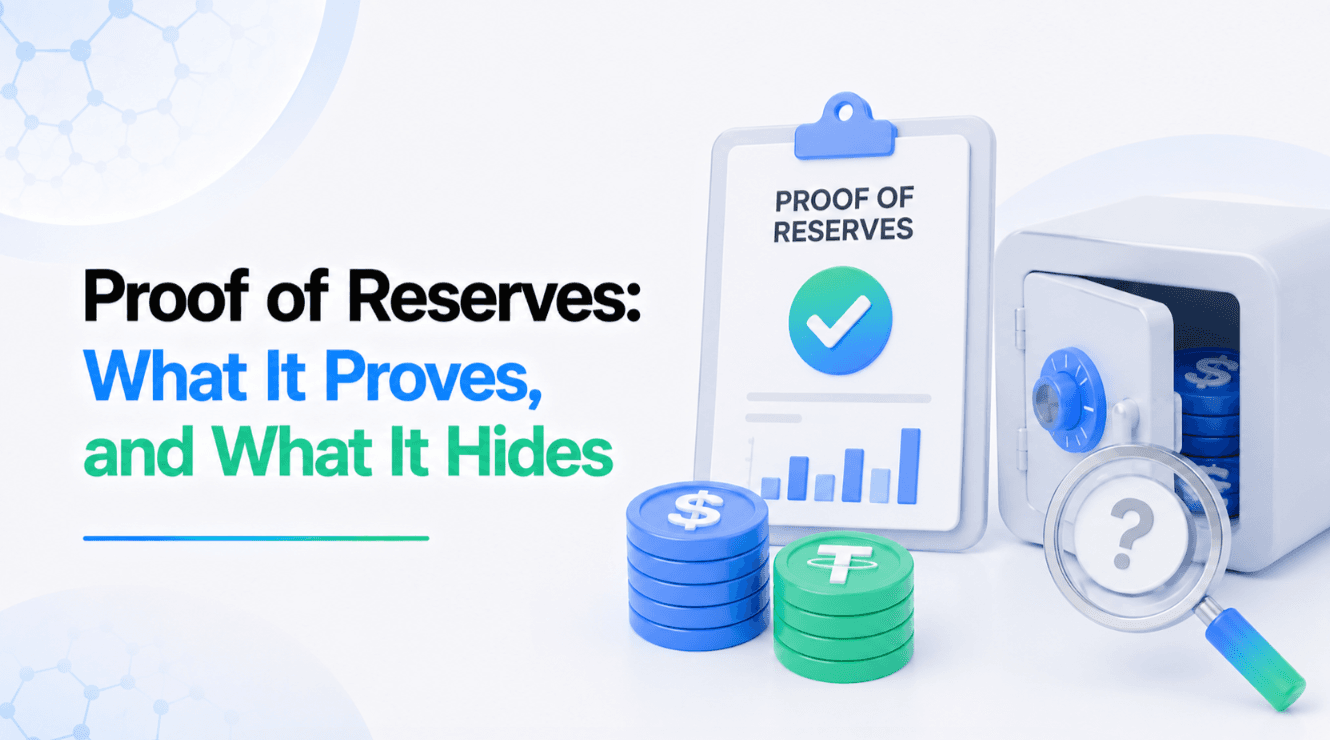
After 2022, when several large platforms turned out to be holding far less than customers believed, proof of reserves became the industry's standard reassurance. Nearly every serious exchange publishes one now, usually with a dashboard, a percentage above 100, and a tool that lets you check your own balance.
It is a genuine improvement on the previous state of affairs, which was nothing at all. It is also routinely presented as proof of solvency, which it is not — and the difference is the whole subject of this article.
What a Merkle proof actually does
The exchange takes every customer balance, hashes each one, and builds those hashes into a tree where each level combines the pairs below it until a single root hash remains. Publishing the root commits the exchange to that exact set of balances: change any one of them and the root changes.
You are then given the specific branch connecting your account to the root. Recomputing it confirms two things at once: your balance was included in the total the exchange claimed, and that total has not been quietly edited since. Cryptographically this is elegant, and it removes the possibility of an exchange excluding large customers to make its liabilities look smaller.
And what it does not do
The tree covers liabilities — what the exchange owes. Separately, the exchange proves control of on-chain wallets holding assets. Solvency is the comparison between the two, and the second half is where the guarantees weaken.
- Borrowed assets: an exchange can borrow coins before the snapshot and return them afterwards, showing reserves it does not permanently hold.
- Timing: a proof describes one moment. Nothing prevents funds moving the following day, which is why cadence matters more than any single report.
- Off-chain obligations: loans, legal claims and corporate debt appear nowhere in a wallet balance, and they compete with customers in an insolvency.
- Exclusions: many proofs cover only major assets, so a long-tail balance may be outside the exercise entirely.
None of that makes the exercise theatre. An exchange willing to commit publicly to its liabilities has given up the easiest form of deception, and the ones that refuse are telling you something by refusing.
That is why we treat a verifiable proof as necessary rather than sufficient in the best crypto exchanges table. It answers a real question honestly and leaves a larger one open.
Attested, self-published, or neither
The most important distinction is who checks. A proof where a named accounting firm attests to the figures is materially stronger than a page the exchange publishes about itself, because someone with a professional licence has put their name to the procedure and can be held to it.
Among the venues we score, Kraken's Merkle-tree proof is attested by an independent accounting firm; Binance and OKX publish verifiable trees that are self-attested, with OKX running a monthly cadence; Coinbase, as a listed company, files audited financial statements instead, which is a broader assurance covering the whole business rather than a wallet snapshot.
Attestation and audit are not the same word
An attestation confirms specified figures at a point in time under agreed procedures. An audit examines financial statements as a whole, including liabilities that never touch a blockchain, and carries far greater professional obligation.
Marketing in this sector blurs the two relentlessly, and the distinction is the reason a listed exchange's annual report tells you more about survival odds than any monthly reserve page. Both are useful; only one covers the debts.
The 2022 failures, and what they actually showed
The platforms that collapsed in 2022 did not fail because a wallet was empty on a particular Tuesday. They failed because they had lent customer assets to a small number of undisclosed counterparties, and when those borrowers failed, the depositors turned out to be unsecured creditors of a company rather than owners of a coin.
A proof of reserves published the week before would have looked reassuring, because the assets existed at that moment and the obligations did not appear anywhere in the exercise. That is not an argument against the practice — it is the precise reason to read what a proof covers rather than the percentage on the front page.
How to read one in five minutes
- Check the date, then check the cadence. A single proof from eighteen months ago is a press release.
- Find out who attests. A named firm changes the character of the document entirely.
- Verify your own balance in the tree. If the tool does not let you, the proof is not a proof for you.
- Look at which assets are covered, and assume anything unlisted is out of scope.
- Read the terms of service on segregation, which decides your legal position if the company fails — a separate and more consequential question.
Where the practice is heading
The direction of travel is toward proofs that cover liabilities cryptographically as well as assets, using techniques that let an exchange demonstrate total obligations without publishing individual balances. Several research implementations exist and adoption has been slow, because the harder half of the problem is also the half that constrains what an exchange can quietly do with customer funds.
Regulation is pushing in the same direction from another angle. Frameworks that require segregation and periodic reporting make the reserve question a supervisory matter rather than a voluntary disclosure, which is a stronger guarantee than any dashboard — and a slower one to arrive.
Until then, read the proof for what it is: evidence that an exchange is willing to be checked on one specific thing, published on a cadence you can verify. That is worth having, and it is not a substitute for keeping savings somewhere a company cannot reach.
What actually protects you
Proof of reserves reduces the chance of being surprised. It does not change the fact that a balance on an exchange is a claim on a company. The two things that genuinely limit your exposure are how much you keep there and what the terms say about client assets.
Which returns to the split covered in custodial vs non-custodial wallets: trade on the exchange, save in self-custody. A good proof of reserves makes an exchange a more reasonable place for the first, and does nothing to make it a reasonable place for the second.
Frequently asked questions
Does proof of reserves prove an exchange is solvent?+
No. It proves customer balances were included in a published total and that the exchange controls certain wallets. Solvency also requires knowing off-chain liabilities — loans, legal claims, corporate debt — which the exercise does not cover.
What is a Merkle tree proof of reserves?+
Customer balances are hashed into a tree whose single root hash is published. Your account's branch lets you confirm your balance was counted and that the total has not been altered, without revealing anyone else's data.
Which exchanges have attested proof of reserves?+
Kraken's is attested by an independent accounting firm; Binance and OKX publish verifiable but self-attested trees, with OKX on a monthly cadence. Coinbase files audited financial statements as a listed company instead.
How often should proof of reserves be published?+
Monthly or better. A proof describes a single moment, so cadence is what turns it from a snapshot into evidence — an annual report tells you almost nothing about the intervening year.
Written by
David TurnerCryptocurrency Markets, Blockchain Technology, Tokenomics Analysis, Digital Asset Regulation, DeFi, Web3 Industry Cover
David Turner is a U.S.-based Markets Reporter at CRYPTO·COINBEAT, covering cryptocurrency markets, blockchain innovation, and the rapidly evolving digital asset ecosystem across North America. Raised in California and educated in economics and digital media, David combines strong analytical skills with years of experience reporting on financial markets and emerging technologies. He began his journalism career covering equity markets, Federal Reserve policy, and fintech developments for several financial news outlets before specializing in cryptocurrency. As blockchain technology gained mainstream adoption, David shifted his focus to Bitcoin, Ethereum, decentralized finance, and digital asset regulation. Prior to joining CRYPTO·COINBEAT, he reported extensively on crypto exchanges, institutional investment, stablecoins, and the expanding Web3 economy. At **CRYPTO·COINBEAT**, David delivers data-driven reporting designed to help readers understand the fast-moving digital asset industry. His coverage frequently explores U.S. crypto legislation, tokenomics, blockchain adoption, market sentiment, and the impact of macroeconomic events on cryptocurrency markets. He is particularly recognized for his in-depth analysis of token supply models, vesting schedules, liquidity trends, and the long-term sustainability of blockchain projects. David earned a B.A. in Economics from the University of California, Los Angeles (UCLA), and completed additional coursework in data journalism and financial analysis. He also authors the daily market briefing, **"Opening Bell Crypto,"** providing traders and investors with concise analysis of overnight market activity, key industry developments, and emerging investment trends.
Keep Reading
KYC and AML in Crypto Explained
KYC verifies who you are; AML is the broader effort to stop illicit money moving through crypto. Together they shape how regulated platforms operate.
Emily Carter · April 27, 2026→
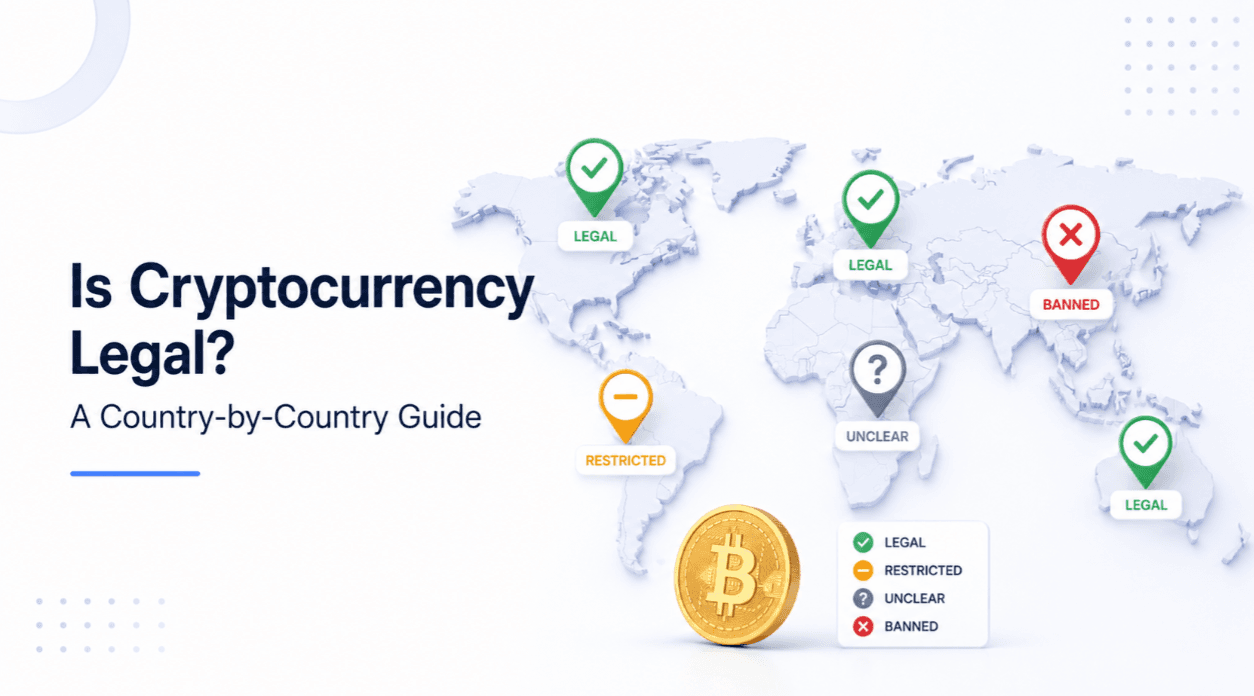
Is Cryptocurrency Legal? A Country-by-Country Guide
Cryptocurrency is legal to own and trade in most countries, restricted in some, and banned in a few. Status depends on local law and changes over time.
Maria Fernandez · May 9, 2026→
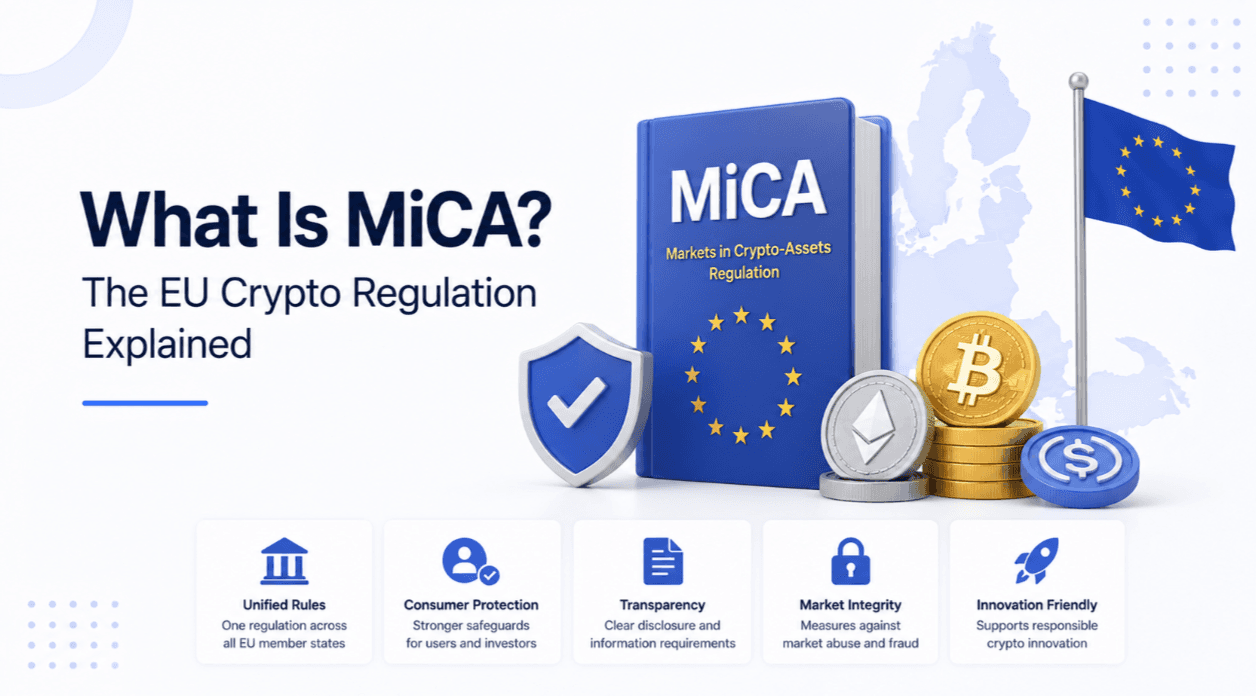
What Is MiCA? The EU Crypto Regulation Explained
MiCA is the European Union's dedicated framework for crypto-assets, creating one set of rules across member states for issuers, stablecoins and service providers.
Emily Carter · May 23, 2026→