Is Cryptocurrency Legal? A Country-by-Country Guide
DeFi Protocols & RWA On-Chain AnalystDeFi Protocols & RWA On-Chain Analyst · May 9, 2026 · 9 min read
Published May 9, 2026 · Reviewed to our editorial standards. This article is informational and not financial advice.
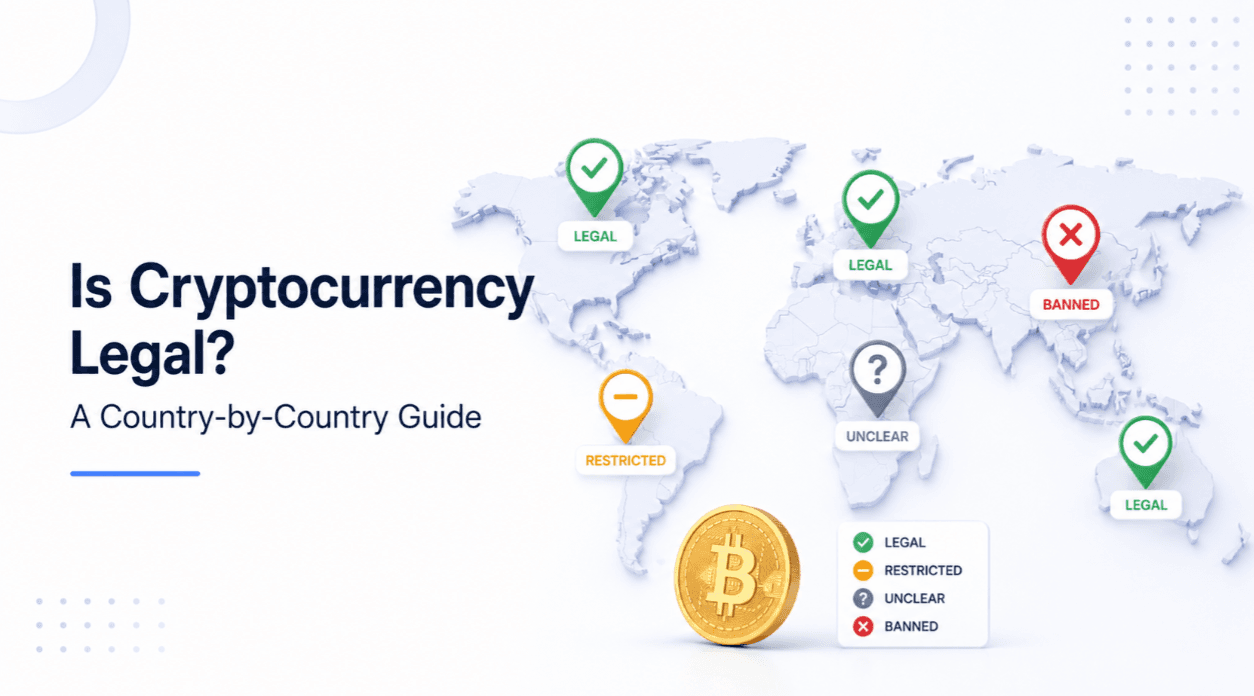
Cryptocurrency is legal to own, buy and sell in the large majority of countries, though it is rarely recognised as official currency. A smaller number of jurisdictions restrict specific activities such as trading or banking access, and a few impose broad bans. Legal status varies widely and changes over time, so local rules always take precedence over any general summary.
Key takeaways
- In most countries you can legally own and trade crypto, even where it is heavily regulated.
- Legal to hold is not the same as legal tender; very few places grant that status.
- Some jurisdictions restrict banking, trading or mining rather than banning outright.
- A handful of countries prohibit crypto broadly, often citing capital controls or stability.
- Status changes frequently, so always verify the current rules where you live.
Legal to own versus legal tender
It helps to separate two questions that people often blur. The first is whether you may legally hold and trade crypto, which is permitted in most of the world. The second is whether crypto counts as legal tender, meaning it must be accepted to settle debts. Almost everywhere, the answer to the second question is no, regardless of how freely crypto trades.
A very small number of jurisdictions have experimented with granting an official or legal-tender role to a cryptocurrency, but these remain exceptions. For the vast majority of users, crypto is a legal asset to own rather than money the state requires anyone to accept.
The distinction has real consequences. Where crypto is not legal tender, a merchant is generally free to refuse it, and the state will not stand behind it the way it does for national currency. Treating crypto as legal to hold rather than as official money keeps it firmly in the category of an asset you choose to use, with the risks and freedoms that come with that.
The broad categories of legal status
Rather than memorise every country, it is more useful to understand the bands into which they fall.
Permissive and regulated
Most major economies allow crypto ownership and trading while subjecting businesses to licensing, anti-money-laundering and tax rules. Here, the question is not whether crypto is allowed but how strictly it is supervised.
Partially restricted
Some countries permit individuals to hold crypto but limit how the financial system interacts with it, for example by barring banks from servicing crypto firms, or by restricting certain trading or mining activity. The asset is not outlawed, but its practical use is curtailed.
Prohibited or near-prohibited
A minority of jurisdictions ban crypto trading, exchanges or mining outright. Reasons commonly cited include protecting capital controls, shielding consumers, or concerns about energy use and financial stability. Even within this group, enforcement and scope differ.
The headline question is rarely whether crypto is legal at all, but which specific activities your jurisdiction permits, restricts or taxes. — CryptoCoinBeat analysis
What a ban does and does not mean
Even where a country bans crypto, the ban usually targets specific activities rather than the abstract idea of owning a digital asset. A government may prohibit exchanges from operating, forbid banks from processing crypto payments, or outlaw mining, while individuals quietly continue to hold coins that authorities cannot easily seize. The practical effect of a ban therefore depends heavily on which activities it names and how vigorously it is enforced.
Bans also tend to be less stable than they appear. Governments have reversed course in both directions, tightening after a scandal or loosening to capture economic activity that was moving offshore. Treating a prohibition as permanent, or as covering more than it actually says, is a common misreading.
Why the same activity differs across borders
Two neighbouring countries can reach opposite conclusions because they weigh different priorities. A jurisdiction worried about capital flight may clamp down on exchanges, while one courting financial innovation builds licensing regimes to attract firms. Domestic politics, banking-sector concerns and international commitments all shape where a country lands.
Legal status also rarely sits in one statute. It emerges from the combination of securities law, payments rules, tax treatment and central-bank policy, which is why a clean yes or no answer is often misleading.
International pressure plays a part too. Countries that want access to global banking and trade tend to adopt the anti-money-laundering standards their partners expect, which nudges them toward regulating crypto rather than ignoring it. A jurisdiction that strays too far from these norms can find its institutions cut off from cross-border finance, so even reluctant governments often build some rulebook for digital assets.
How to check the rules where you are
Because status shifts and varies, treat any list as a starting point rather than a verdict. A few practical checks will get you closer to an accurate picture for your own situation.
- Look for official statements from your central bank and securities or markets regulator.
- Check whether licensed exchanges operate locally, which usually signals a permissive regime.
- Confirm how your tax authority treats crypto gains and income.
- Note any restrictions on banking access, mining or specific tokens.
- Re-check periodically, since rules can change quickly and sometimes with little notice.
Travelling and moving between countries
Crypto's borderless design does not exempt anyone from local law. Someone who can legally trade at home may find that the same activity is restricted in a country they move to, or that a platform refuses service based on residence. Tax residency adds another layer, since obligations can follow where you live rather than where an exchange is based.
- Check whether your usual platform serves residents of your destination.
- Understand that legality at home does not guarantee legality abroad.
- Be aware that tax and reporting duties often track your residency.
- Watch for local rules on carrying or declaring assets when relocating.
Beyond legality: what else to weigh
Legality is the first question, not the last. Even where crypto is fully permitted, separate rules govern how you must report it, what consumer protections apply, and whether certain services can market to you. A jurisdiction can welcome ownership while heavily restricting advertising, leverage or specific products, so a green light on legality does not mean an absence of rules.
- Tax reporting duties can apply even where trading is freely legal.
- Consumer-protection and advertising rules shape how products reach you.
- Restrictions may target derivatives, leverage or particular tokens specifically.
- Licensing of local platforms affects how much recourse you have if one fails.
The direction of travel
Globally, the trend has been toward regulating rather than banning, with many governments preferring licensing and reporting over prohibition. That said, restrictions can tighten as well as loosen, particularly around stablecoins, anonymity and consumer marketing.
The safest mindset is to assume the rules in your jurisdiction will keep evolving and to revisit your understanding periodically. What was permitted, restricted or untaxed last year may have shifted, and platforms often update their own policies in response well before most users notice.
This guide is educational only and is not legal advice. The legal status of cryptocurrency varies by jurisdiction and changes frequently. Before acting, verify the current rules where you live and, where the stakes are meaningful, consult a qualified local professional.
Frequently asked questions
Is owning cryptocurrency legal in most countries?+
Yes. In the large majority of countries you can legally own, buy and sell cryptocurrency, even where the sector is heavily regulated. Legal status, however, varies by jurisdiction and can change, and being legal to own is different from being recognised as official legal tender.
Is crypto considered legal tender anywhere?+
Almost nowhere. The vast majority of jurisdictions treat crypto as a legal asset to hold rather than money that must be accepted to settle debts. A very small number have experimented with granting an official or legal-tender role, but these remain rare exceptions rather than the norm.
Why do some countries ban cryptocurrency?+
Countries that restrict or ban crypto commonly cite protecting capital controls, shielding consumers from fraud, financial-stability concerns, or energy use from mining. Even among restrictive jurisdictions, the scope and enforcement differ; some bar only banking access or trading rather than prohibiting ownership entirely.
How can I check if crypto is legal where I live?+
Start with official statements from your central bank and securities regulator, and check whether licensed exchanges operate locally. Confirm how your tax authority treats crypto and note any limits on banking, mining or specific tokens. Re-check periodically, because rules can change quickly and with little notice.
Written by
Maria FernandezDeFi Protocols, Real-World Assets, On-Chain Analytics, Stablecoins, Spanish-Language Coverage
Maria Fernandez is an On-Chain Research Analyst at **CRYPTO·COINBEAT**, specializing in real-world asset (RWA) tokenization, decentralized finance, and stablecoin ecosystems. Originally from Mexico City and now based in Miami, Maria brings a unique Latin American perspective to blockchain research, combining deep technical analysis with insights into emerging digital asset markets across the Americas. Before joining **CRYPTO·COINBEAT**, Maria spent several years researching decentralized finance protocols, producing in-depth analysis on lending platforms, governance systems, and the growing adoption of tokenized real-world assets. Her early research into institutional RWA integration and decentralized collateral models helped explain one of the fastest-growing sectors within the blockchain industry. Maria's analytical approach combines on-chain transaction analysis, protocol revenue metrics, liquidity monitoring, and governance activity to evaluate the long-term health of DeFi ecosystems. She works extensively with blockchain analytics platforms, including Dune Analytics, Nansen, and Flipside Crypto, and has created numerous public dashboards that simplify complex blockchain data for investors and researchers alike. Her coverage of stablecoin market events and liquidity shifts has helped readers better understand risk during periods of heightened market volatility. She holds a B.Sc. in Industrial Engineering from ITAM (Instituto Tecnológico Autónomo de México) and a Graduate Certificate in FinTech from MIT Sloan. Passionate about blockchain education, Maria regularly contributes both English- and Spanish-language research, helping make advanced on-chain analysis more accessible to a global audience while supporting the continued growth of crypto adoption throughout Latin America.
Keep Reading
KYC and AML in Crypto Explained
KYC verifies who you are; AML is the broader effort to stop illicit money moving through crypto. Together they shape how regulated platforms operate.
Emily Carter · April 27, 2026→
What Is MiCA? The EU Crypto Regulation Explained
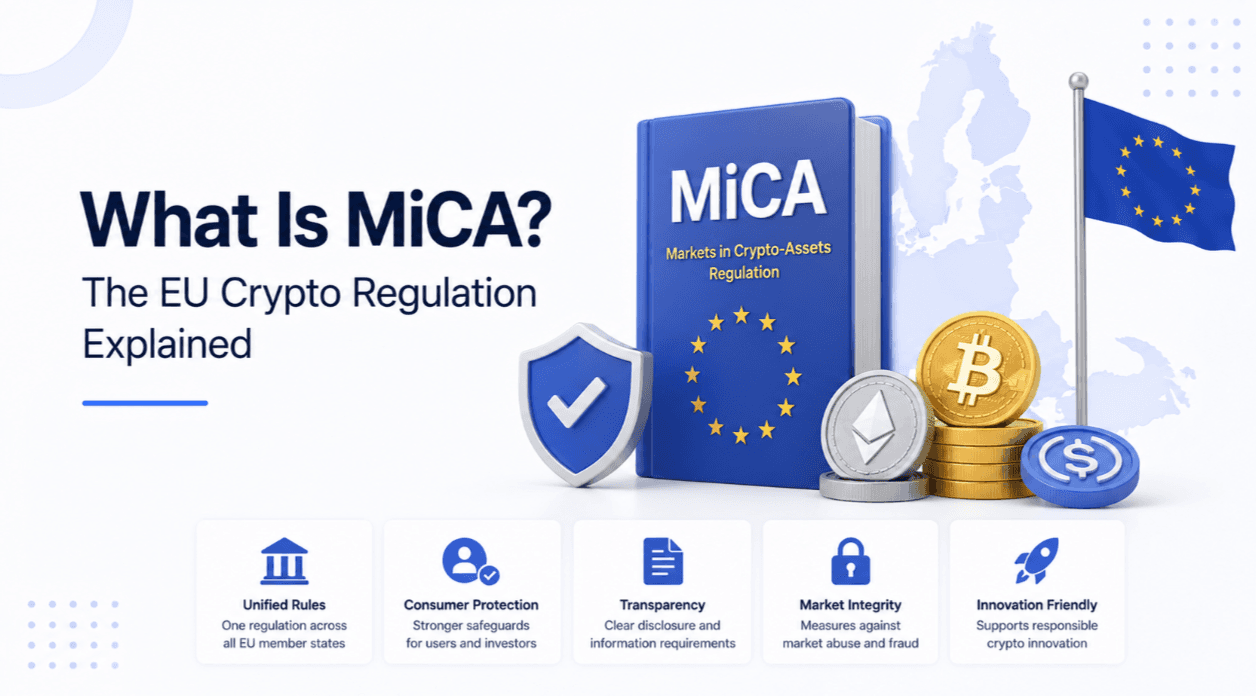
MiCA is the European Union's dedicated framework for crypto-assets, creating one set of rules across member states for issuers, stablecoins and service providers.
Emily Carter · May 23, 2026→
Crypto Regulation Explained: A Global Overview
There is no single global rulebook for crypto. Instead, overlapping authorities apply securities, payments and anti-money-laundering law in ways that vary by country.
Emily Carter · June 2, 2026→