What Is MiCA? The EU Crypto Regulation Explained
By Emily Carter
Policy Correspondent · May 23, 2026 · 10 min read
Published May 23, 2026 · Reviewed to our editorial standards. This article is informational and not financial advice.
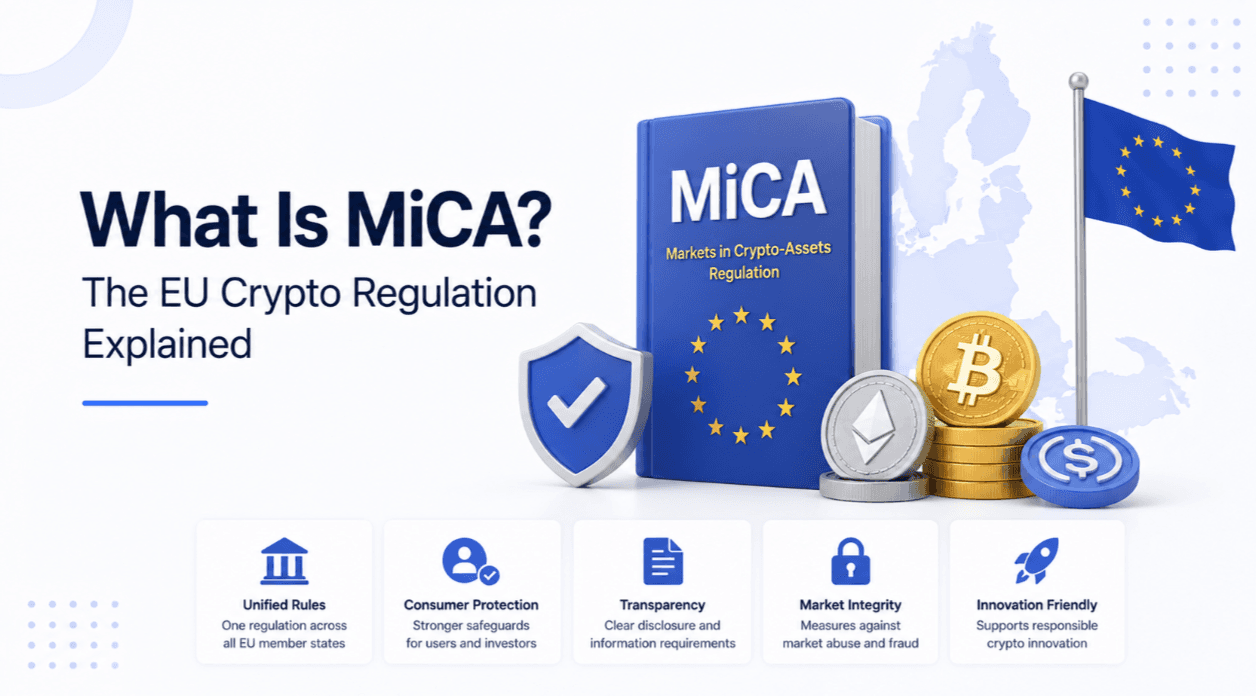
MiCA, the Markets in Crypto-Assets Regulation, is the European Union's comprehensive rulebook for crypto-assets that are not already covered by existing financial law. It harmonises rules across all member states, setting requirements for token issuers, stablecoin arrangements and crypto-asset service providers. Its aim is to protect users and support market integrity while letting compliant firms operate across the bloc under one licence.
Key takeaways
- MiCA is the EU's dedicated framework for crypto-assets outside existing financial law.
- It replaces a fragmented set of national rules with one harmonised regime.
- Stablecoins face some of the strictest requirements, including reserve and reporting rules.
- Service providers must be authorised and meet conduct and custody standards.
- A single authorisation can allow firms to operate across all member states.
What MiCA is and why it exists
Before MiCA, crypto firms in the EU faced a mix of national rules that differed by country, creating uncertainty for businesses and uneven protection for users. MiCA responds by establishing common definitions, obligations and supervisory expectations across the single market. The headline benefit for industry is passporting: authorisation in one member state can permit operation throughout the bloc.
Crucially, MiCA targets crypto-assets that fall outside existing EU financial legislation. Assets that already qualify as financial instruments remain under those other frameworks, so MiCA fills a gap rather than overriding established securities law.
This scoping choice matters because it avoids regulating the same asset twice under conflicting rules. A token that behaves like a share, for instance, stays within existing securities law, while a payment-style or utility token that previously sat in a grey area now has a defined home. The practical result is a clearer map of which rulebook applies to which kind of asset across the EU.
The categories of crypto-asset MiCA covers
MiCA sorts in-scope assets into a few groups, each with tailored obligations.
- Asset-referenced tokens, which aim to hold value by referencing several assets, currencies or baskets.
- E-money tokens, which reference a single official currency and behave like digital money.
- Other crypto-assets, a broad category covering utility tokens and many general tokens.
Issuers in these categories face disclosure duties, typically including a published information document that must be fair, clear and not misleading. The two stablecoin-style categories carry the heaviest extra requirements.
The distinction between an asset-referenced token and an e-money token turns mainly on what the token references. One that tracks a single official currency sits closer to electronic money and is treated accordingly, while one referencing a basket of assets or currencies falls into the asset-referenced group. Both promise stability, but the backing they rely on differs, and MiCA tailors its requirements to that difference.
How MiCA treats stablecoins
Stablecoins draw the most demanding rules because they are designed to hold steady value and could scale into systemic payment instruments. Issuers generally must maintain adequate reserves, manage them prudently, and meet redemption and reporting obligations. Larger or more significant stablecoins face enhanced oversight, reflecting the financial-stability concerns regulators have voiced about widely used private money.
MiCA's defining choice was to regulate stablecoins as seriously as the payment infrastructure they aspire to become. — CryptoCoinBeat analysis
The reserve requirement is the heart of the stablecoin rules. Backing assets must genuinely exist, be safeguarded, and be available so that holders can redeem at par. By pairing this with reporting and governance duties, MiCA tries to ensure a token claiming to be worth one euro can actually deliver one euro on demand, which is precisely the promise that has failed in past stablecoin breakdowns elsewhere.
Rules for crypto-asset service providers
Businesses that offer crypto services in the EU, such as exchanges, custodians, brokers and advisers, must be authorised as crypto-asset service providers. Authorisation comes with ongoing duties around governance, capital, custody of client assets, conflict-of-interest management and fair treatment of clients.
- Hold client assets securely and keep them separate from the firm's own.
- Provide clear information and handle complaints fairly.
- Maintain governance, risk controls and adequate financial resources.
- Follow market-abuse rules that prohibit manipulation and insider dealing.
Market abuse and transparency
Beyond licensing, MiCA imports market-integrity ideas familiar from traditional finance. It prohibits manipulation and the misuse of inside information about crypto-assets admitted to trading, and expects providers to detect and report suspicious activity. The aim is to make crypto markets behave less like an unpoliced frontier and more like supervised venues, where participants face consequences for distorting prices.
What MiCA means for users and firms
For users, MiCA is intended to raise the baseline of protection: clearer disclosures, safer custody and recourse when things go wrong. For firms, it offers a path to operate across the EU under one regime, in exchange for meeting authorisation and conduct standards that can be demanding for smaller players.
There are trade-offs. Compliance costs can weigh on startups and may push some services to adjust which tokens they list or which features they offer to EU users. Supporters argue this is the price of a trustworthy market that can attract mainstream participants; critics worry it favours larger incumbents able to absorb the overhead. Both effects are likely to show up as the regime beds in.
MiCA does not cover everything. Fully decentralised arrangements without an identifiable issuer or provider, certain non-fungible tokens, and assets already classed as financial instruments sit outside or beside its scope. Other EU rules, including anti-money-laundering law, continue to apply alongside it.
Practical effects for users in the EU
For someone using a crypto platform in the EU, MiCA tends to show up in concrete ways rather than as abstract law. Providers must give clearer information before you buy, hold your assets under defined custody standards, and operate under supervision that can act when things go wrong. Some tokens or services may be withdrawn or adjusted where they cannot meet the requirements.
- Clearer, standardised information before acquiring a crypto-asset.
- Defined custody and segregation rules for assets a provider holds for you.
- A supervised provider you can complain to and an authority that can intervene.
- Possible changes to token availability as firms align with the rules.
Common misconceptions about MiCA
Because MiCA is broad, it is often misread. It does not turn every crypto activity into a licensed financial service, nor does it ban decentralised protocols outright. Equally, it is not a guarantee that any MiCA-compliant token is a sound investment; compliance addresses conduct, disclosure and stability, not whether a project will succeed. Reading authorisation as a quality stamp on returns is a mistake.
How MiCA fits the wider picture
MiCA is widely viewed as one of the most complete regional crypto frameworks, and regulators elsewhere study it as a reference point. It does not make the EU rules identical to those of other jurisdictions, so firms operating internationally still face overlapping and sometimes conflicting obligations.
This article is educational only and is not legal advice. MiCA's detailed requirements and their interpretation evolve through guidance and supervisory practice, and rules differ across jurisdictions. For compliance decisions, consult a qualified professional familiar with EU crypto law.
Frequently asked questions
What does MiCA stand for?+
MiCA stands for Markets in Crypto-Assets, the European Union's regulation creating a harmonised framework for crypto-assets that are not already covered by other EU financial law. It sets rules for token issuers, stablecoin arrangements and crypto-asset service providers across all member states under a single regime.
Does MiCA cover stablecoins?+
Yes, and they face some of its strictest requirements. MiCA divides stablecoin-style assets into asset-referenced tokens and e-money tokens, imposing reserve, redemption and reporting obligations. Larger or more significant stablecoins receive enhanced oversight because regulators worry about their potential impact on financial stability.
Do crypto exchanges need a licence under MiCA?+
Businesses offering crypto services in the EU generally must be authorised as crypto-asset service providers. Authorisation brings duties on governance, capital, custody of client assets, conflict management and market-abuse prevention. Once authorised, a firm can passport its services across member states under a single regime.
What does MiCA not cover?+
MiCA generally excludes assets already classed as financial instruments, certain non-fungible tokens, and fully decentralised arrangements with no identifiable issuer or service provider. Other EU laws, including anti-money-laundering rules, still apply alongside it, so MiCA is one layer of a broader regulatory structure rather than the whole.
Written by
Emily CarterFormer regulatory analyst · J.D.
Emily Carter is a legal and regulatory writer specializing in cryptocurrency, blockchain policy, and digital asset compliance. Before joining CRYPTO·COINBEAT, she worked as a regulatory analyst in the United States, tracking developments in federal financial legislation, anti-money laundering (AML) requirements, and emerging policies shaping the digital asset industry. She earned her Juris Doctor (J.D.) degree and combines legal expertise with a talent for translating complex regulatory topics into clear, accessible language. Her work focuses on cryptocurrency taxation, DeFi regulation, exchange compliance, stablecoins, and the evolving role of U.S. agencies in overseeing digital assets. At CRYPTO·COINBEAT, Emily writes educational guides and policy explainers designed for both newcomers and experienced crypto users. She is committed to helping readers understand how regulatory changes affect investors, businesses, and the broader blockchain ecosystem.
Keep Reading
KYC and AML in Crypto Explained
KYC verifies who you are; AML is the broader effort to stop illicit money moving through crypto. Together they shape how regulated platforms operate.
Emily Carter · April 27, 2026→
Is Cryptocurrency Legal? A Country-by-Country Guide
Cryptocurrency is legal to own and trade in most countries, restricted in some, and banned in a few. Status depends on local law and changes over time.
Maria Fernandez · May 9, 2026→
Crypto Regulation Explained: A Global Overview
There is no single global rulebook for crypto. Instead, overlapping authorities apply securities, payments and anti-money-laundering law in ways that vary by country.
Emily Carter · June 2, 2026→