What a Crypto Card Is, and How It Actually Charges You
DeFi Protocols & RWA On-Chain Analyst · September 29, 2026 · 8 min read
Published September 29, 2026 · Reviewed to our editorial standards. This article is informational and not financial advice.
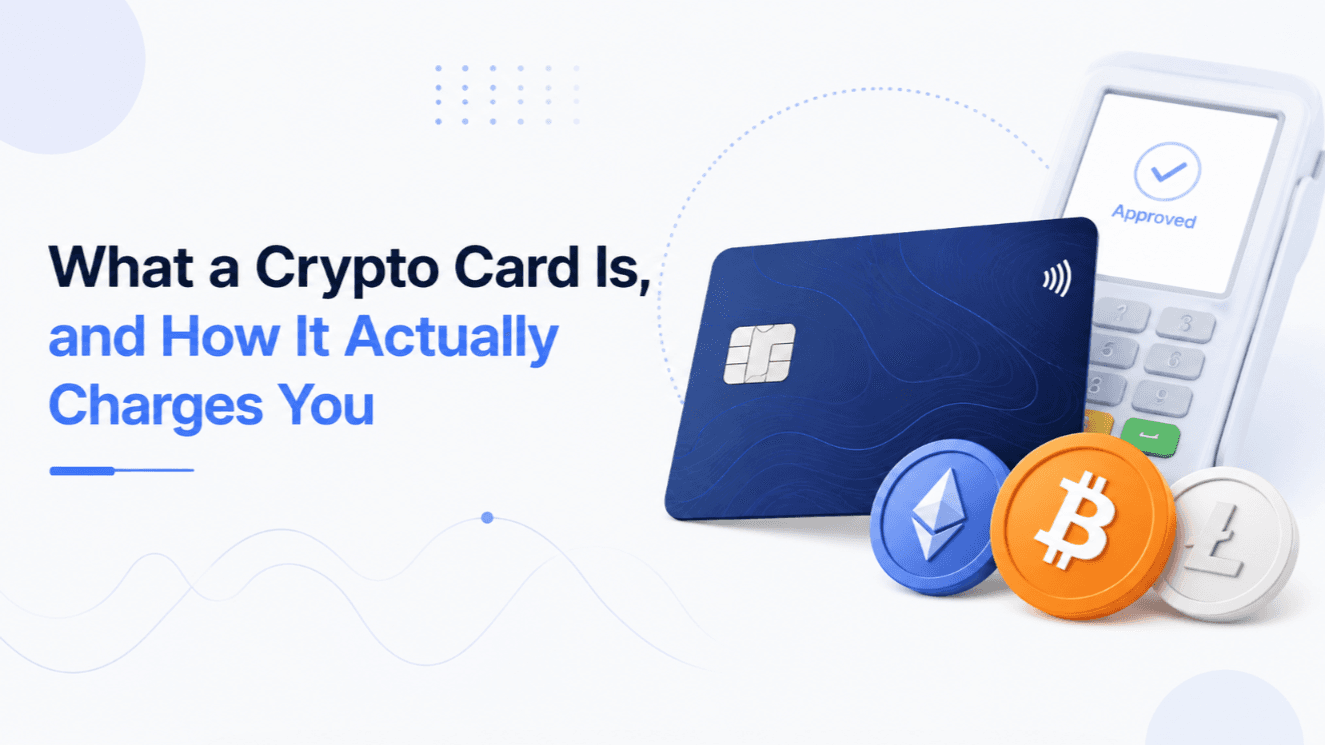
A crypto card looks like an ordinary debit card and behaves like one at the till. Behind that, something specific happens: your crypto is sold for fiat at the moment of purchase, and the fiat settles the transaction on the card network. Everything that makes these products good or bad is in the details of that conversion.
Where the money is made
Three places. The conversion spread applied when your asset is sold, which is the largest and least visible. Interchange, paid by the merchant, which funds the rewards. And FX markup when you spend in a currency other than the card's base.
The advertised cashback is real, and it is usually smaller than the spread you paid to earn it. That is why comparing cards on reward percentage alone produces the wrong answer, and why our best crypto cards table weights true all-in cost above rewards.
Custodial by default, with one exception
Almost every card requires you to hold a balance with the issuer, which means the usual custodial trade: convenience in exchange for a claim on a company. If the programme stops — and programmes in this category have stopped when a banking partner withdrew — your balance is caught up in that.
The exception is the self-custodial model, where funds sit in a smart account you control until settlement. It is more setup and it removes the counterparty question from everyday spending, which is why it leads our table.
Staking tiers are a market position
The headline reward rates on several cards require locking a large amount of the issuer's own token. That is not a membership fee — it is an investment in a volatile asset, made to earn a few percent back on groceries.
Price it honestly: if the token falls by half over the year you hold it, the cashback has to be enormous to compensate. Reward terms attached to those tiers have also been reduced more than once across the category, which is a risk you carry without any say.
Every purchase may be a taxable event
In most jurisdictions, spending a volatile asset is a disposal: the coffee is not the taxable event, converting bitcoin to pay for it is. Daily use can produce hundreds of small disposals a year, each needing a cost basis and a gain or loss.
Two things reduce the burden. Spending a stablecoin balance produces gains near zero, so the paperwork shrinks. And credit-mode cards borrow against collateral rather than selling it, which in many jurisdictions is not a disposal at all. This is general information rather than tax advice, and the detail is in our tax guide.
What to check before applying
- The conversion spread, which is often stated separately from the fee schedule or not at all.
- Monthly and ATM fees, including what applies after any free allowance.
- Whether meaningful rewards require locking a token, and what the terms say about changing them.
- Which entity issues the card and under whose licence, since that decides what happens if a partner withdraws.
- Whether your country is actually supported, published per market rather than implied.
Rewards, and how to value them honestly
Work out what you actually spend on a card in a year, apply the reward rate you would genuinely qualify for rather than the headline tier, and subtract any subscription fee and the spread on the conversions. The remaining number is the reward, and it is frequently smaller than a good cashback credit card returns with no token position at all.
Then ask what the locked stake would have to be worth for the deal to make sense. If a card requires locking an amount equal to several years of expected rewards, the rewards are not the product — the token position is, and it should be evaluated as an investment on its own terms.
What happens if the programme stops
This category has a documented history of cards ceasing to work at short notice when an issuing partner or a banking relationship ended. Balances have generally been returned, and the interruption has been real: a card that stops working while you are travelling is a practical problem regardless of who eventually gets the money.
Two habits reduce the exposure. Keep only spending money on the card rather than a balance, and carry a conventional payment method as a fallback. Neither costs anything, and both convert an outage from a crisis into an inconvenience.
Who these are actually for
People who hold crypto and want to spend some of it without a manual sale-and-transfer each time, in markets where the card works. That is a genuine convenience and worth a modest cost.
There is also a practical reason to hold one that has nothing to do with rewards: it is a working fiat off-ramp that does not require a bank transfer. In markets where crypto-to-bank rails are slow or unreliable, spending directly is occasionally the fastest route out, and that utility is worth more than any cashback rate.
They are a poor deal for anyone chasing rewards through a locked token position, and a bad idea for spending long-term holdings, since every purchase realises a gain you might not have chosen to realise. Keep a small spending balance in a stablecoin, and leave savings where they are.
Treating the card as anything more than a spending tool is how a convenience becomes an exposure nobody intended to take: a yield product, a reason to hold a volatile token, or a place to keep a balance are three different mistakes wearing the same piece of plastic.
Frequently asked questions
How do crypto cards work?+
Your crypto is sold for fiat at the moment of purchase and the fiat settles on the card network. The conversion spread applied during that sale is where most of the cost sits, usually exceeding the advertised cashback.
Do crypto cards charge hidden fees?+
The published schedules are usually accurate; the conversion spread is the part that is often not itemised. Compare cards on the total cost of a purchase rather than on the reward percentage.
Is spending crypto with a card taxable?+
In most jurisdictions spending a volatile asset is a disposal, so each purchase can create a gain or loss to report. Spending a stablecoin balance or using a credit-mode card that borrows against collateral materially reduces the bookkeeping.
Which crypto card is best?+
It depends on what you optimise for: self-custodial settlement, the widest country coverage, or rewards paid in a liquid asset. Our cards table scores true all-in cost, issuer stability, coverage and reward honesty separately so the trade-off is visible.
Written by
Maria FernandezDeFi Protocols, Real-World Assets, On-Chain Analytics, Stablecoins, Spanish-Language Coverage
Maria Fernandez is an On-Chain Research Analyst at **CRYPTO·COINBEAT**, specializing in real-world asset (RWA) tokenization, decentralized finance, and stablecoin ecosystems. Originally from Mexico City and now based in Miami, Maria brings a unique Latin American perspective to blockchain research, combining deep technical analysis with insights into emerging digital asset markets across the Americas. Before joining **CRYPTO·COINBEAT**, Maria spent several years researching decentralized finance protocols, producing in-depth analysis on lending platforms, governance systems, and the growing adoption of tokenized real-world assets. Her early research into institutional RWA integration and decentralized collateral models helped explain one of the fastest-growing sectors within the blockchain industry. Maria's analytical approach combines on-chain transaction analysis, protocol revenue metrics, liquidity monitoring, and governance activity to evaluate the long-term health of DeFi ecosystems. She works extensively with blockchain analytics platforms, including Dune Analytics, Nansen, and Flipside Crypto, and has created numerous public dashboards that simplify complex blockchain data for investors and researchers alike. Her coverage of stablecoin market events and liquidity shifts has helped readers better understand risk during periods of heightened market volatility. She holds a B.Sc. in Industrial Engineering from ITAM (Instituto Tecnológico Autónomo de México) and a Graduate Certificate in FinTech from MIT Sloan. Passionate about blockchain education, Maria regularly contributes both English- and Spanish-language research, helping make advanced on-chain analysis more accessible to a global audience while supporting the continued growth of crypto adoption throughout Latin America.
Keep Reading
Crypto Volatility and Risk Management: A Practical Framework
Volatility is the price of admission to crypto. Managing it — rather than fearing it — is what separates survivors from casualties.
Maria Fernandez · April 25, 2026→
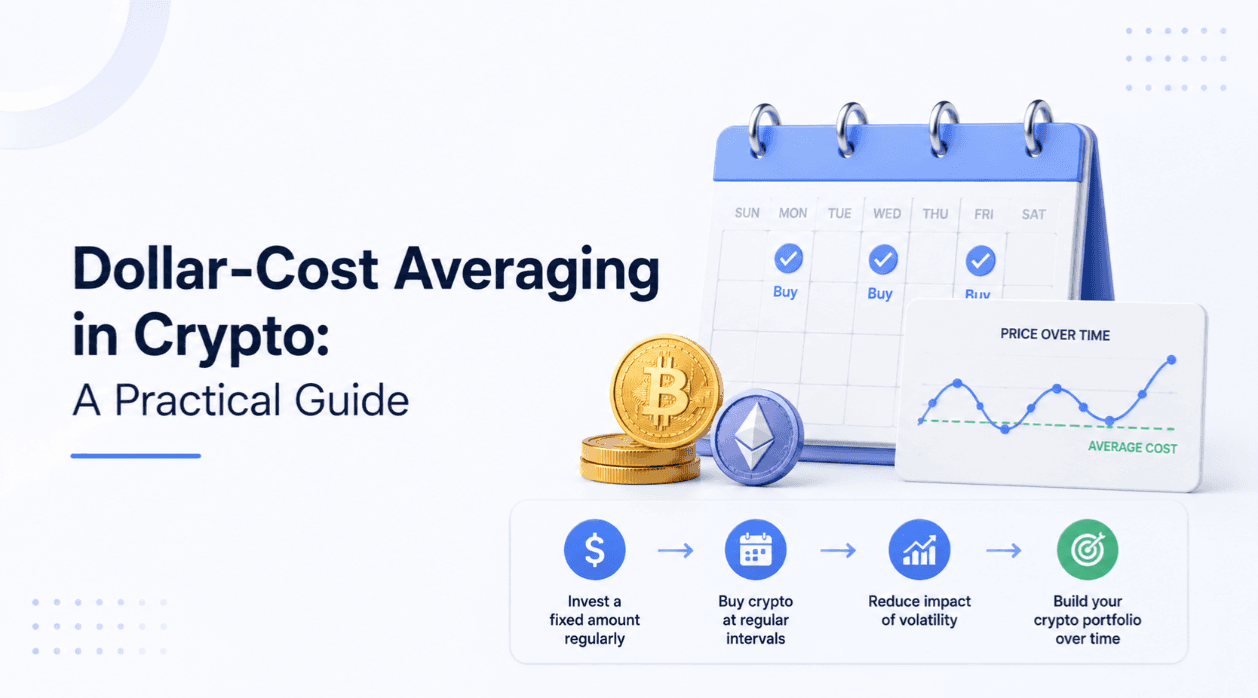
Dollar-Cost Averaging in Crypto: A Practical Guide
Buying fixed amounts on a fixed schedule removes the pressure of timing the market. Here is how DCA works in crypto.
David Turner · May 5, 2026→

Crypto Market Cycles: What Drives Bull and Bear Markets
Crypto moves in cycles of expansion and contraction. Understanding the forces behind them beats trying to time them.
Maria Fernandez · May 23, 2026→