How Do Decentralized Exchanges (DEXs) Work?
DeFi Protocols & RWA On-Chain AnalystDeFi Protocols & RWA On-Chain Analyst · June 3, 2026 · 10 min read
Published June 3, 2026 · Reviewed to our editorial standards. This article is informational and not financial advice.
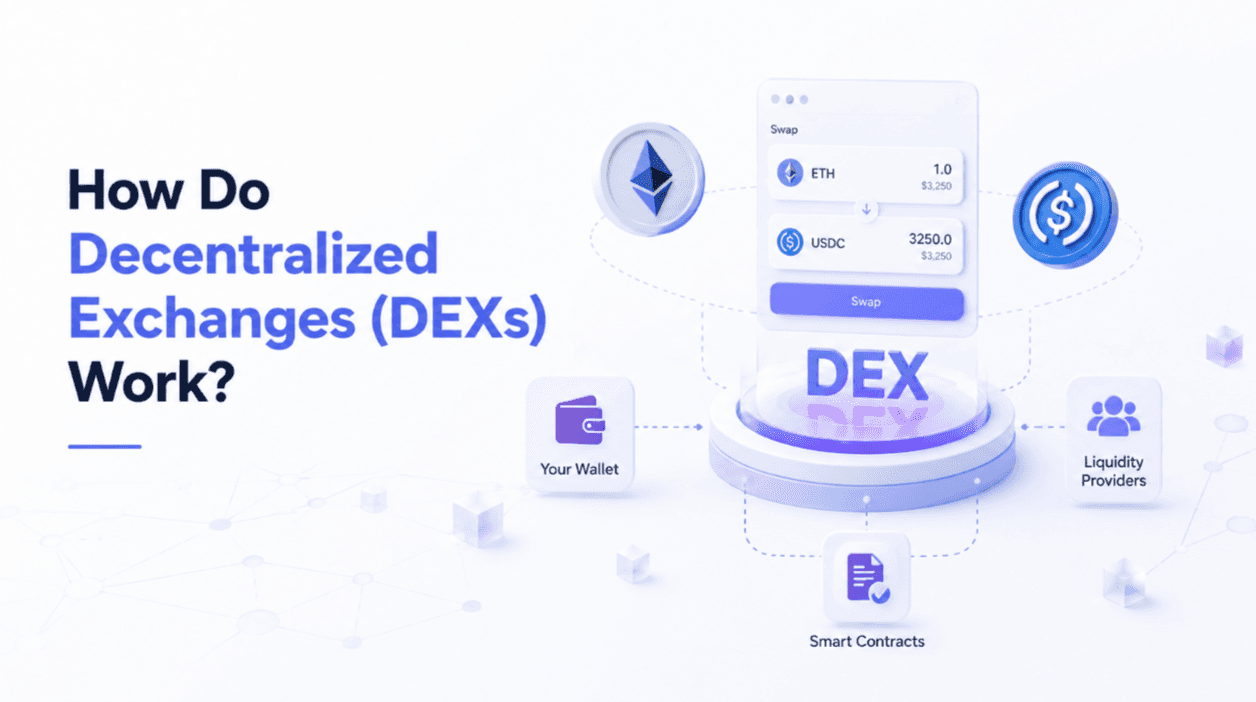
A decentralized exchange, or DEX, lets you trade one crypto token for another directly from your own wallet, with no company holding your funds in between. Most DEXs replace the traditional order book with an automated market maker (AMM): a smart contract that prices every trade against a shared pool of tokens, so swaps settle instantly without a counterparty on the other side.
Key takeaways
- DEXs settle trades through smart contracts, so you keep custody of your assets until the swap executes.
- Most use an automated market maker that prices trades against a liquidity pool instead of matching buyers and sellers.
- Liquidity providers deposit token pairs and earn fees, but face impermanent loss when prices move.
- Slippage, gas fees, and failed transactions are normal parts of on-chain trading.
- Risks include smart-contract bugs, scam tokens, and front-running, none of which a help desk can reverse.
DEX vs centralized exchange
On a centralized exchange, you deposit funds into the company’s custody, and it runs an internal order book that matches your buy with someone else’s sell. You trust the operator to hold your balance, run the matching fairly, and let you withdraw on demand.
A DEX flips that model. Your tokens stay in your wallet until you sign a transaction, the trade settles on a public blockchain, and the logic lives in open code rather than a private server. You gain self-custody and transparency. You give up the convenience, customer support, and recourse that a centralized operator can provide.
How automated market makers price a trade
The heart of most DEXs is the automated market maker. Rather than waiting for a matching order, an AMM holds reserves of two tokens in a liquidity pool and uses a formula to set the price. The best-known version uses a constant product formula, often written as x times y equals k, where x and y are the reserves of each token and k stays constant.
When you buy one token from the pool, its reserve shrinks and the other grows, so the price you pay rises as your order gets larger. This is why big trades on thin pools move the price sharply. The formula needs no human market maker; the math alone guarantees there is always a quote, as long as the pool holds liquidity.
Liquidity pools and providers
Pools are funded by liquidity providers, who deposit an equal value of both tokens in a pair. In return they receive LP tokens representing their share and earn a cut of the trading fees the pool collects. Providers are essential plumbing: without their deposits, there is nothing to trade against and prices become wildly unstable.
Impermanent loss
Providing liquidity is not free money. When the two tokens’ prices diverge, the AMM automatically rebalances the pool, leaving providers with more of the falling asset and less of the rising one. Compared with simply holding both tokens, this gap is called impermanent loss. It becomes permanent if you withdraw while prices are out of line, and fees do not always cover it.
What happens when you swap
From the user’s side, a swap is a few clicks, but several things happen under the hood.
- You connect your wallet and choose the two tokens plus an amount.
- The DEX routes your trade through one or more pools to find a workable price.
- You approve the token for spending if the contract has not been authorized before.
- You set a slippage tolerance, the maximum price movement you will accept before the trade reverts.
- You sign the transaction and pay a network gas fee; the swap settles on-chain within seconds to minutes.
On a DEX, the order book is replaced by math. The price is whatever the pool’s reserves say it is at the instant your transaction lands. — CryptoCoinBeat analysis
Order-book and aggregator DEXs
Not every DEX is an AMM. Some recreate a traditional order book on-chain or on a fast secondary layer, matching limit orders much like a centralized venue but settling without custody. Aggregators add another layer, scanning many DEXs at once and splitting a single order across pools to find the best overall price. For larger trades, an aggregator often reduces slippage meaningfully.
Risks and costs to understand
Trading on a DEX carries risks a centralized exchange would normally shield you from. Smart-contract bugs can drain pools. Scam tokens are trivial to list, so a token that looks tradable may be a honeypot you can buy but never sell. Front-running and sandwich attacks let bots detect your pending trade and profit at your expense, especially on large or high-slippage orders.
There are practical costs too. Gas fees are charged whether a transaction succeeds or fails, so a reverted swap still costs money. Setting slippage too high invites sandwich attacks; setting it too low causes failed trades during volatility. Always verify a token’s contract address from an independent source, and approve only the amount you intend to trade rather than an unlimited allowance.
This article is educational and not financial advice. DEX trading is high-risk: you can lose funds to bugs, scams, or adverse price moves with no way to reverse a transaction. Nothing here recommends any token or platform. Research independently and consider professional guidance before trading.
Aggregators: why you rarely trade against one pool
In practice most swaps no longer hit a single pool. An aggregator splits the order across several venues and chains, which reduces price impact on anything but the smallest trades. That is why a quote from an aggregator often beats the underlying exchange's own front end — the routing is doing work the pool cannot.
It also adds a party to trust: the routing engine runs off-chain and its contracts are usually upgradeable, unlike the immutable pools underneath. Our decentralised exchange table scores that distinction directly, because an immutable pool and a live routing layer are genuinely different risk profiles.
MEV, and how to stop paying it
When you broadcast a swap, it sits in public before it is included in a block. A searcher can buy ahead of you and sell after, pocketing the difference — a sandwich attack, paid for out of your slippage tolerance. The wider your slippage setting, the more there is to take.
- Set slippage as tight as the pair allows rather than accepting a permissive default.
- Avoid round-number amounts in thin pools, which are the easiest to model and target.
- Submit through a private relay or an RPC endpoint that offers MEV protection.
- Use a fill mode where solvers compete for your order rather than executing directly against pools.
Frequently asked questions
Are DEXs safer than centralized exchanges?+
They remove custody risk because you hold your own assets, so a DEX cannot run off with your funds the way a failed custodian could. But they add smart-contract risk, scam-token risk, and front-running. Neither model is simply safer; they trade one set of risks for another.
What is slippage on a DEX?+
Slippage is the difference between the price you expect and the price you actually get when your trade settles. It grows on large orders or thin pools. Setting a slippage tolerance limits how far the price can move before the trade reverts, protecting you from very bad fills.
Why did my swap fail but still cost a fee?+
Blockchains charge gas for the computation a transaction uses, even when it reverts. A swap can fail if the price moves past your slippage limit, if liquidity is insufficient, or if you did not approve enough allowance. You pay for the attempted work regardless of the outcome.
What is impermanent loss when providing liquidity?+
When the two tokens in a pool diverge in price, the AMM rebalances your share, leaving you worse off than if you had simply held the tokens. That shortfall is impermanent loss. It becomes permanent on withdrawal, and trading fees do not always make up the difference.
Written by
Maria FernandezDeFi Protocols, Real-World Assets, On-Chain Analytics, Stablecoins, Spanish-Language Coverage
Maria Fernandez is an On-Chain Research Analyst at **CRYPTO·COINBEAT**, specializing in real-world asset (RWA) tokenization, decentralized finance, and stablecoin ecosystems. Originally from Mexico City and now based in Miami, Maria brings a unique Latin American perspective to blockchain research, combining deep technical analysis with insights into emerging digital asset markets across the Americas. Before joining **CRYPTO·COINBEAT**, Maria spent several years researching decentralized finance protocols, producing in-depth analysis on lending platforms, governance systems, and the growing adoption of tokenized real-world assets. Her early research into institutional RWA integration and decentralized collateral models helped explain one of the fastest-growing sectors within the blockchain industry. Maria's analytical approach combines on-chain transaction analysis, protocol revenue metrics, liquidity monitoring, and governance activity to evaluate the long-term health of DeFi ecosystems. She works extensively with blockchain analytics platforms, including Dune Analytics, Nansen, and Flipside Crypto, and has created numerous public dashboards that simplify complex blockchain data for investors and researchers alike. Her coverage of stablecoin market events and liquidity shifts has helped readers better understand risk during periods of heightened market volatility. She holds a B.Sc. in Industrial Engineering from ITAM (Instituto Tecnológico Autónomo de México) and a Graduate Certificate in FinTech from MIT Sloan. Passionate about blockchain education, Maria regularly contributes both English- and Spanish-language research, helping make advanced on-chain analysis more accessible to a global audience while supporting the continued growth of crypto adoption throughout Latin America.
Keep Reading
Crypto Lending and Borrowing in DeFi Explained
DeFi lending markets let anyone earn interest or borrow against crypto, governed entirely by code. Here is how collateral, rates, and liquidations actually work.
David Turner · May 2, 2026→
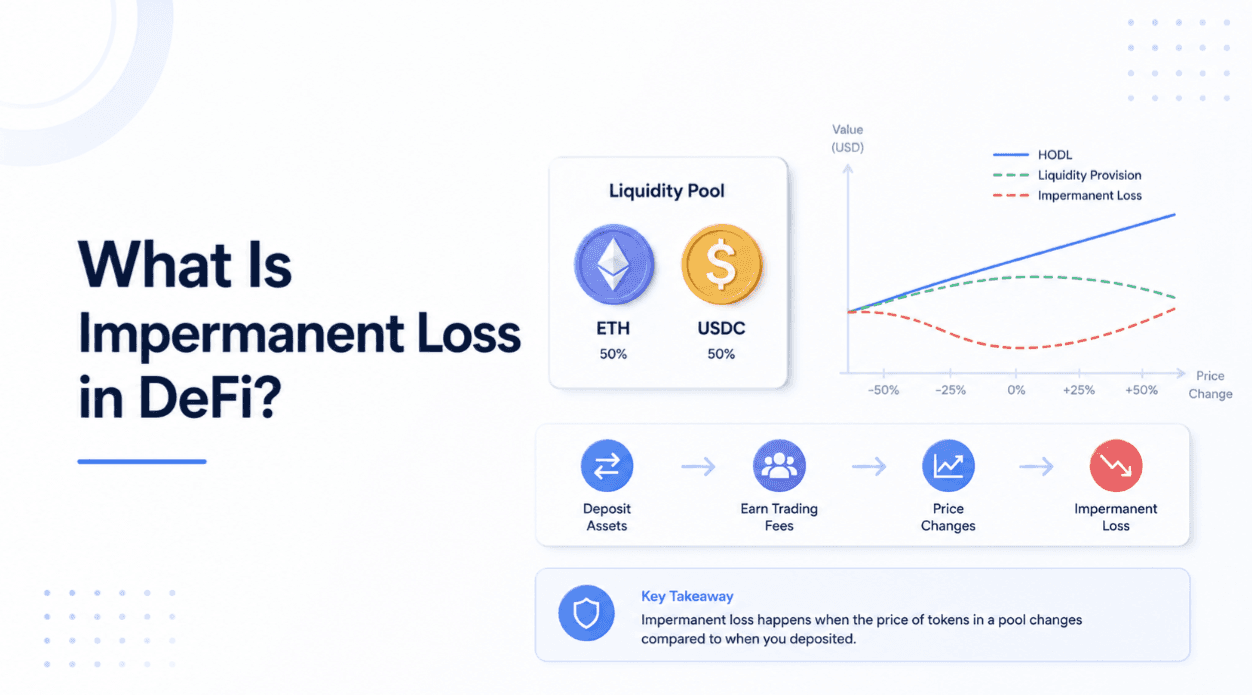
What Is Impermanent Loss in DeFi?
Impermanent loss quietly erodes the value of liquidity positions when token prices move. Here is why it happens, how big it gets, and when fees offset it.
Maria Fernandez · May 9, 2026→
Yield Farming and Liquidity Mining Explained
Yield farming chases returns by moving crypto between DeFi protocols. We break down where the yield comes from, how APY can mislead, and the risks behind big numbers.
David Turner · May 23, 2026→