Yield Farming and Liquidity Mining Explained
By David Turner
Senior Crypto Markets Reporter at CryptoGrows. · May 23, 2026 · 10 min read
Published May 23, 2026 · Reviewed to our editorial standards. This article is informational and not financial advice.
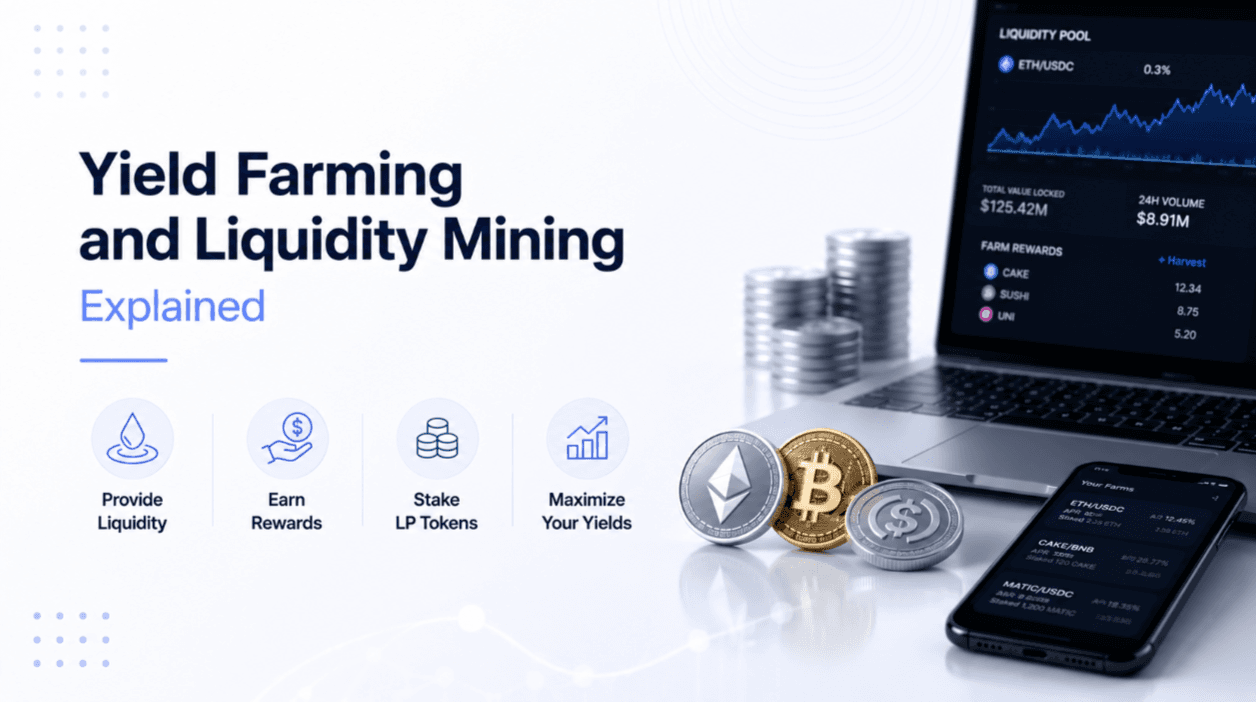
Yield farming is the practice of putting crypto assets to work across DeFi protocols to earn returns, typically by supplying liquidity, lending, or staking tokens in exchange for fees and rewards. Liquidity mining is a specific form of it, where a protocol pays out its own governance token to attract deposits. Both can produce eye-catching yields, and both carry risks that scale with the numbers on offer.
Key takeaways
- Yield farming earns returns by supplying capital to DeFi protocols; liquidity mining adds extra token rewards on top.
- Yield comes from real sources like trading fees and loan interest, plus incentive tokens that may not hold value.
- Advertised APY is often inflated by token emissions and assumes conditions that rarely last.
- Risks include impermanent loss, smart-contract exploits, token price collapse, and reward dilution.
- Very high yields almost always signal very high risk, not free money.
Where the yield actually comes from
Sustainable yield in DeFi traces back to someone paying for a service. Liquidity providers on a DEX earn a slice of trading fees. Lenders earn interest paid by borrowers. These are organic returns: they exist because real users are willing to pay for liquidity or capital.
Liquidity mining layers something else on top. To bootstrap usage, a protocol mints and distributes its own token to depositors. That reward can dwarf the organic fee yield, which is exactly the point: it pulls in capital quickly. But it also means a large part of your return is paid in a token whose price can fall, sometimes faster than you can sell. When the emissions slow or the token sinks, the headline yield evaporates.
How yield farming works step by step
A typical farming position moves through a few stages, often automated by the protocol’s interface.
- Deposit assets into a pool, lending market, or vault, often as a token pair.
- Receive a receipt token (such as an LP token) representing your share of the position.
- Stake that receipt token in a rewards contract to start earning incentive tokens.
- Periodically harvest the rewards and decide whether to sell, hold, or compound them.
- Compound by reinvesting rewards to grow the position, accepting added fees and risk each cycle.
Reading APY and APR honestly
Two numbers dominate farming dashboards, and they are easy to misread. APR is the simple annual rate without compounding. APY assumes you reinvest rewards on a set schedule, so it is always higher than the equivalent APR. A protocol showing a four-digit APY is usually projecting current token emissions forward for a year, an assumption that almost never holds.
Those projected yields ignore several drains: gas fees on every harvest and compound, the price decline of reward tokens as more are minted, and impermanent loss on the underlying pair. A nominal 200% APY can become a real loss once the reward token halves in price and impermanent loss eats the principal. Treat advertised yield as a ceiling under ideal conditions, not a forecast.
In yield farming, the headline number is marketing. The real return is whatever survives token inflation, impermanent loss, and fees once you finally cash out. — CryptoCoinBeat analysis
The main risks
Impermanent loss and price risk
If you farm with a token pair, diverging prices cause impermanent loss, the same dynamic that affects all AMM liquidity providers. On top of that, the reward token itself carries price risk. Many farm tokens are designed with heavy emissions, which dilutes holders and pressures the price downward over time.
Smart-contract and protocol risk
Farming usually stacks several contracts: the DEX, the rewards contract, sometimes an auto-compounding vault on top. Each added layer is another place a bug or exploit can drain funds. New, unaudited protocols offering the highest yields are also the most likely to fail, whether through an honest flaw or a deliberate rug pull where the team removes liquidity and disappears.
Liquidity and exit risk
High yields attract a crowd, and crowds leave together. When emissions drop or sentiment turns, capital exits fast, the reward token sells off, and pool liquidity thins. Getting out at a good price during that rush is hard, and gas costs spike when everyone transacts at once.
Who yield farming is actually for
Yield farming sits at the advanced end of DeFi. It rewards people who understand AMM mechanics, can read a contract or at least an audit, and treat positions as active risk that needs monitoring rather than a set-and-forget savings account. If a yield looks far above what lending and trading fees could plausibly fund, the difference is being paid in risk, token inflation, or both.
This article is educational and not financial advice. Yield farming is high-risk and can lead to partial or total loss through exploits, token collapse, impermanent loss, or scams. Nothing here recommends any protocol, token, or strategy. Research independently and consider qualified professional advice before committing capital.
Frequently asked questions
Is yield farming profitable?+
It can be, but advertised yields overstate real returns. After token price declines, impermanent loss, and gas fees, many farms end up flat or negative. Organic yield from fees and lending is modest; the eye-catching numbers come from incentive tokens that often lose value quickly.
What is the difference between yield farming and staking?+
Staking usually means locking a single token to help secure a network or protocol and earning a relatively predictable reward. Yield farming is broader and more active, moving capital between pools and protocols to chase returns from fees and incentive tokens, with more moving parts and higher risk.
Why are some DeFi yields so high?+
Extremely high yields are typically paid in a protocol’s freshly minted token rather than from real revenue. The protocol inflates its supply to attract deposits. As more tokens enter circulation, the price tends to fall, so the real yield is far lower and the risk far higher than the number suggests.
Can I lose my deposit while yield farming?+
Yes. Smart-contract exploits, rug pulls, collapsing reward tokens, and impermanent loss can each reduce or wipe out your principal. The newest protocols offering the highest yields tend to be the riskiest. Never farm with funds you cannot afford to lose entirely.
Written by
David TurnerCryptocurrency Markets, Blockchain Technology, Tokenomics Analysis, Digital Asset Regulation, DeFi, Web3 Industry Cover
David Turner is a U.S.-based Markets Reporter at CRYPTO·COINBEAT, covering cryptocurrency markets, blockchain innovation, and the rapidly evolving digital asset ecosystem across North America. Raised in California and educated in economics and digital media, David combines strong analytical skills with years of experience reporting on financial markets and emerging technologies. He began his journalism career covering equity markets, Federal Reserve policy, and fintech developments for several financial news outlets before specializing in cryptocurrency. As blockchain technology gained mainstream adoption, David shifted his focus to Bitcoin, Ethereum, decentralized finance, and digital asset regulation. Prior to joining CRYPTO·COINBEAT, he reported extensively on crypto exchanges, institutional investment, stablecoins, and the expanding Web3 economy. At **CRYPTO·COINBEAT**, David delivers data-driven reporting designed to help readers understand the fast-moving digital asset industry. His coverage frequently explores U.S. crypto legislation, tokenomics, blockchain adoption, market sentiment, and the impact of macroeconomic events on cryptocurrency markets. He is particularly recognized for his in-depth analysis of token supply models, vesting schedules, liquidity trends, and the long-term sustainability of blockchain projects. David earned a B.A. in Economics from the University of California, Los Angeles (UCLA), and completed additional coursework in data journalism and financial analysis. He also authors the daily market briefing, **"Opening Bell Crypto,"** providing traders and investors with concise analysis of overnight market activity, key industry developments, and emerging investment trends.
Keep Reading
Crypto Lending and Borrowing in DeFi Explained
DeFi lending markets let anyone earn interest or borrow against crypto, governed entirely by code. Here is how collateral, rates, and liquidations actually work.
David Turner · May 2, 2026→
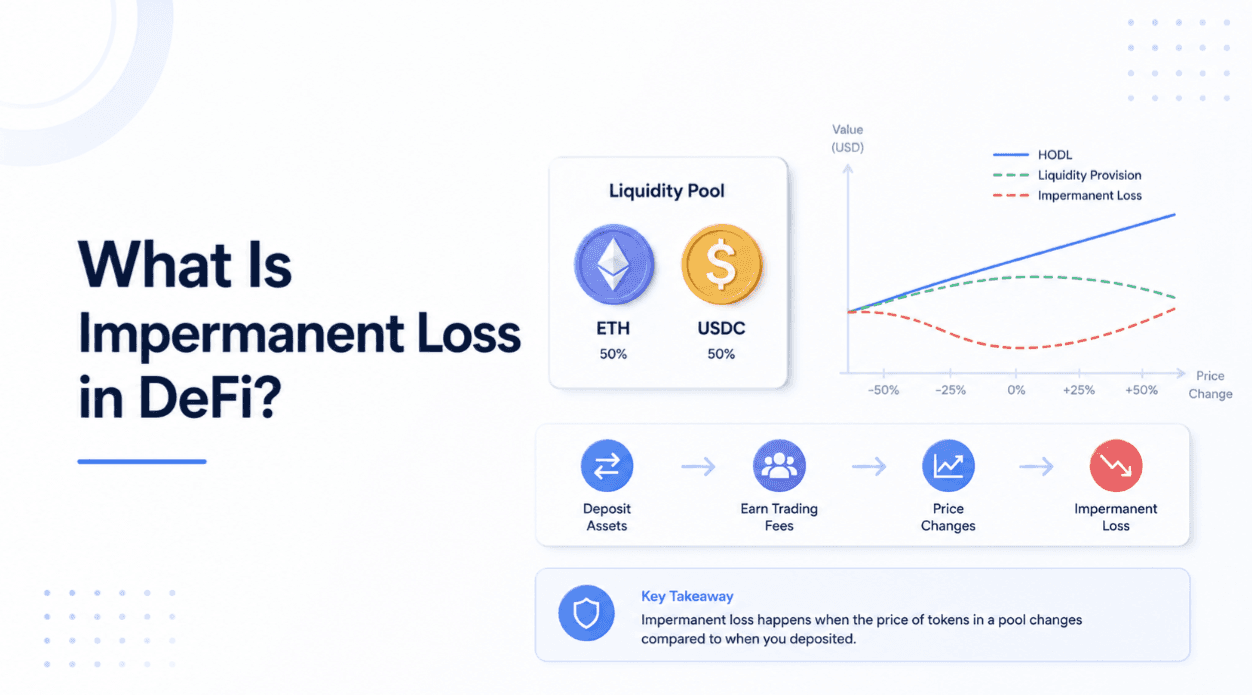
What Is Impermanent Loss in DeFi?
Impermanent loss quietly erodes the value of liquidity positions when token prices move. Here is why it happens, how big it gets, and when fees offset it.
Maria Fernandez · May 9, 2026→
How Do Decentralized Exchanges (DEXs) Work?
Decentralized exchanges let you trade tokens straight from your wallet, with no broker holding your funds. Here is how AMMs and liquidity pools price every swap.
Maria Fernandez · June 3, 2026→