What Is Impermanent Loss in DeFi?
DeFi Protocols & RWA On-Chain AnalystDeFi Protocols & RWA On-Chain Analyst · May 9, 2026 · 9 min read
Published May 9, 2026 · Reviewed to our editorial standards. This article is informational and not financial advice.
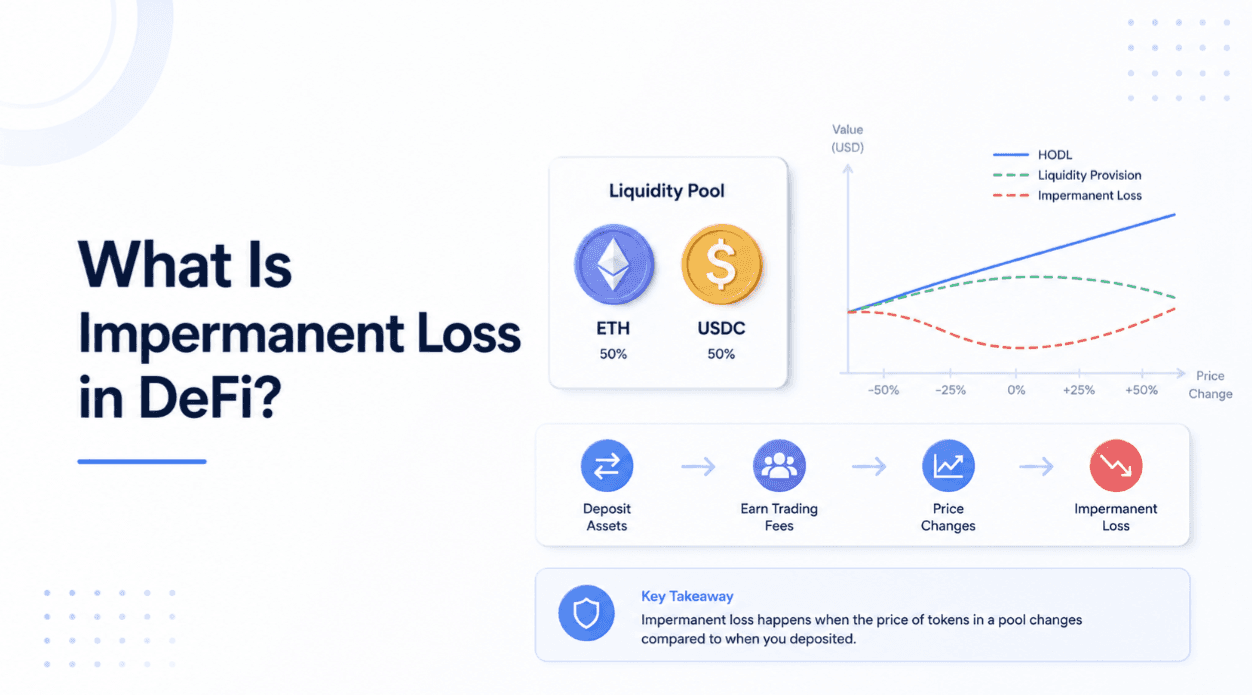
Impermanent loss is the difference in value between providing two tokens to a liquidity pool and simply holding those same tokens in your wallet. It happens because an automated market maker automatically rebalances your deposit as prices move, leaving you with more of the token that fell and less of the one that rose. The loss is called impermanent because it shrinks if prices return to where you started, and becomes permanent only when you withdraw.
Key takeaways
- Impermanent loss affects liquidity providers in AMM pools whenever the two tokens’ prices diverge.
- It measures what you gave up versus just holding the tokens, not an absolute cash loss on its own.
- The larger the price divergence, the larger the loss, and it grows in a predictable curve.
- Trading fees and rewards can offset it, but only if they outweigh the gap by withdrawal time.
- Pools of two correlated or pegged assets suffer far less impermanent loss than volatile pairs.
Why rebalancing creates the loss
An AMM keeps a pool balanced using a pricing formula, most commonly the constant product rule where the product of the two reserves stays fixed. When the market price of one token rises, arbitrage traders buy it from the pool until the pool’s price matches the market. That buying drains the rising token and adds the other one.
As a liquidity provider, you own a share of whatever the pool holds. After that arbitrage, your share contains less of the token that went up and more of the token that lagged. Had you just held the original two tokens, you would own more of the winner. The value you missed out on is the impermanent loss. The mechanism that keeps the pool tradable is exactly what creates the gap.
How big does it get?
Impermanent loss follows a known curve tied to how far the price ratio moves, not to direction. Whether one token doubles or halves relative to the other, the loss is the same size. The figures below assume a standard two-asset constant product pool and ignore fees.
- A 1.25x price change between the tokens causes roughly a 0.6% loss versus holding.
- A 1.5x change causes roughly a 2% loss.
- A 2x change causes roughly a 5.7% loss.
- A 4x change causes roughly a 20% loss.
- A 5x change causes roughly a 25% loss.
The pattern matters more than the exact numbers. Small price moves cost very little, which is why pools of pegged or tightly correlated assets are popular. Large moves, common with volatile tokens, can erase a meaningful chunk of value before fees are even considered.
Impermanent loss is not a fee you pay; it is upside you forgo. You are effectively selling winners and buying losers automatically, in exchange for collecting trading fees. — CryptoCoinBeat analysis
When fees make liquidity provision worthwhile
Providers are compensated through trading fees and sometimes extra incentive tokens. A pool is profitable when those earnings exceed the impermanent loss over your holding period. High-volume pools generate more fees, which is why a busy pair can stay profitable even with real price divergence, while a quiet pool may leave you behind on both fronts.
The practical question is whether fee income outpaces divergence. Stable, range-bound assets generate steady fees with minimal loss. Volatile, trending assets can pay generous fees but expose you to large impermanent loss if the trend runs hard in one direction. There is no single right answer; it depends on volatility, volume, and how long you stay in.
Ways to reduce impermanent loss
You cannot eliminate impermanent loss in a standard AMM, but you can manage your exposure to it.
- Choose correlated or pegged pairs, such as two stablecoins, where the price ratio barely moves.
- Favor high-volume pools where fee income has a better chance of covering divergence.
- Use weighted or concentrated-liquidity pools that can change the loss profile, accepting their own added complexity.
- Avoid pairing a stable asset with a highly volatile one during strong directional trends.
- Monitor positions and be willing to exit, since the loss only locks in when you withdraw.
A common misconception
Impermanent loss is often confused with losing money outright. You can finish a liquidity position with more dollars than you started with and still have experienced impermanent loss, because the benchmark is holding, not your entry price. The reverse is also true: a falling market can leave you down overall even if impermanent loss was small. Keep the two ideas separate when you evaluate a position.
This article is educational and not financial advice. Providing liquidity is high-risk and can result in losses from impermanent loss, smart-contract exploits, or token price declines. Nothing here recommends any pool, token, or protocol. Research independently and consider qualified professional advice before depositing funds.
Frequently asked questions
Is impermanent loss a real loss?+
It is real but relative. It measures how much less your position is worth compared with simply holding the two tokens. You can still end up with more value than you started with, yet have given up gains you would have kept by holding. It only locks in when you withdraw.
How can I avoid impermanent loss completely?+
You cannot avoid it entirely in a standard AMM pool with two diverging assets. You can minimize it by providing liquidity for pegged or strongly correlated pairs, such as two stablecoins, where prices barely separate. Concentrated-liquidity designs change the profile but add complexity and their own risks.
Do trading fees cover impermanent loss?+
Sometimes. Fees compensate liquidity providers, and in high-volume pools they can outweigh the loss. In quiet pools or during large price moves, they often do not. Whether you come out ahead depends on volume, volatility, and how long you hold the position before withdrawing.
Why is it called impermanent?+
Because the gap can shrink or disappear if the token prices return to the ratio you started with. As long as you stay in the pool and prices recover, the loss reverses. It becomes permanent only at the moment you withdraw while prices remain diverged.
Written by
Maria FernandezDeFi Protocols, Real-World Assets, On-Chain Analytics, Stablecoins, Spanish-Language Coverage
Maria Fernandez is an On-Chain Research Analyst at **CRYPTO·COINBEAT**, specializing in real-world asset (RWA) tokenization, decentralized finance, and stablecoin ecosystems. Originally from Mexico City and now based in Miami, Maria brings a unique Latin American perspective to blockchain research, combining deep technical analysis with insights into emerging digital asset markets across the Americas. Before joining **CRYPTO·COINBEAT**, Maria spent several years researching decentralized finance protocols, producing in-depth analysis on lending platforms, governance systems, and the growing adoption of tokenized real-world assets. Her early research into institutional RWA integration and decentralized collateral models helped explain one of the fastest-growing sectors within the blockchain industry. Maria's analytical approach combines on-chain transaction analysis, protocol revenue metrics, liquidity monitoring, and governance activity to evaluate the long-term health of DeFi ecosystems. She works extensively with blockchain analytics platforms, including Dune Analytics, Nansen, and Flipside Crypto, and has created numerous public dashboards that simplify complex blockchain data for investors and researchers alike. Her coverage of stablecoin market events and liquidity shifts has helped readers better understand risk during periods of heightened market volatility. She holds a B.Sc. in Industrial Engineering from ITAM (Instituto Tecnológico Autónomo de México) and a Graduate Certificate in FinTech from MIT Sloan. Passionate about blockchain education, Maria regularly contributes both English- and Spanish-language research, helping make advanced on-chain analysis more accessible to a global audience while supporting the continued growth of crypto adoption throughout Latin America.
Keep Reading
Crypto Lending and Borrowing in DeFi Explained
DeFi lending markets let anyone earn interest or borrow against crypto, governed entirely by code. Here is how collateral, rates, and liquidations actually work.
David Turner · May 2, 2026→
Yield Farming and Liquidity Mining Explained
Yield farming chases returns by moving crypto between DeFi protocols. We break down where the yield comes from, how APY can mislead, and the risks behind big numbers.
David Turner · May 23, 2026→
How Do Decentralized Exchanges (DEXs) Work?
Decentralized exchanges let you trade tokens straight from your wallet, with no broker holding your funds. Here is how AMMs and liquidity pools price every swap.
Maria Fernandez · June 3, 2026→