How to Read a Transaction Before You Sign It
By David Turner
Senior Crypto Markets Reporter at CryptoGrows. · September 5, 2026 · 8 min read
Published September 5, 2026 · Reviewed to our editorial standards. This article is informational and not financial advice.
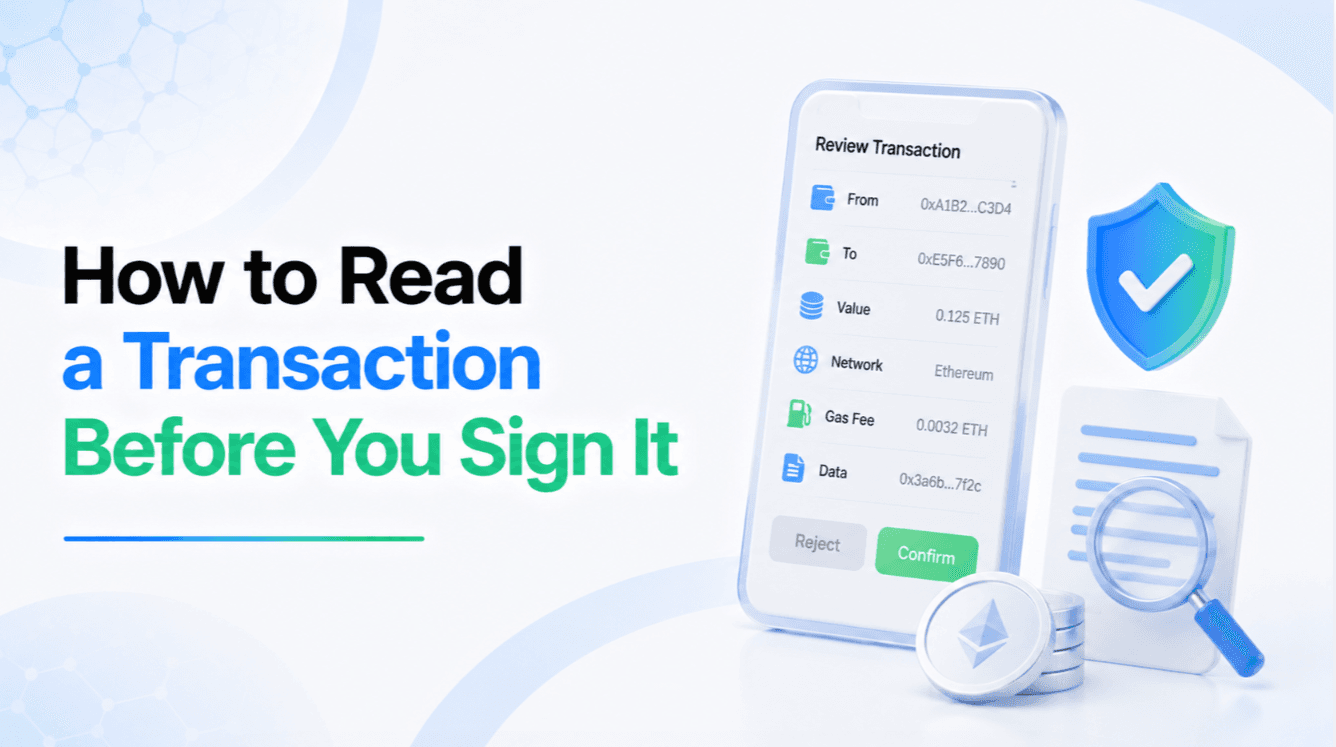
Every loss that involves a user clicking something ends at the same screen: a confirmation prompt that was approved without being understood. It is the last checkpoint, and for most people it is a formality — a dialogue to dismiss on the way to the thing they wanted to do.
Learning to read it takes about ten minutes and closes the largest remaining gap in most people's security. Here is what the fields mean and what the dangerous shapes look like.
The four questions a prompt should answer
- What am I sending, and how much — including whether the amount is capped or unlimited.
- Who receives it, or which contract gains permission over it.
- What will my balances look like afterwards, which is the only summary that matters.
- Which network is this on, because the same address on the wrong chain is a different destination.
If the interface cannot answer all four, that is not a reason to proceed carefully. It is a reason to use a different wallet, because the information exists and some wallets simply choose to show it.
Simulation is the feature that matters
The most useful development in wallets over the past few years is transaction simulation: the wallet runs the transaction against current chain state and shows the resulting balance changes before you sign. Instead of interpreting calldata, you read a plain summary — this leaves, that arrives.
A malicious transaction is usually obvious in that view even when it is opaque in the raw data, because the outcome is the thing being hidden. Wallets differ sharply here, which is why our self-custody wallet table weights signing clarity above every other axis.
What a normal transaction looks like
A simple transfer names a recipient, an amount and a fee, and nothing else. A swap shows one token leaving, another arriving, and usually a minimum received figure reflecting your slippage tolerance. A deposit into a protocol shows tokens leaving and a receipt token arriving.
In every case the shape should match what you asked for. If you clicked "swap 100 USDC for ETH" and the summary shows a different token leaving, or an approval rather than a swap, stop — the mismatch is the signal, and it does not need further interpretation.
What the dangerous ones look like
- An approval when you expected a swap, particularly for an unlimited amount.
- A signature request with no gas and no clear summary — often a gasless permit granting spending rights.
- Any prompt where the amount reads as unlimited, maximum, or an implausibly large number.
- A recipient address that does not match anything you recognise, on a transfer you initiated.
- A simulation the wallet cannot produce, which sometimes indicates the transaction is designed to behave differently when executed.
Verify on the device, not in the browser
February 2025 settled this argument. Attackers compromised a developer machine at Safe{Wallet} and served tampered JavaScript that showed Bybit's signers a routine transfer while altering the underlying transaction. Roughly $1.5bn left. The contracts were fine; the display lied.
The conclusion generalises to anyone with a hardware wallet: the screen on the device is produced by firmware the website cannot touch, and the screen in your browser is not. For anything that matters, read the device. That is the reason it has a screen, and the reason our hardware wallet table scores display quality and clear-signing support so heavily.
Addresses and networks: the two boring checks
Check the first and last four characters of a recipient address, and one group in the middle. Clipboard-hijacking malware swaps a copied address for the attacker's, and the swapped one is chosen to match at the ends, which is exactly where people look.
Then check the network. The same address exists on every EVM chain and is controlled by the same key, but tokens are chain-specific: sending a token on the wrong network usually means it is recoverable only by someone who controls that address on that chain — which may be an exchange that will not help you. Wallets that switch networks automatically for a given site remove most of this risk, which is one reason our self-custody wallet table credits it.
Batched transactions and what they hide
Some interfaces bundle several actions into one signature — approve and swap, or claim and stake. That is convenient and it means one confirmation now authorises several distinct things, only one of which you may have read.
With simulation, the bundle is still legible because you see the net effect. Without it, a batch is the easiest place to hide an extra step, and the honest advice is not to sign one from a site you have not used before.
A habit that costs fifteen seconds
Before every signature, ask what you expect to happen, then check that the summary says the same thing. Where they disagree, cancel — you can always retry, and a cancelled legitimate transaction costs nothing but a moment.
Attackers rely on the gap between intent and attention, and the gap is widest when you are rushed, tired, or excited about a mint that closes in four minutes. That is not incidental. It is the design.
If you want a single rule that survives every new attack pattern: never sign anything whose outcome you could not describe out loud to somebody else. The wording matters — not "I know what this site is", but "I know what leaves my wallet and what arrives". Everything in this article is a way of getting to that sentence before the signature rather than after it.
Frequently asked questions
What is transaction simulation in a crypto wallet?+
The wallet runs the transaction against current chain state and shows the resulting balance changes before you sign, so you read a plain outcome rather than raw calldata. It is the most effective single defence against malicious signatures.
How do I know if a transaction is a scam?+
Compare the summary against what you intended. An approval when you expected a swap, an unlimited amount, an unfamiliar recipient, or a signature request with no readable summary are all reasons to cancel rather than investigate further.
Why should I check the hardware wallet screen instead of the browser?+
Because a web interface can be tampered with. In February 2025 attackers altered the Safe{Wallet} interface to show Bybit's signers a routine transfer while changing the real transaction, taking roughly $1.5bn. The device screen is produced by firmware a website cannot reach.
What is a gasless signature request?+
A signed message rather than a transaction, often used for permit-style approvals. It costs no gas and produces no pending transaction to inspect, which makes it easier to miss — and it can grant the same spending rights.
Written by
David TurnerCryptocurrency Markets, Blockchain Technology, Tokenomics Analysis, Digital Asset Regulation, DeFi, Web3 Industry Cover
David Turner is a U.S.-based Markets Reporter at CRYPTO·COINBEAT, covering cryptocurrency markets, blockchain innovation, and the rapidly evolving digital asset ecosystem across North America. Raised in California and educated in economics and digital media, David combines strong analytical skills with years of experience reporting on financial markets and emerging technologies. He began his journalism career covering equity markets, Federal Reserve policy, and fintech developments for several financial news outlets before specializing in cryptocurrency. As blockchain technology gained mainstream adoption, David shifted his focus to Bitcoin, Ethereum, decentralized finance, and digital asset regulation. Prior to joining CRYPTO·COINBEAT, he reported extensively on crypto exchanges, institutional investment, stablecoins, and the expanding Web3 economy. At **CRYPTO·COINBEAT**, David delivers data-driven reporting designed to help readers understand the fast-moving digital asset industry. His coverage frequently explores U.S. crypto legislation, tokenomics, blockchain adoption, market sentiment, and the impact of macroeconomic events on cryptocurrency markets. He is particularly recognized for his in-depth analysis of token supply models, vesting schedules, liquidity trends, and the long-term sustainability of blockchain projects. David earned a B.A. in Economics from the University of California, Los Angeles (UCLA), and completed additional coursework in data journalism and financial analysis. He also authors the daily market briefing, **"Opening Bell Crypto,"** providing traders and investors with concise analysis of overnight market activity, key industry developments, and emerging investment trends.
Keep Reading
Ethereum Layer-2 Scaling: How Rollups Make ETH Cheaper and Faster
Rollups move execution off Ethereum’s base layer while keeping its security. Here is how optimistic and zk-rollups work and where they differ.
Maria Fernandez · May 3, 2026→
Proof of Stake and ETH Staking Explained
Ethereum secures itself with staked ETH instead of mining. Here is how validators, rewards and slashing work, and what staking really involves.
David Turner · May 16, 2026→
Ethereum Gas Fees Explained: Why Transactions Cost What They Do
Gas is how Ethereum prices computation. Here is what you are really paying for, why fees swing so hard, and how to keep them down.
David Turner · May 25, 2026→