Ledger vs Trezor: Open Firmware Against Chain Coverage
Staff · August 26, 2026 · 8 min read
Published August 26, 2026 · Reviewed to our editorial standards. This article is informational and not financial advice.
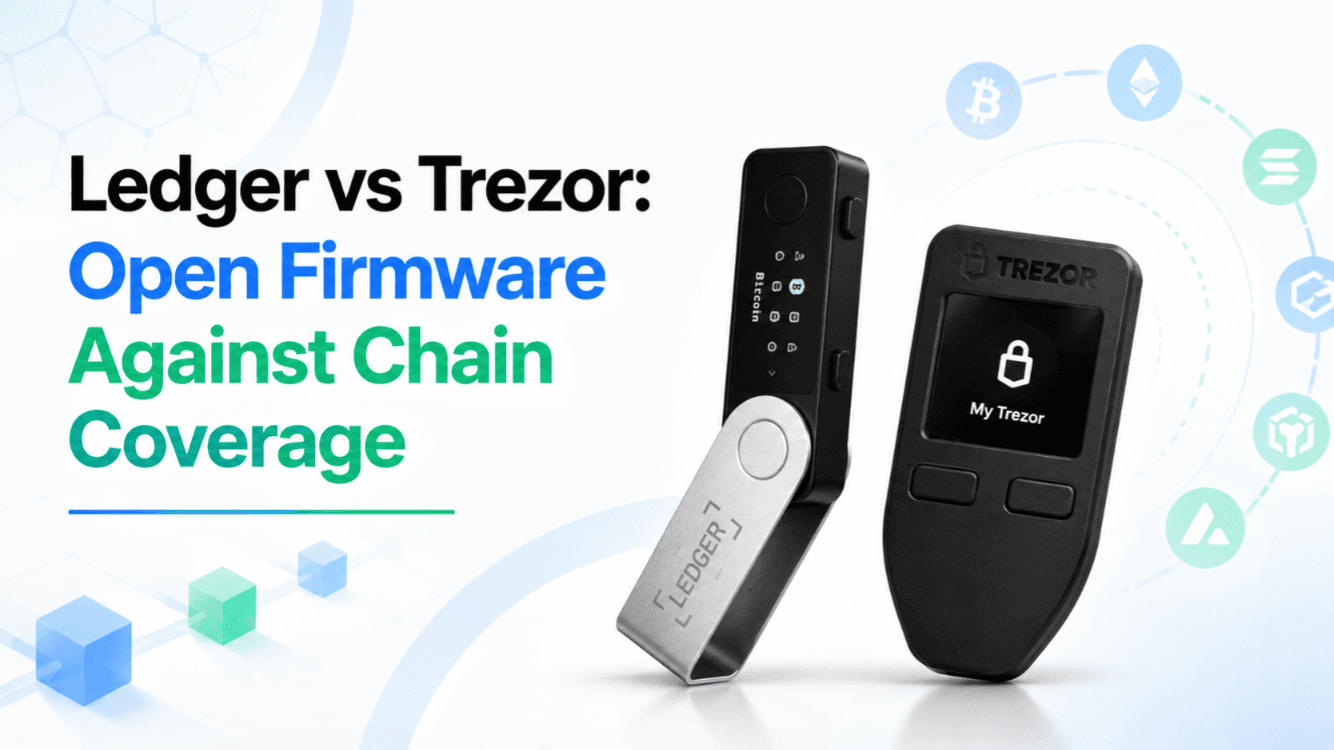
Ledger and Trezor have been the two default answers in hardware wallets for a decade, and the choice between them is not really about build quality or price. It comes down to a single question: do you need to be able to inspect the firmware that holds your keys, or do you need the device to support every chain you own?
Both scored well in our hardware wallet table — Trezor's Safe line ahead on openness, Ledger ahead on coverage. Here is what actually separates them.
The firmware question
Trezor publishes its firmware under an open licence with reproducible builds, meaning a third party can verify that the code running on the device matches the published source. Ledger's firmware is closed; only parts of the surrounding stack are published, and builds cannot be independently reproduced.
That distinction was abstract until May 2023, when Ledger announced Ledger Recover, an opt-in service that splits an encrypted recovery phrase into shards held by third parties. The backlash was not about the service so much as what its existence demonstrated: the firmware could be built to export key material, which many owners had assumed was architecturally impossible. Ledger delayed the release and committed to publishing more code. Nothing about the hardware changed that week; what changed was public understanding of what a closed system can be asked to do.
If you weight verifiability, that episode settles the argument. If you weight the practical security record, note that no extraction of a seed from a current Ledger device has been published, and its certified secure element has a strong physical-attack history.
Physical attacks: Trezor's older weakness
Trezor's earlier models did not contain a secure element, and published research demonstrated that an attacker holding the device could extract the seed. That is a real finding and it is why the Safe line exists: it pairs a certified secure element with the same open firmware, closing the gap without giving up auditability.
The practical implication is specific rather than general. If you own an older Trezor, your device is vulnerable to someone who physically holds it — worth upgrading, and worth using a passphrase in the meantime. If you are buying a Safe model today, the weakness does not apply.
Coverage, and who it matters to
Ledger supports more chains and applications than any competitor, with mature clear-signing on major protocols and the most polished companion app in the category. If your holdings span a dozen ecosystems, it may be the only device that covers all of them from one seed.
Trezor supports fewer chains by a wide margin. For a holder whose portfolio is Bitcoin, Ethereum and a handful of major assets, that gap is theoretical. For someone active across newer networks, it is the deciding factor — and no amount of firmware transparency helps with a chain the device cannot sign for.
Screens, and what you can actually read
Trezor's Safe 5 has a colour touchscreen that decodes transaction details clearly, which matters more than the specification sheet suggests: the loss that actually happens is a user approving something they did not understand. Ledger's smaller display is workable and clear-signing support on major protocols is good, but complex contract interactions are harder to read on it.
The 2020 breach still shapes the experience
A leak of Ledger's e-commerce and marketing database exposed customer contact details, including postal addresses. Years of targeted phishing followed, including counterfeit devices posted to real customers. Nothing about the wallet's cryptography was affected — but if you own a Ledger, treat every unsolicited message and package concerning it as hostile.
Recovery: standard words against optional shards
Both devices use standard BIP-39 recovery phrases, so a wallet created on either can be restored on the other, or on any compatible device. That interoperability is worth stating plainly, because it means neither purchase locks you in: the backup outlives the brand.
Trezor's Safe models add SLIP-39, which splits the backup into shares where a defined subset restores the wallet — genuinely useful if you want geographic redundancy without a single card that grants everything. Ledger's answer is the paid Recover service, where an encrypted seed is sharded among third parties who can return it after identity checks. One approach keeps the problem in your hands; the other outsources it to companies. Which you prefer is the same question as the firmware one, in different clothing.
Price, and what the money buys
Both sit in the same broad price band, with entry models cheaper than flagship ones. What the extra money buys, in both ranges, is screen quality and connectivity rather than stronger key protection: the secure element in a cheaper model of the same generation is typically the same part. If budget is the binding constraint, a current entry-level model from either vendor protects keys as well as its flagship sibling — you simply read transactions on a smaller screen.
That matters more than it sounds, because reading the transaction is the job. Between a flagship you leave in a drawer because it is precious and an entry model you actually use to verify every signature, the second is the safer purchase.
Which one to buy
- Choose Trezor Safe if you want firmware you or anyone else can audit, hold mainly major assets, and value a screen that makes signing legible. See the Trezor Safe 5 review.
- Choose Ledger if your portfolio spans many ecosystems and you accept a closed firmware model in exchange for coverage no rival matches. See the Ledger Nano X review.
- Consider neither if you are a Bitcoin-only holder who wants air-gapped signing — that is a different shortlist entirely, covered in our hardware wallet table.
Whichever you pick, the setup decides more than the brand does. Generate the seed on the device, back it up on metal, test the recovery before funding it, and read the screen every time you sign. Our hardware wallet setup guide walks through the sequence.
Frequently asked questions
Is Trezor safer than Ledger?+
On verifiability, yes: Trezor's firmware is open with reproducible builds, so the code can be independently checked, while Ledger's is closed. On physical-attack resistance, current models from both are strong — though older Trezors without a secure element were shown by researchers to be extractable.
What was the Ledger Recover controversy?+
In May 2023 Ledger announced an opt-in service that splits an encrypted seed into shards held by third parties. The concern was what it revealed: the closed firmware can be built to export key material, which owners had assumed was impossible. Ledger delayed the rollout after the backlash.
Which supports more coins, Ledger or Trezor?+
Ledger, by a wide margin — it has the broadest chain and application support of any hardware wallet. Trezor covers Bitcoin, Ethereum and major assets well but supports far fewer networks.
Should I replace an older Trezor?+
If it predates the Safe line and therefore has no secure element, yes — published research showed a seed can be extracted by someone who physically holds it. Until you upgrade, a passphrase materially reduces that risk.
Written by
CryptoCoinBeatKeep Reading
Bitcoin ETFs Explained: How Spot Bitcoin ETFs Work
Spot Bitcoin ETFs let investors hold bitcoin exposure in a brokerage account. Here is how they work and how they differ from owning coins.
Maria Fernandez · May 3, 2026→
How to Store Bitcoin Safely: Wallets and Best Practices
Storing bitcoin safely comes down to protecting your private keys. Here is how wallet types compare and the habits that keep funds secure.
David Turner · May 17, 2026→

Bitcoin Halving Explained: What It Is and Why It Matters
Every four years Bitcoin cuts its issuance rate in half. Here is how the halving works, what history shows, and why it shapes supply.
Maria Fernandez · May 28, 2026→