Liquid Staking Tokens: Why They Discount and How Exits Work
By David Turner
Senior Crypto Markets Reporter at CryptoCoinBeat. · October 29, 2026 · 10 min read
Published October 29, 2026 · Reviewed to our editorial standards. This article is informational and not financial advice.
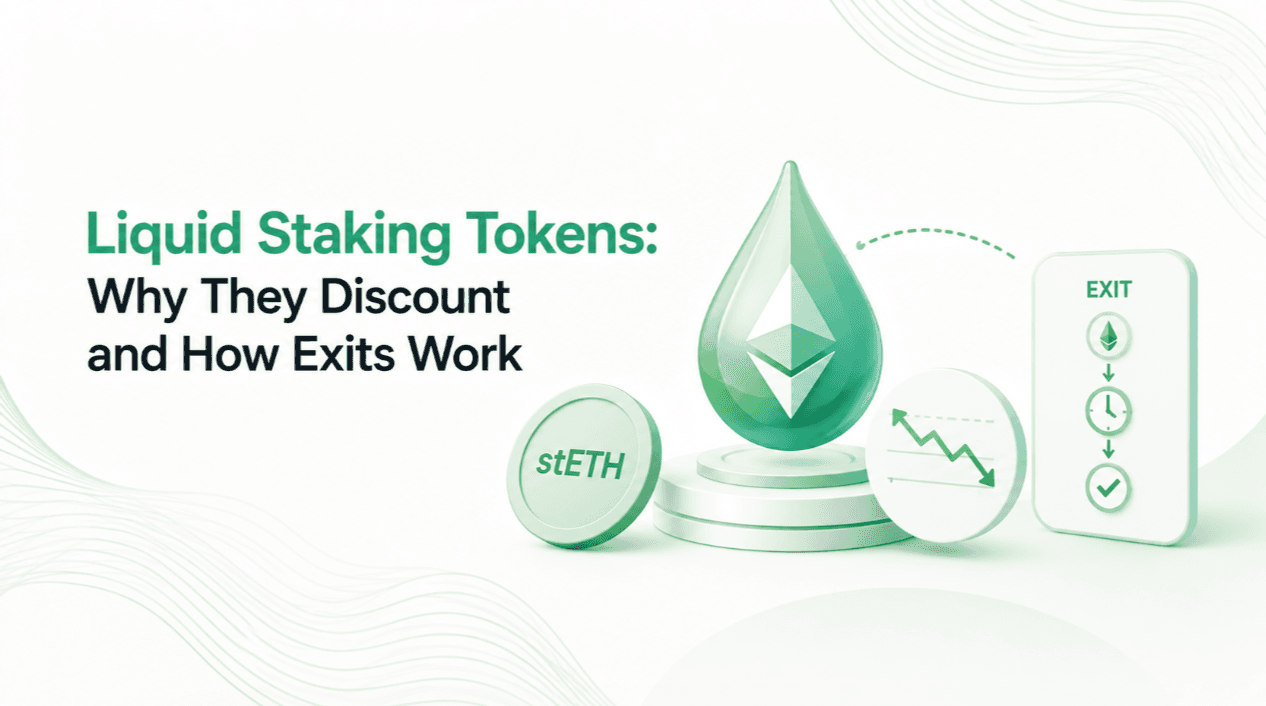
In June 2022, stETH traded several per cent below ether and much of the market read it as a depeg. It was not one. The token was fully backed the entire time, the staking was working, and nothing about the protocol had failed.
What had happened was simpler and more instructive: the token represented ether that could not yet be withdrawn, holders wanted out immediately, and the only available exit was selling to someone else. The discount was the price of immediacy.
Why the discount exists at all
A liquid staking token is a claim on staked capital. Staked capital has an exit process — a queue, a delay, sometimes several layers of them. The token trades continuously; the underlying claim settles slowly. Any gap between those two speeds shows up as a price.
In calm conditions the gap is negligible, because arbitrageurs will happily buy the token slightly below par, redeem, and pocket the difference. That trade keeps the price honest. When the queue lengthens or redemption is unavailable, the trade stops working and the price is set by whoever is willing to wait.
What actually happened in 2022
Ethereum's withdrawals did not exist yet. Anyone who had staked was locked in with no protocol-level exit at all, indefinitely, until an upgrade that had not yet shipped. The only way out of the position was the secondary market.
Then leveraged holders started unwinding. Large funds and lenders held stETH against borrowed money, and as the market fell they had to sell into a book that had never been tested for that kind of volume. The discount widened to several per cent, which forced more liquidations, which widened it further.
It closed the following year, when the Shapella upgrade enabled withdrawals and the arbitrage trade became possible again. Anyone who bought the discount and waited was paid for their patience — which is what a liquidity discount, as distinct from a solvency problem, always offers.
What changed and what did not
What changed: redemption exists. Every major liquid staking protocol now supports protocol-level withdrawals, so the token has a floor mechanism it lacked in 2022. A sustained deep discount would now be arbitraged away as fast as the queue permits.
What did not change: the queue is still a queue. Exiting a validator means waiting behind everyone else who is exiting, and that wait lengthens precisely when many people want out at once. The market exit remains the fast exit, and the discount remains its price.
So the shape of the risk has changed from open-ended to bounded. Instead of 'no exit until an upgrade ships', it is 'exit in days to weeks, or now at a discount'. Materially better, not eliminated.
Restaking tokens discount harder
Liquid restaking tokens sit on top of the same construction with another layer added. Exiting can require leaving the restaking layer before the staking layer, each with its own delay, which lengthens the total unwinding time.
Longer exits mean bigger discounts under stress, and thinner markets mean the discount arrives on smaller volume. Add a bridge — as the April 2026 Kelp incident did, when $292m of unbacked rsETH was minted through a cross-chain adapter — and the discount can reflect an actual backing problem rather than a timing one.
That is the distinction to hold onto. A liquidity discount closes when the queue clears. A backing discount does not close at all, because the claim is genuinely worth less than it says.
How to tell which one you are looking at
- Check the protocol's published exit queue: is it long, or is redemption impaired?
- Check the collateralisation directly on-chain — does the staked balance still cover the supply?
- Check whether the discount is on all venues or one, since a single thin book can misprice independently.
- Check whether withdrawals are being processed at all, which separates a delay from a halt.
- Read the protocol's own incident channel before reading anyone's interpretation of it.
Five minutes of checking distinguishes a buying opportunity from a falling knife, and the two look identical on a chart.
What this means for using LSTs as collateral
This is where discounts do the most damage. A position collateralised by a staking token is liquidated on that token's market price, not on the value of the ether behind it — so a liquidity discount can liquidate a position that was never actually under-collateralised.
Worse, the liquidation sells the token into the same thin market that produced the discount, deepening it and triggering the next liquidation. That loop is what turned a few per cent of discount into a cascade in 2022, and the mechanism has not gone anywhere.
If you borrow against a staking token, size the position for the discount rather than for the peg. A loan-to-value that survives a ten per cent discount is a different loan from one that assumes parity, and the difference costs nothing until the day it is everything.
The practical position
Hold liquid staking tokens for the staking yield and the composability, understand that the exit has two speeds, and never borrow as though the fast one is free. Prefer tokens with deep markets if you might need the fast exit — Lido vs Rocket Pool covers exactly that gap.
Our liquid staking table scores each protocol on withdrawal design, published queue length and what the token actually traded at during past stress, because those three facts are the whole of this risk.
Frequently asked questions
Why did stETH trade below ETH in 2022?+
Ethereum withdrawals did not exist yet, so staked ether had no protocol exit. Holders who wanted out had to sell, and leveraged unwinding pushed the discount to several per cent. It closed once withdrawals shipped in 2023.
Is a liquid staking token discount the same as a depeg?+
Usually not. A liquidity discount means the claim is fully backed but slow to redeem, and it closes as the queue clears. A backing discount means the claim is genuinely worth less, and it does not close.
Can stETH depeg again?+
It can discount again under heavy exit demand, since the withdrawal queue still lengthens under stress. A sustained deep discount is much less likely now that redemption exists and arbitrage can work.
Is it risky to borrow against liquid staking tokens?+
Yes, because liquidation uses the token's market price. A liquidity discount can liquidate a position that was never under-collateralised, and the forced selling deepens the discount further.
Written by
David TurnerCryptocurrency Markets, Blockchain Technology, Tokenomics Analysis, Digital Asset Regulation, DeFi, Web3 Industry Cover
David Turner is a U.S.-based Markets Reporter at CRYPTO·COINBEAT, covering cryptocurrency markets, blockchain innovation, and the rapidly evolving digital asset ecosystem across North America. Raised in California and educated in economics and digital media, David combines strong analytical skills with years of experience reporting on financial markets and emerging technologies. He began his journalism career covering equity markets, Federal Reserve policy, and fintech developments for several financial news outlets before specializing in cryptocurrency. As blockchain technology gained mainstream adoption, David shifted his focus to Bitcoin, Ethereum, decentralized finance, and digital asset regulation. Prior to joining CRYPTO·COINBEAT, he reported extensively on crypto exchanges, institutional investment, stablecoins, and the expanding Web3 economy. At **CRYPTO·COINBEAT**, David delivers data-driven reporting designed to help readers understand the fast-moving digital asset industry. His coverage frequently explores U.S. crypto legislation, tokenomics, blockchain adoption, market sentiment, and the impact of macroeconomic events on cryptocurrency markets. He is particularly recognized for his in-depth analysis of token supply models, vesting schedules, liquidity trends, and the long-term sustainability of blockchain projects. David earned a B.A. in Economics from the University of California, Los Angeles (UCLA), and completed additional coursework in data journalism and financial analysis. He also authors the daily market briefing, **"Opening Bell Crypto,"** providing traders and investors with concise analysis of overnight market activity, key industry developments, and emerging investment trends.
Keep Reading
Ethereum Layer-2 Scaling: How Rollups Make ETH Cheaper and Faster
Rollups move execution off Ethereum’s base layer while keeping its security. Here is how optimistic and zk-rollups work and where they differ.
Maria Fernandez · May 3, 2026→
Proof of Stake and ETH Staking Explained
Ethereum secures itself with staked ETH instead of mining. Here is how validators, rewards and slashing work, and what staking really involves.
David Turner · May 16, 2026→
Ethereum Gas Fees Explained: Why Transactions Cost What They Do
Gas is how Ethereum prices computation. Here is what you are really paying for, why fees swing so hard, and how to keep them down.
David Turner · May 25, 2026→