MetaMask vs Rabby: Which Wallet Shows You More
By David Turner
Senior Crypto Markets Reporter at CryptoGrows. · September 7, 2026 · 8 min read
Published September 7, 2026 · Reviewed to our editorial standards. This article is informational and not financial advice.
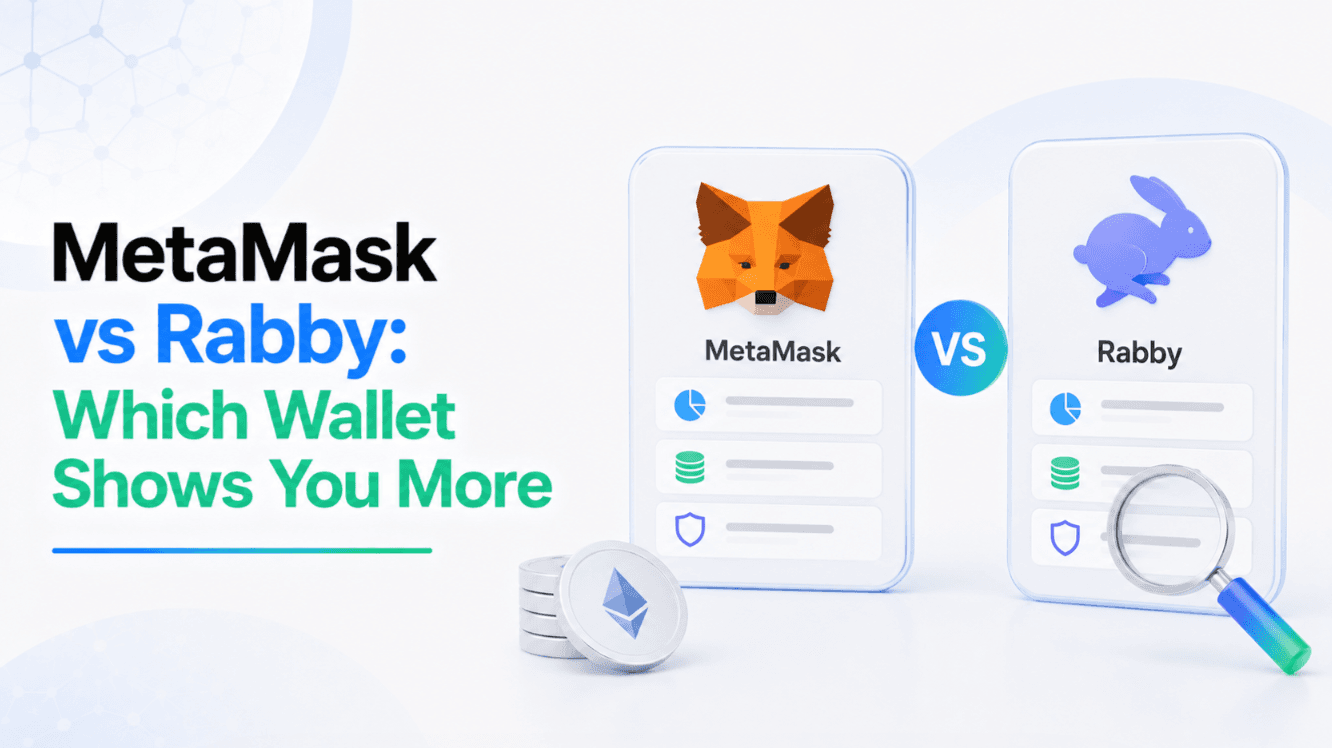
Comparisons between EVM wallets usually devolve into feature lists, which obscures the only difference that decides outcomes. Wallets do not lose funds because their cryptography is weak — they lose funds because a user approved something they did not understand. The question is therefore simple: which wallet makes the consequences of a signature obvious before you commit to it?
On that measure Rabby leads, and it leads by enough that our self-custody wallet table places it first. But MetaMask holds a position no rival can take by improving software, and that matters too.
Simulation: the feature that separates them
Rabby simulates every transaction against current chain state and shows the resulting balance changes and permission grants before you sign. Not calldata, not a contract name — a plain summary of what leaves your wallet and what arrives. A hostile transaction is usually obvious in that view even when the raw data is unreadable, because the outcome is exactly what an attacker is trying to hide.
MetaMask now shows previews with simulation on supported networks and flags some malicious contracts, which is a genuine improvement on where it was two years ago. It remains less thorough, less consistent across chains, and less prominent in the flow. Where Rabby treats explaining the transaction as the product, MetaMask treats it as a safety feature layered onto a confirmation dialogue.
Approvals and network handling
Both let you edit an unlimited approval down before signing — a capability most users never discover in either. Rabby surfaces permission grants as a named outcome in the summary; MetaMask surfaces the editable field but leaves the interpretation to you. Given that most drained wallets are drained through token approvals, that difference in framing is worth more than it sounds.
Rabby also switches networks automatically to match the site you are on, which removes a small but real category of mistake: signing on the wrong chain, or hunting through a network menu and picking a lookalike RPC.
Where MetaMask wins
Compatibility, and it is not close. Every EVM application is built and tested against MetaMask, so when a connection fails somewhere unusual, opening MetaMask is the reliable fix. Its Snaps architecture also extends it beyond EVM chains, which no competitor matches, and its hardware-wallet support is mature.
That is a real argument for keeping it installed even if you sign elsewhere. Compatibility is not a design achievement — it is an ecosystem position — and it cannot be replicated by writing better software.
The cost nobody reads
MetaMask's in-app swap carries a disclosed wallet fee on top of the routing spread. It is convenient and, on a large trade, materially more expensive than routing through an aggregator yourself. Rabby does not push its own swap in the same way and generally quotes closer to the underlying route.
For occasional small swaps this is noise. For anyone trading regularly it is the difference between paying for convenience once and paying for it every time — worth a minute's comparison before accepting an in-wallet quote.
Openness
Rabby's client is published under an open licence. MetaMask's core is open with proprietary components elsewhere in the product. For a piece of software that sees every site you visit and every transaction you sign, that distinction is not academic: an open client can be reviewed by people with no commercial interest in what it does.
Hardware wallets and the pairing question
Both connect to hardware devices, and this is where the comparison stops being about software. A hardware wallet plus either extension is a materially different security posture from either extension alone, because the key never sits in the browser and the transaction is displayed by firmware no website can reach.
The practical nuance is that simulation and device display solve different halves of the same problem. The extension tells you what the transaction will do in readable language; the device confirms that what you approve is what actually gets signed. Rabby's summary plus a hardware screen is the strongest ordinary configuration available, and it costs nothing beyond the device you should already own for savings.
Migrating between them
There is no migration, which surprises people. Both derive addresses from a standard BIP-39 recovery phrase, so importing the same phrase into the second wallet reproduces the same addresses and balances — nothing moves on-chain, no transaction is needed, and nothing is at risk in the process beyond entering a phrase on a machine you trust.
The safer route, if the phrase currently lives in a browser extension, is to connect a hardware wallet to the new client rather than typing the phrase again. A phrase that has only ever existed inside a device is worth keeping that way.
Which to use
- Sign with Rabby for day-to-day EVM activity, and connect a hardware wallet to it for anything meaningful. See the Rabby review.
- Keep MetaMask installed for the applications that assume it, and for non-EVM chains via Snaps. See the MetaMask review.
- Compare swap quotes against an aggregator before accepting an in-wallet rate in either.
- Keep long-term holdings in an address neither wallet has ever connected to a site with, as described in our crypto security guide.
One caveat on running both: keep them pointed at different jobs rather than the same wallet in two places. Import the phrase once, into whichever client you will sign with, and connect the other by hardware or leave it empty for connection testing. Two extensions holding the same hot key doubles the software that can be compromised without doubling anything useful.
Running both is not a compromise; it is the sensible configuration. They cost nothing, they use the same recovery phrase standard, and the second one exists to solve the problem the first cannot.
Frequently asked questions
Is Rabby safer than MetaMask?+
On signing clarity, yes: Rabby simulates every transaction and shows resulting balance changes and permission grants by default, where MetaMask's previews are less thorough and less consistent. Both are non-custodial and both support hardware wallets.
Can I use the same seed phrase in both wallets?+
Yes. Both use standard BIP-39 recovery phrases and derive the same addresses, so the same wallet can be opened in either — which is what makes running both practical.
Does Rabby support Bitcoin or Solana?+
No, it is EVM-only. If you hold assets on other chains you will need a second wallet alongside it, which is one reason many people keep MetaMask and its Snaps installed.
Why are in-wallet swaps more expensive?+
Because the wallet adds its own fee on top of the routing spread. MetaMask discloses this. On small trades it is negligible; on larger ones, comparing against an aggregator quote is worth the extra minute.
Written by
David TurnerCryptocurrency Markets, Blockchain Technology, Tokenomics Analysis, Digital Asset Regulation, DeFi, Web3 Industry Cover
David Turner is a U.S.-based Markets Reporter at CRYPTO·COINBEAT, covering cryptocurrency markets, blockchain innovation, and the rapidly evolving digital asset ecosystem across North America. Raised in California and educated in economics and digital media, David combines strong analytical skills with years of experience reporting on financial markets and emerging technologies. He began his journalism career covering equity markets, Federal Reserve policy, and fintech developments for several financial news outlets before specializing in cryptocurrency. As blockchain technology gained mainstream adoption, David shifted his focus to Bitcoin, Ethereum, decentralized finance, and digital asset regulation. Prior to joining CRYPTO·COINBEAT, he reported extensively on crypto exchanges, institutional investment, stablecoins, and the expanding Web3 economy. At **CRYPTO·COINBEAT**, David delivers data-driven reporting designed to help readers understand the fast-moving digital asset industry. His coverage frequently explores U.S. crypto legislation, tokenomics, blockchain adoption, market sentiment, and the impact of macroeconomic events on cryptocurrency markets. He is particularly recognized for his in-depth analysis of token supply models, vesting schedules, liquidity trends, and the long-term sustainability of blockchain projects. David earned a B.A. in Economics from the University of California, Los Angeles (UCLA), and completed additional coursework in data journalism and financial analysis. He also authors the daily market briefing, **"Opening Bell Crypto,"** providing traders and investors with concise analysis of overnight market activity, key industry developments, and emerging investment trends.
Keep Reading
Ethereum Layer-2 Scaling: How Rollups Make ETH Cheaper and Faster
Rollups move execution off Ethereum’s base layer while keeping its security. Here is how optimistic and zk-rollups work and where they differ.
Maria Fernandez · May 3, 2026→
Proof of Stake and ETH Staking Explained
Ethereum secures itself with staked ETH instead of mining. Here is how validators, rewards and slashing work, and what staking really involves.
David Turner · May 16, 2026→
Ethereum Gas Fees Explained: Why Transactions Cost What They Do
Gas is how Ethereum prices computation. Here is what you are really paying for, why fees swing so hard, and how to keep them down.
David Turner · May 25, 2026→