TVL Explained: What It Measures and How It Misleads
By David Turner
Senior Crypto Markets Reporter at CryptoCoinBeat. · November 12, 2026 · 9 min read
Published November 12, 2026 · Reviewed to our editorial standards. This article is informational and not financial advice.
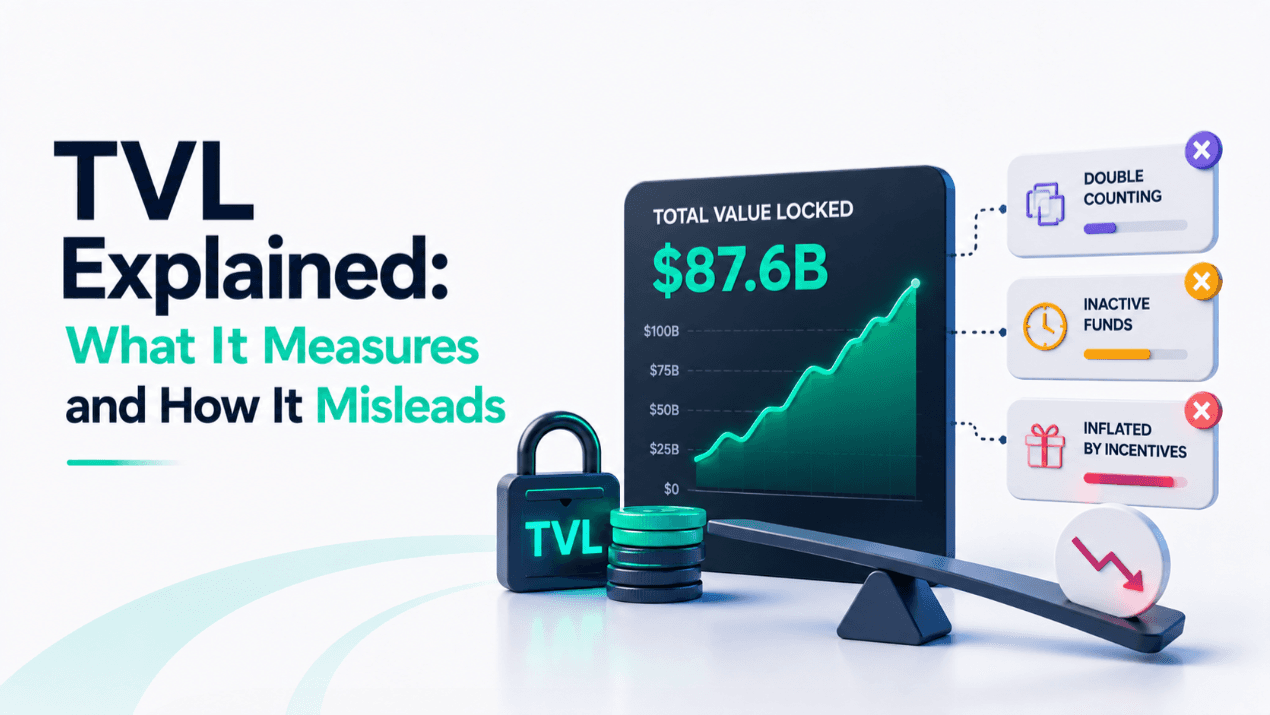
Total value locked is the number every DeFi protocol leads with: the dollar value of assets held in its contracts. It is easy to compute, easy to compare and easy to misread, which is why it became the sector's default measure of success.
It does measure something real. It just measures fewer things than people think.
What it actually is
The sum of assets sitting in a protocol's contracts, priced at current market rates. Deposits in a lending pool, liquidity in a trading pool, collateral backing a stablecoin, capital staked with a protocol — all of it counted at spot value.
The immediate consequence is that TVL moves with prices. A protocol whose deposits do not change at all sees its TVL rise 40% in a bull market and fall 40% in a crash. Growth charts that look like adoption are often just the price of ether.
The four ways it double-counts
Liquid staking. Deposit ether into a staking protocol and receive a token; the ether counts once at the staking protocol. Deposit that token into a lending market and it counts again there. One underlying asset, two entries in the sector total.
Restaking. The same capital secures the base chain, then a restaking layer, then possibly a liquid restaking wrapper, then a lending market. One deposit, four counts, and the sector's aggregate figure grows without a single new dollar arriving.
Recursive lending. Deposit collateral, borrow against it, deposit the borrowings, repeat. Each cycle adds to TVL while adding leverage rather than capital, and it unwinds violently in exactly the conditions where the reported figure is being cited as evidence of strength.
Bridged assets. A token bridged to another chain is counted on the destination while the original remains locked on the source. Both appear in totals.
What TVL does not tell you
Whether the protocol earns anything. Capital parked to farm incentives generates TVL and no revenue, and leaves the moment the incentives stop. Revenue and fee figures answer this and TVL does not.
Whether the deposits are sticky. Mercenary capital and long-term deposits look identical in the number. The distinction only shows up when emissions end.
Whether the protocol is safe. TVL is a measure of what an attacker could take, not of how well it is defended — arguably it is a measure of the size of the target.
When it is genuinely useful
As a liquidity proxy: a lending market with deep TVL can absorb a large deposit or withdrawal without moving rates dramatically, and a trading pool with deep TVL gives better execution. That is a real property and TVL measures it directly.
As a change signal: a sharp fall tells you something happened — an exploit, a delisting, an incentive ending. Aave's TVL dropping by about $6.6bn in the days after the April 2026 rsETH incident was a genuine signal about a genuine event.
And as a rough sanity check on a young protocol. A brand-new contract holding a very large sum is worth a second look, not because it is wrong, but because the incentive to attack it scales with the number.
What to read alongside it
- Protocol revenue and fees, which separate parked capital from used capital.
- TVL denominated in the underlying asset rather than dollars, which strips out price movement.
- Utilisation, for lending markets — the share of deposits actually borrowed.
- The share of yield made up of token emissions rather than income.
- Unique depositors, which distinguishes broad participation from a handful of whales.
Aggregators publish most of these alongside TVL, and the better ones now offer double-counting adjustments for staking and restaking specifically. Use those settings — the raw figure is the marketing figure.
TVL for different protocol types
The number means different things by category, which comparisons across categories quietly ignore. For a lending market, TVL is deposits available to borrow — a direct measure of capacity. For a trading pool, it is the depth backing quoted prices, which maps to slippage.
For a liquid staking protocol, it is simply how much has been staked, which is closer to market share than to anything financial. For a yield aggregator, it is capital that may be deployed anywhere, so the figure tells you nothing about what risk it is actually taking.
Ranking protocols across those categories on one number therefore compares things that are not alike. A staking protocol will always dwarf a trading venue that generates far more revenue, and the ranking says nothing about which is the better business.
Who computes it, and why the figures differ
Two aggregators can report meaningfully different TVL for the same protocol, because they make different decisions about what to include: bridged assets, staked governance tokens, positions on secondary chains, and whether to net out double counting.
None of that is dishonest — the methodology is usually published — but it means a figure quoted without a source is not a fact so much as a choice. If a number matters to your decision, check which methodology produced it and whether the same one was used for the comparison.
How to use it honestly
Read TVL as one input about depth, denominated in the underlying asset, adjusted for double counting, and read next to revenue. Read it as a change detector when it moves sharply. Do not read it as a measure of quality, safety or adoption, because it is not built to be one.
Our ratings tables score protocols on exploit history, disclosure and behaviour under stress rather than on size, which is why the largest protocol does not automatically top a table — see lending and best DeFi protocols for how that plays out in practice.
Frequently asked questions
What does TVL mean in crypto?+
Total value locked: the dollar value of assets held in a protocol's smart contracts at current market prices. It measures depth, not revenue, safety or adoption.
Why is TVL misleading?+
It moves with token prices, and the same underlying asset can be counted several times through liquid staking, restaking, recursive borrowing and bridging.
Is high TVL good?+
It indicates depth, which is genuinely useful for lending and trading. It also indicates the size of the prize for an attacker, and says nothing about whether the protocol earns anything.
What should I look at instead of TVL?+
Protocol revenue, TVL denominated in the underlying asset, utilisation, the share of yield that is emissions rather than income, and the number of unique depositors.
Written by
David TurnerCryptocurrency Markets, Blockchain Technology, Tokenomics Analysis, Digital Asset Regulation, DeFi, Web3 Industry Cover
David Turner is a U.S.-based Markets Reporter at CRYPTO·COINBEAT, covering cryptocurrency markets, blockchain innovation, and the rapidly evolving digital asset ecosystem across North America. Raised in California and educated in economics and digital media, David combines strong analytical skills with years of experience reporting on financial markets and emerging technologies. He began his journalism career covering equity markets, Federal Reserve policy, and fintech developments for several financial news outlets before specializing in cryptocurrency. As blockchain technology gained mainstream adoption, David shifted his focus to Bitcoin, Ethereum, decentralized finance, and digital asset regulation. Prior to joining CRYPTO·COINBEAT, he reported extensively on crypto exchanges, institutional investment, stablecoins, and the expanding Web3 economy. At **CRYPTO·COINBEAT**, David delivers data-driven reporting designed to help readers understand the fast-moving digital asset industry. His coverage frequently explores U.S. crypto legislation, tokenomics, blockchain adoption, market sentiment, and the impact of macroeconomic events on cryptocurrency markets. He is particularly recognized for his in-depth analysis of token supply models, vesting schedules, liquidity trends, and the long-term sustainability of blockchain projects. David earned a B.A. in Economics from the University of California, Los Angeles (UCLA), and completed additional coursework in data journalism and financial analysis. He also authors the daily market briefing, **"Opening Bell Crypto,"** providing traders and investors with concise analysis of overnight market activity, key industry developments, and emerging investment trends.
Keep Reading
Crypto Lending and Borrowing in DeFi Explained
DeFi lending markets let anyone earn interest or borrow against crypto, governed entirely by code. Here is how collateral, rates, and liquidations actually work.
David Turner · May 2, 2026→
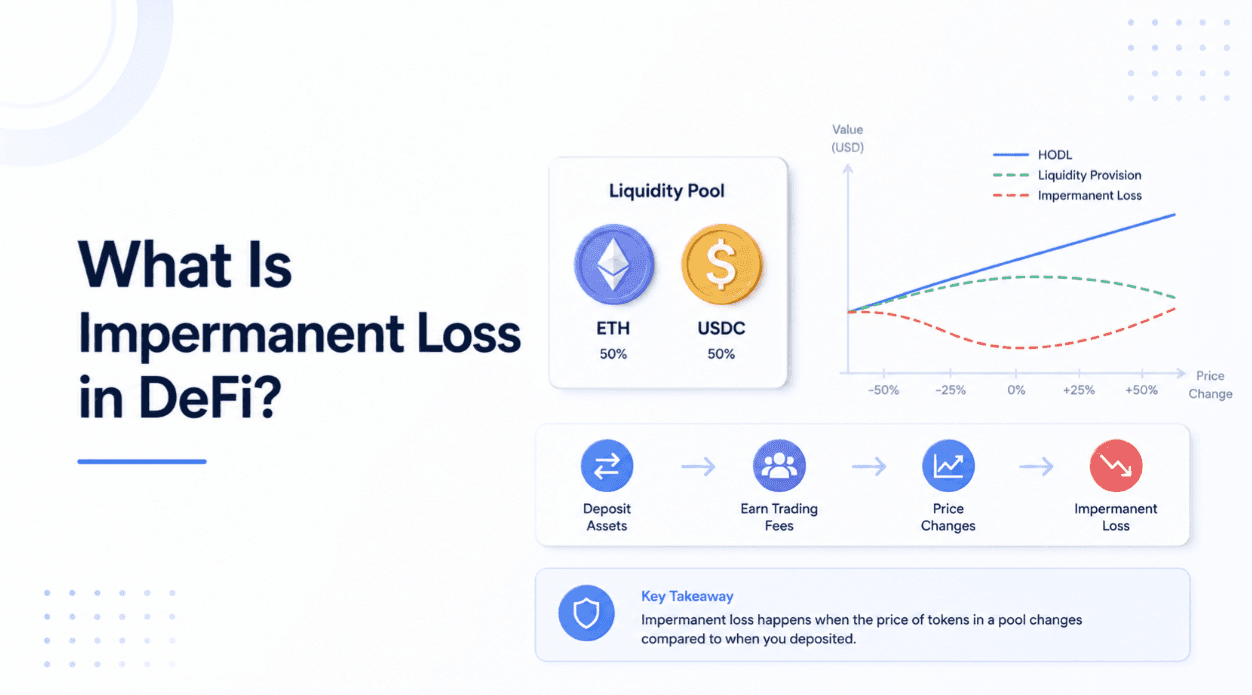
What Is Impermanent Loss in DeFi?
Impermanent loss quietly erodes the value of liquidity positions when token prices move. Here is why it happens, how big it gets, and when fees offset it.
Maria Fernandez · May 9, 2026→

Yield Farming and Liquidity Mining Explained
Yield farming chases returns by moving crypto between DeFi protocols. We break down where the yield comes from, how APY can mislead, and the risks behind big numbers.
David Turner · May 23, 2026→