How Ethereum Upgrades Change Scalability
DeFi Protocols & RWA On-Chain Analyst · June 14, 2026
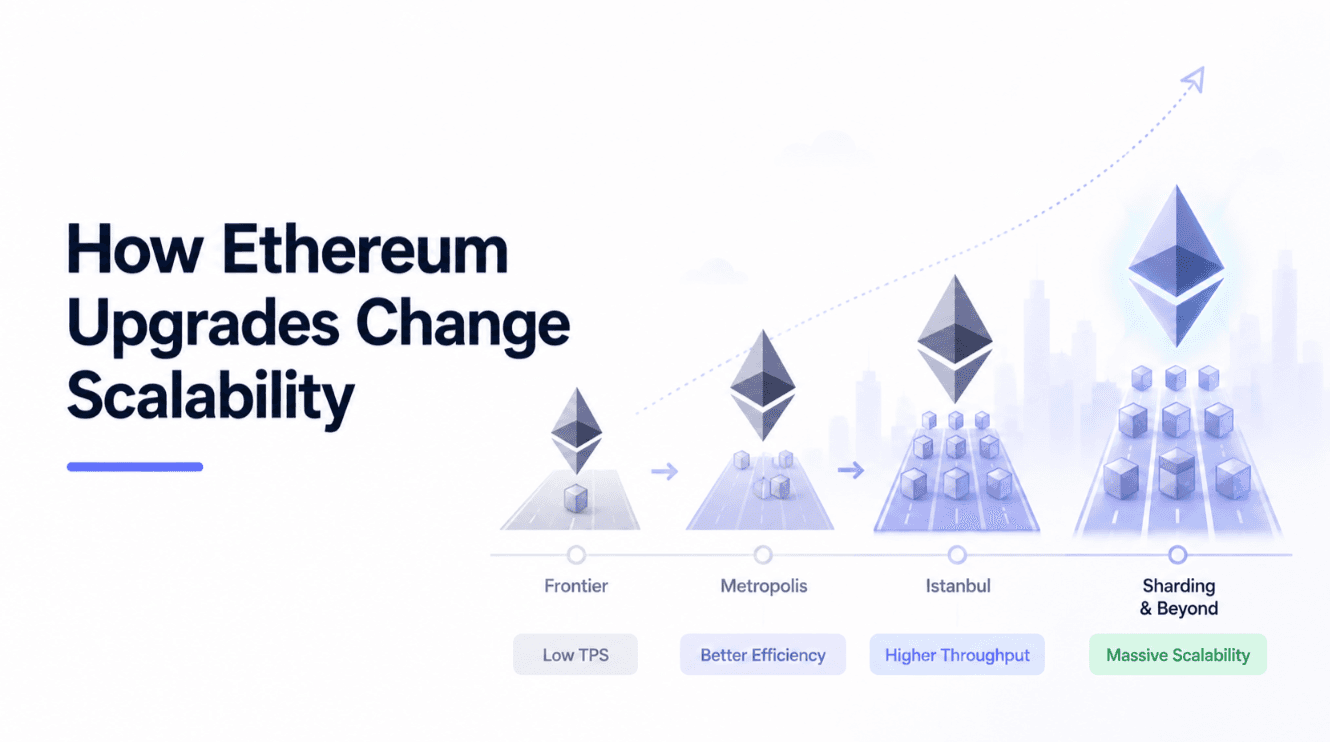
Ethereum upgrades change scalability by improving how the network stores, posts, and verifies data rather than simply cramming more transactions onto the base chain. The strategy is to keep the core layer secure and lean while pushing volume onto rollups, then making the data those rollups depend on cheaper and more plentiful.
Why Ethereum does not just get bigger
The obvious way to scale a blockchain is to process more transactions directly on the main chain. Ethereum largely rejects that path because forcing every node to handle more work would push out smaller operators and weaken decentralization. Instead, the roadmap treats the base layer as a settlement and security anchor and moves heavy activity elsewhere.
That framing explains why upgrades often look indirect. Rather than raising a simple throughput number, they tend to target the plumbing that lets rollups do more for less.
The data bottleneck
Rollups process transactions off-chain but must post data back to Ethereum so anyone can verify and reconstruct what happened. For years that data competed for the same scarce space as everything else, making it expensive. Several upgrades focus squarely on this constraint, giving rollups a dedicated and cheaper way to publish their data.
- Dedicated data lanes lower what rollups pay to post information.
- Temporary data storage means nodes are not burdened by old records forever.
- Greater data availability lets more rollups operate at once.
- Lower posting costs flow through to cheaper user fees on layer-2s.
Verification without re-running everything
A second front is verification. The network is moving toward methods that let participants confirm a chain is valid without personally re-executing every transaction or storing the entire history. If a node can check a compact proof instead of repeating all the work, the barrier to participating stays low even as activity grows.
Scaling Ethereum is mostly an exercise in checking more while storing and re-doing less. — CryptoCoinBeat analysis
How the pieces fit together
Each upgrade slots into a layered design. Rollups supply raw capacity. Cheaper data posting makes that capacity affordable. Lighter verification keeps the base layer accessible to ordinary operators. No single change delivers scale on its own; the gains come from the combination working in concert over successive upgrades.
This is why progress can feel incremental. A given upgrade might only address data costs or only improve verification, yet each removes a ceiling that previously limited how far rollups could push.
What it means going forward
The direction is consistent even as specifics evolve: more capacity through layer-2s, cheaper data underneath them, and verification that does not demand ever-heavier hardware. For users that should mean steadily lower costs and higher throughput, while the base layer holds onto the security and openness that give Ethereum its value.
This article is for general information only and is not financial advice. Roadmaps and technical details change, so confirm the current state of any upgrade before relying on it.
CryptoCoinBeat Newsroom · Published June 14, 2026 · Informational, not financial advice.
More from the wire
- MarketsSEC Greenlights Tokenized Stock Trading as Fed Rate Hike Tests Crypto Market Resilience
- RegulationUS Crypto Regulation and Market Structure Advance: CFTC Rulemaking Meets Coinbase's Stock-Perps Push
- RegulationUS Regulators Advance Tokenized Stocks Pathway and Bitcoin Reserve Bill in Landmark Week
- RegulationBitcoin and Ether Hold Steady as Fed Delivers First Rate Hike in Three Years, US Lawmakers Advance Crypto Bills
- MarketsUS Crypto Markets Face Double Test as CLARITY Act Stalls and Fed Decision Looms