Aave vs Morpho: Shared Pools or Isolated Markets
DeFi Protocols & RWA On-Chain Analyst · November 8, 2026 · 11 min read
Published November 8, 2026 · Reviewed to our editorial standards. This article is informational and not financial advice.
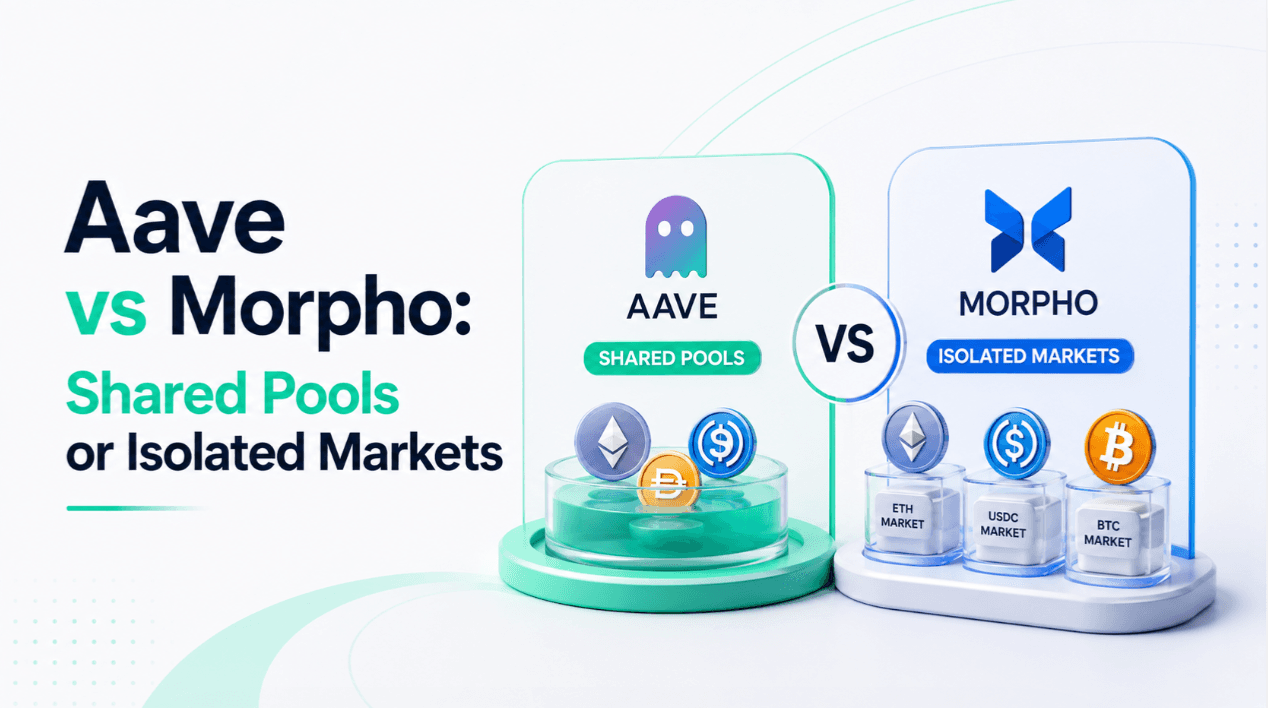
Aave and Morpho both let you deposit an asset, earn interest from borrowers, and borrow against collateral. They differ in one structural decision, and that decision determines who absorbs the loss when a listed asset turns out to be worthless.
Until April 2026 this was a design argument. Now it is a case study with figures attached.
How Aave is built
Aave runs shared liquidity pools. Depositors supply into a common pool, borrowers draw from it against collateral, and governance decides which assets may be listed and on what parameters — loan-to-value, liquidation threshold, oracle source, caps.
The advantage is depth. A single deep pool gives borrowers the best rates and depositors the most reliable utilisation, and Aave has the largest lending book in DeFi as a direct result. It has run since 2020 across many chains, through every crash of that period, with an extensive published audit history and no exploit of its own contracts.
The exposure is equally structural: a listing decision reaches every depositor in that pool. Governance is careful and the risk framework is serious, but the surface is shared by design.
How Morpho is built
Morpho creates isolated markets. Each market pairs one collateral asset with one loan asset and fixes its own loan-to-value, oracle and liquidation parameters at creation, published on-chain and immutable thereafter. Depositors reach these markets directly or through vaults curated by third parties.
The advantage is containment. A market that fails takes down that market and nothing else, because there is no shared pool for the damage to travel through. The design is Aave-derived, audited, and has run since 2023 with no exploit on record.
The cost is fragmentation and a shifted responsibility. Liquidity is split across many markets, and the risk judgement moves from a governance process to whoever curated the vault you deposited into — which is better if you check and worse if you assume.
April 2026, which settled the argument
An attacker exploited Kelp DAO's cross-chain adapter to mint roughly 116,500 unbacked rsETH — about $292m of tokens backed by nothing. Those tokens were then posted as collateral in lending markets that had accepted rsETH, and borrowed against.
Aave had listed the asset in its shared pools. It was left carrying between $177m and $236m of bad debt, and its total value locked fell by roughly $6.6bn in the days that followed. Aave's own contracts were never exploited — the code did exactly what it was configured to do, with an asset that could be minted from nothing.
Morpho's exposure was about $1m, contained across two isolated markets, with no other vault affected. The isolation was tested live and it held.
What that does and does not prove
It proves the containment property is real rather than theoretical. That is not nothing — most architectural claims in DeFi have never been tested under fire, and this one was.
It does not prove Morpho is safer in general. The same isolation that contained the damage also means nobody is centrally vetting what gets listed: anyone can create a market with any oracle and any parameters, and a badly curated vault can put you in one. The risk did not disappear; it moved to a different party.
Nor does it make Aave a poor protocol. It remains the deepest and most crash-tested market in DeFi and still the default for most borrowers. What changed is that the cost of a shared pool is now a known quantity.
Which to use
- Borrowing at size against major collateral: Aave, for depth, rate stability and the longest record.
- Depositing and prioritising containment: Morpho, having read the specific market or vault's parameters.
- Using a Morpho vault: check who curates it, what markets it allocates to, and what oracle each uses.
- Either way: read the collateral list, because the asset you did not think about is the one that generates the bad debt.
Governance versus curation
The two designs put the risk judgement in different hands, and neither hand is obviously better. Aave’s listings go through a public governance process with published risk analysis, delay and debate — slow, visible, and occasionally wrong in the way committees are wrong.
Morpho’s vault curators make allocation decisions independently, competing on their record. That is faster and more accountable in principle, since a curator who does badly loses their depositors, and it means the quality of your position depends on a party you may not have researched.
If you use Morpho through a vault, research the curator the way you would research a fund manager: what they allocate to, what parameters they accept, what they did during past incidents. If you use Aave, read the governance forum for the assets you are exposed to.
The oracle question sits under both
Every lending protocol depends on a price feed, and every liquidation is triggered by one. A feed that reads a thin market or a single venue's book can liquidate solvent positions, and a feed that lags can leave insolvent ones open.
Both protocols publish their oracle sources per asset, which is the transparency standard the category should be held to. Read them for the specific asset you are posting rather than trusting a general reputation, since the parameters vary market by market.
Our lending table scores both on exploit history, parameter transparency, oracle disclosure and behaviour under stress, and bad debt in DeFi lending covers who ends up paying when it happens.
Frequently asked questions
Is Morpho safer than Aave?+
It contains damage better, which April 2026 demonstrated with $1m of exposure against $177–236m. It also devolves risk assessment to vault curators rather than a governance process, so safety depends on which market you enter.
Did Aave get hacked in 2026?+
No. Its contracts have never been exploited. It was left with $177–236m of bad debt because unbacked rsETH minted in the Kelp bridge exploit was posted as collateral in a pool that had listed the asset.
What is an isolated lending market?+
A market pairing one collateral asset with one loan asset, with its own parameters fixed at creation. A failure in that market cannot reach depositors in any other, because there is no shared pool.
Which protocol has better rates?+
It varies by asset and utilisation. Aave's depth tends to give more stable rates at size; Morpho's isolated markets can price specific pairs more efficiently, which is the point of separating them.
Written by
Maria FernandezDeFi Protocols, Real-World Assets, On-Chain Analytics, Stablecoins, Spanish-Language Coverage
Maria Fernandez is an On-Chain Research Analyst at **CRYPTO·COINBEAT**, specializing in real-world asset (RWA) tokenization, decentralized finance, and stablecoin ecosystems. Originally from Mexico City and now based in Miami, Maria brings a unique Latin American perspective to blockchain research, combining deep technical analysis with insights into emerging digital asset markets across the Americas. Before joining **CRYPTO·COINBEAT**, Maria spent several years researching decentralized finance protocols, producing in-depth analysis on lending platforms, governance systems, and the growing adoption of tokenized real-world assets. Her early research into institutional RWA integration and decentralized collateral models helped explain one of the fastest-growing sectors within the blockchain industry. Maria's analytical approach combines on-chain transaction analysis, protocol revenue metrics, liquidity monitoring, and governance activity to evaluate the long-term health of DeFi ecosystems. She works extensively with blockchain analytics platforms, including Dune Analytics, Nansen, and Flipside Crypto, and has created numerous public dashboards that simplify complex blockchain data for investors and researchers alike. Her coverage of stablecoin market events and liquidity shifts has helped readers better understand risk during periods of heightened market volatility. She holds a B.Sc. in Industrial Engineering from ITAM (Instituto Tecnológico Autónomo de México) and a Graduate Certificate in FinTech from MIT Sloan. Passionate about blockchain education, Maria regularly contributes both English- and Spanish-language research, helping make advanced on-chain analysis more accessible to a global audience while supporting the continued growth of crypto adoption throughout Latin America.
Keep Reading
Crypto Lending and Borrowing in DeFi Explained
DeFi lending markets let anyone earn interest or borrow against crypto, governed entirely by code. Here is how collateral, rates, and liquidations actually work.
David Turner · May 2, 2026→
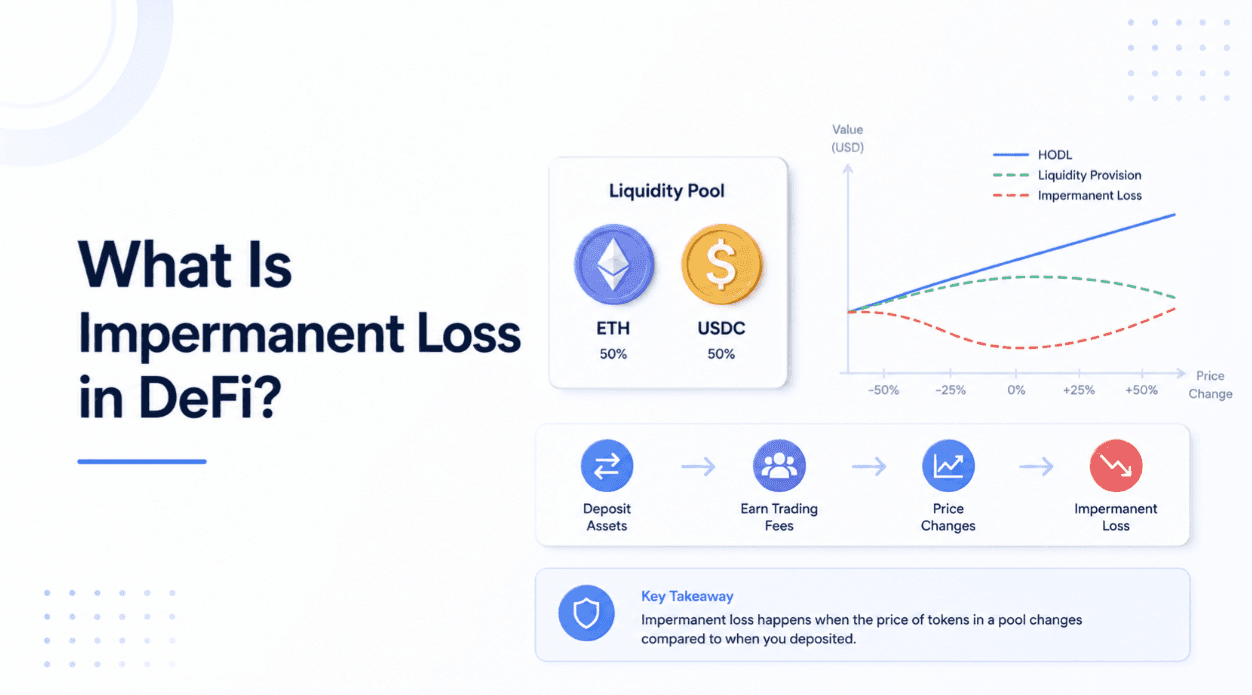
What Is Impermanent Loss in DeFi?
Impermanent loss quietly erodes the value of liquidity positions when token prices move. Here is why it happens, how big it gets, and when fees offset it.
Maria Fernandez · May 9, 2026→
Yield Farming and Liquidity Mining Explained
Yield farming chases returns by moving crypto between DeFi protocols. We break down where the yield comes from, how APY can mislead, and the risks behind big numbers.
David Turner · May 23, 2026→