Bad Debt in DeFi Lending: Who Pays When Collateral Fails
DeFi Protocols & RWA On-Chain Analyst · November 10, 2026 · 11 min read
Published November 10, 2026 · Reviewed to our editorial standards. This article is informational and not financial advice.
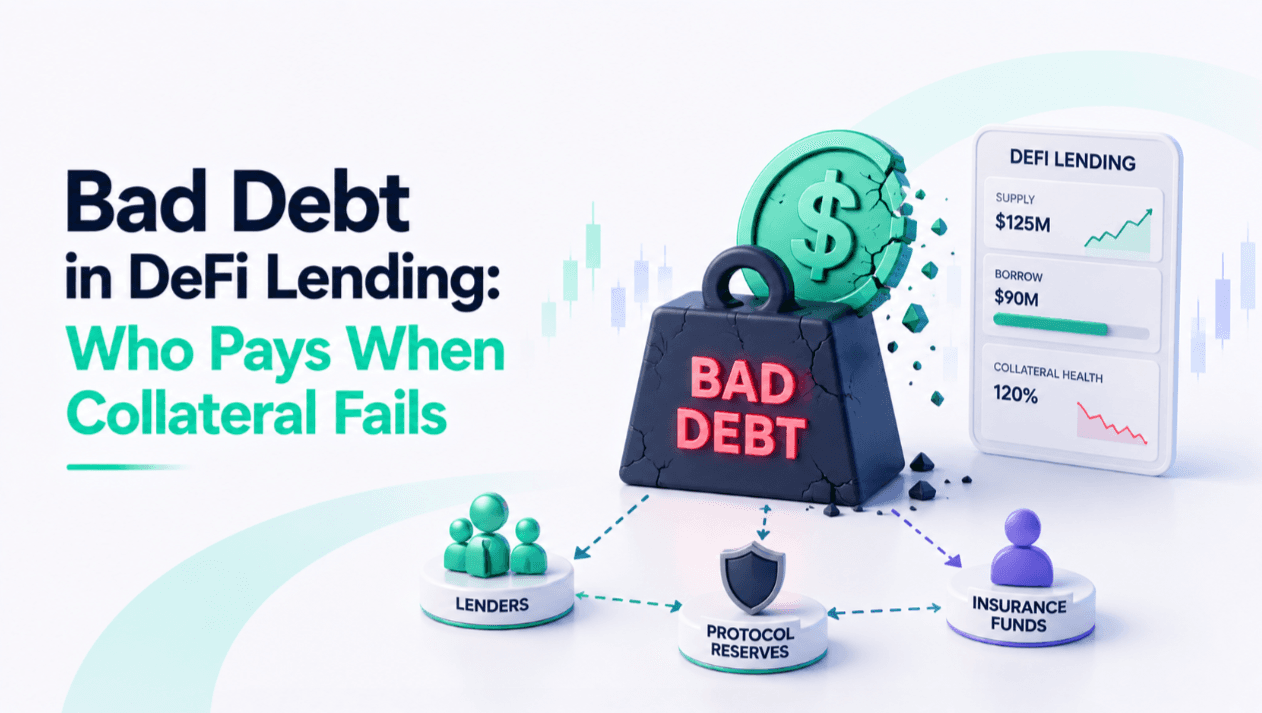
The pitch for on-chain lending is that every loan is over-collateralised, so defaults cannot happen: if the collateral falls, liquidators sell it and the lender is made whole. It works remarkably well, right up until it does not.
Bad debt is what remains when the collateral is worth less than the loan and liquidation cannot close the gap. Someone always absorbs that shortfall, and knowing who — before you deposit — is the whole exercise.
The three ways it happens
The collateral falls faster than liquidators can act. Liquidation needs a buyer, a working price feed and network capacity. Take away any one during a violent move and positions sit underwater while the price keeps falling.
The collateral is illiquid. A large position in a thinly traded asset cannot be sold at the quoted price, so liquidating it moves the market against itself. The November 2022 CRV short squeeze did this to Aave, leaving roughly $1.6m of bad debt that the treasury covered.
Or the collateral was never real. April 2026 produced the largest example: unbacked rsETH minted through Kelp DAO's compromised bridge adapter was posted as collateral and borrowed against, leaving Aave with $177–236m of bad debt. No liquidation could help, because the asset was worth nothing and always had been.
Who absorbs it
In a shared-pool protocol, depositors do — usually indirectly. The protocol may cover the shortfall from a treasury or safety module, which is funded by fees and by token holders who staked into it, so the loss lands on the token or the treasury rather than on individual balances.
If the shortfall exceeds those resources, it becomes a hole in the pool: depositors cannot all withdraw, because the assets backing some deposits are gone. That is the scenario every risk framework exists to prevent.
In an isolated-market protocol, the depositors in that specific market absorb it and nobody else does. Cleaner, harsher, and easier to reason about in advance.
Custodial lending fails differently
Centralised lenders made under-collateralised loans to trading firms, which is a different business — closer to a credit fund than a pawnbroker. In 2022, that business met a market where its borrowers were the ones failing.
Maple's on-chain credit pools recorded significant defaults after FTX collapsed, when borrowing firms could not repay. Several retail-facing lenders halted withdrawals and entered bankruptcy, having rehypothecated customer assets in ways depositors could not see.
The lesson is not that credit lending is illegitimate. It is that the opacity is the risk: with an on-chain pool you can read the collateral and the bad debt directly, and with a custodial lender you are reading a marketing page.
How to check your exposure
- Read the protocol's full collateral list — the risky asset is one you have not thought about.
- Check whether pools are shared or isolated, since that decides whether a bad listing reaches you.
- Look up the oracle for each collateral asset and what market it reads.
- Find the protocol's published bad debt figure, which serious ones report openly.
- Establish what backstop exists — treasury, safety module, insurance fund — and how large it is relative to the book.
All five are public for on-chain protocols. That transparency is the single strongest argument for on-chain lending over the custodial alternative, and it is only an advantage if someone reads it.
What good risk management looks like
Conservative listing: fewer assets, each with a real market and a defensible oracle. Supply caps limiting total exposure per asset. Isolation modes for anything novel. And a willingness to delist quickly when an asset's circumstances change.
Aave's 2026 experience is instructive precisely because its framework is one of the better ones. The failure was not sloppiness — it was accepting a bridged, restaking-derived asset whose supply could be forged upstream. Any protocol listing that asset would have taken the same loss.
Which points at the real lesson: the risk in a lending market is rarely the lending market. It is the longest, youngest dependency chain behind the assets it accepts, as restaking explained sets out in detail.
The role of liquidators
Liquidation is not automatic in the sense people imagine. It is performed by independent bots that monitor positions and act when there is a profit in doing so, paid a bonus out of the collateral for the service.
That means liquidation depends on someone finding it worthwhile. A small underwater position in an obscure asset on a congested network may not be profitable to close, so it sits there accruing bad debt while larger positions get cleared first — which is the quiet mechanism behind most small, persistent shortfalls.
How protocols recover from it
Bad debt does not usually kill a protocol. It gets absorbed by a treasury, repaid over time from fee income, or socialised across depositors in a controlled way — and the protocol continues operating, with the asset delisted and parameters tightened.
What matters is whether the recovery is disclosed. A protocol that publishes the figure, names the cause and describes how it will be covered is behaving like an institution; one that quietly adjusts numbers is telling you something about how it will behave next time.
Watch the response as closely as the event. The 2026 incident produced tightened collateral frameworks across the sector, which is the system working as intended even though it took a large loss to produce it.
The practical position
Deposit into protocols whose collateral lists you have actually read, prefer isolated exposure for anything novel, and treat a protocol's published bad-debt history as a feature rather than a warning sign — the ones that report it are the ones you can assess.
Our lending table records bad-debt events, backstop size and parameter transparency for each protocol, with sources for every figure.
Frequently asked questions
What is bad debt in DeFi?+
The shortfall left when a loan's collateral is worth less than the loan and liquidation cannot close the gap. It arises from fast price falls, illiquid collateral, or collateral that was never genuinely backed.
Who pays for bad debt in a lending protocol?+
A treasury or safety module absorbs it where one exists, funded by fees and stakers. Beyond that capacity it becomes a hole in the pool, meaning not all depositors can withdraw.
Has Aave had bad debt?+
Twice on the record: roughly $1.6m from the November 2022 CRV short squeeze, covered by the treasury, and $177–236m in April 2026 from unbacked rsETH posted as collateral after the Kelp bridge exploit.
Do isolated markets prevent bad debt?+
They do not prevent it, they contain it. A failure in one isolated market cannot reach depositors elsewhere, which April 2026 demonstrated when Morpho's exposure stayed around $1m.
Written by
Maria FernandezDeFi Protocols, Real-World Assets, On-Chain Analytics, Stablecoins, Spanish-Language Coverage
Maria Fernandez is an On-Chain Research Analyst at **CRYPTO·COINBEAT**, specializing in real-world asset (RWA) tokenization, decentralized finance, and stablecoin ecosystems. Originally from Mexico City and now based in Miami, Maria brings a unique Latin American perspective to blockchain research, combining deep technical analysis with insights into emerging digital asset markets across the Americas. Before joining **CRYPTO·COINBEAT**, Maria spent several years researching decentralized finance protocols, producing in-depth analysis on lending platforms, governance systems, and the growing adoption of tokenized real-world assets. Her early research into institutional RWA integration and decentralized collateral models helped explain one of the fastest-growing sectors within the blockchain industry. Maria's analytical approach combines on-chain transaction analysis, protocol revenue metrics, liquidity monitoring, and governance activity to evaluate the long-term health of DeFi ecosystems. She works extensively with blockchain analytics platforms, including Dune Analytics, Nansen, and Flipside Crypto, and has created numerous public dashboards that simplify complex blockchain data for investors and researchers alike. Her coverage of stablecoin market events and liquidity shifts has helped readers better understand risk during periods of heightened market volatility. She holds a B.Sc. in Industrial Engineering from ITAM (Instituto Tecnológico Autónomo de México) and a Graduate Certificate in FinTech from MIT Sloan. Passionate about blockchain education, Maria regularly contributes both English- and Spanish-language research, helping make advanced on-chain analysis more accessible to a global audience while supporting the continued growth of crypto adoption throughout Latin America.
Keep Reading
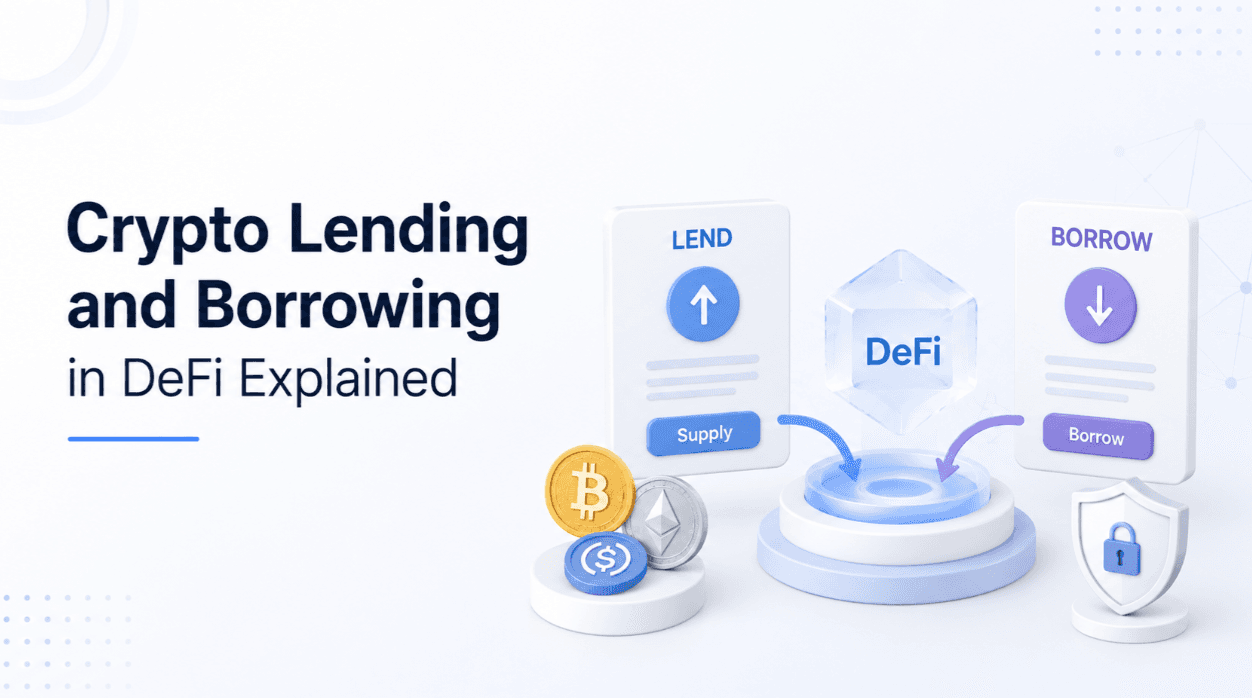
Crypto Lending and Borrowing in DeFi Explained
DeFi lending markets let anyone earn interest or borrow against crypto, governed entirely by code. Here is how collateral, rates, and liquidations actually work.
David Turner · May 2, 2026→
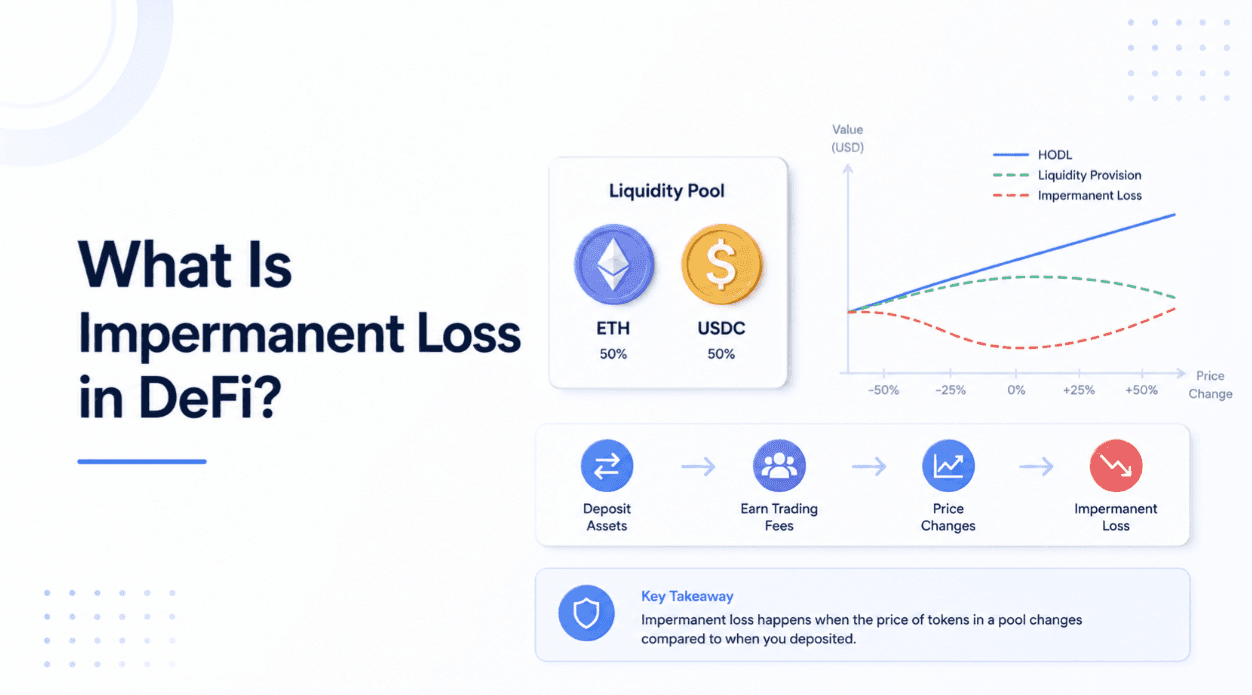
What Is Impermanent Loss in DeFi?
Impermanent loss quietly erodes the value of liquidity positions when token prices move. Here is why it happens, how big it gets, and when fees offset it.
Maria Fernandez · May 9, 2026→

Yield Farming and Liquidity Mining Explained
Yield farming chases returns by moving crypto between DeFi protocols. We break down where the yield comes from, how APY can mislead, and the risks behind big numbers.
David Turner · May 23, 2026→