Restaking Explained: Extra Yield, Extra Slashing
By Emily Carter
Policy Correspondent · November 2, 2026 · 12 min read
Published November 2, 2026 · Reviewed to our editorial standards. This article is informational and not financial advice.
Restaking takes capital already staked to secure a blockchain and pledges it again to secure other services, which pay fees for the privilege. The insight underneath is real: economic security is expensive to build from scratch, and a network with a large stake has more of it than it needs for one job.
The implication is equally real. Capital securing several things at once can be penalised by several things at once, and the penalty rules for most of those things are new.
How the construction works
You stake ether, then delegate that staked position to an operator who runs infrastructure for one or more services that have opted into the system. Those services define what correct behaviour looks like and what happens when an operator fails to deliver it. In exchange, they pay fees, which flow back to you minus commissions.
The variants matter. Native restaking points a validator's withdrawal credentials at the restaking contracts while leaving key control with the staker — the arrangement to prefer. Liquid restaking wraps the whole thing in a tradeable token, adding a layer of convenience and a layer of exposure.
What you are actually pledging
Three things. Your base staking position, which remains exposed to the chain's own slashing rules. Additional penalty conditions defined by each service your operator supports. And the operational competence of that operator across all of them simultaneously.
You did not individually choose most of those services — your operator did, or the liquid restaking protocol did on your behalf. The honest protocols publish which services their stake secures and who the operators are, and that disclosure is the single most useful thing to check before depositing.
Slashing regimes are still being written
This is the most important and least discussed fact about the category. Ethereum's slashing conditions have years of production behind them, with a well-understood record of what triggers them and how much they cost. The equivalents on secured services mostly do not.
Several are still being phased in, which the better protocols disclose openly. That means the penalty mechanics you are exposed to have not been through a genuine stress event, and nobody — including the people who wrote them — knows exactly how they will behave when one arrives.
What is slashing covers how the base chain’s penalties work, which is the floor these newer regimes build on.
That is not an accusation. It is the definition of a young system, and it is what the extra yield is compensating you for.
The failure that actually happened
In April 2026, an attacker minted roughly 116,500 unbacked rsETH — about $292m — by exploiting Kelp DAO's cross-chain adapter, which ran a single-point verification configuration. It was the largest DeFi loss of that year.
The detail that matters: the restaking contracts were not breached. Neither was the base staking. The bridge wrapped around them was, and the unbacked tokens then propagated into lending markets that had accepted rsETH as collateral, leaving Aave with between $177m and $236m of bad debt while Morpho's isolated markets contained about $1m.
So the category's first major loss came not from slashing, and not from the novel security model, but from the ordinary plumbing bolted onto the side of it. That is a pattern worth generalising: in a stack of five layers, the weakest is rarely the one everyone is arguing about.
Exits are layered too
Unwinding a restaked position can mean leaving the restaking layer before the staking layer, each with its own delay. Longer exits produce sharper discounts on liquid restaking tokens under stress, and those markets are thinner than the plain staking ones to begin with.
Model the full unwinding time before depositing, not the advertised yield. A position you cannot leave for three weeks is a different instrument from one you can leave in three days, whatever the rate card says.
What restaking is actually for
It is worth stating what the services buying this security do, because the yield has to come from somewhere real. They are things that need a set of honest participants and a way to punish dishonest ones: data availability layers, oracle networks, bridges, sequencers and coprocessors.
Historically each would have had to bootstrap its own token and its own validator set, which is slow and expensive and produces weak security in the early years. Renting security from an existing pool is a genuinely better mechanism, and the fees paid for it are ordinary income rather than emissions.
That distinction matters when you assess the rate. A restaking yield made of service fees is durable in a way an emissions-funded rate is not — so ask which one you are being paid in, and in what token.
How to size a position
- Prefer native restaking, where withdrawal key control stays with you, over wrapped tokens where it does not.
- Read the published list of secured services and operators — if it is not published, that is the answer.
- Check how many bridges sit between you and your capital, since that is where the losses have come from.
- Establish the full exit path, layer by layer, and the queue at each.
- Size it as the speculative part of a portfolio, not as a yield enhancement on core holdings.
Where the sector went after 2026
The response was instructive. ether.fi, whose systems were not compromised, nonetheless published an externally audited hardening of its cross-chain transfers in July 2026 and then introduced a separate token splitting plain staking from restaking exposure.
That second move is an admission worth noting: many holders of liquid restaking tokens never wanted the restaking risk and had no way to decline it. Being able to choose the layers you are exposed to is a genuine improvement over a single token that bundles them.
Our liquid restaking table scores each protocol on exposure disclosure, key control, exit design and behaviour during the 2026 incidents. It is the youngest table on the Ratings Desk and the scores are capped accordingly, because several protocols in it have under two years of production history.
Frequently asked questions
What is restaking in crypto?+
Pledging already-staked capital to secure additional services beyond the base chain, which pay fees in return. The extra yield comes with the additional penalty conditions those services define.
Is restaking safe?+
It adds slashing conditions, operator risk and often bridge risk on top of base staking. Slashing regimes on secured services are still being phased in, so the mechanics have not been stress-tested in production.
What happened with Kelp DAO in April 2026?+
An attacker exploited its cross-chain adapter, which used a single-point verification configuration, to mint about 116,500 unbacked rsETH — roughly $292m. The restaking contracts themselves were not breached.
What is the difference between native and liquid restaking?+
Native restaking points your validator's withdrawal credentials at the restaking contracts while you keep key control. Liquid restaking issues a tradeable token instead, adding contract and market exposure on top.
Written by
Emily CarterFormer regulatory analyst · J.D.
Emily Carter is a legal and regulatory writer specializing in cryptocurrency, blockchain policy, and digital asset compliance. Before joining CRYPTO·COINBEAT, she worked as a regulatory analyst in the United States, tracking developments in federal financial legislation, anti-money laundering (AML) requirements, and emerging policies shaping the digital asset industry. She earned her Juris Doctor (J.D.) degree and combines legal expertise with a talent for translating complex regulatory topics into clear, accessible language. Her work focuses on cryptocurrency taxation, DeFi regulation, exchange compliance, stablecoins, and the evolving role of U.S. agencies in overseeing digital assets. At CRYPTO·COINBEAT, Emily writes educational guides and policy explainers designed for both newcomers and experienced crypto users. She is committed to helping readers understand how regulatory changes affect investors, businesses, and the broader blockchain ecosystem.
Keep Reading

Crypto Lending and Borrowing in DeFi Explained
DeFi lending markets let anyone earn interest or borrow against crypto, governed entirely by code. Here is how collateral, rates, and liquidations actually work.
David Turner · May 2, 2026→
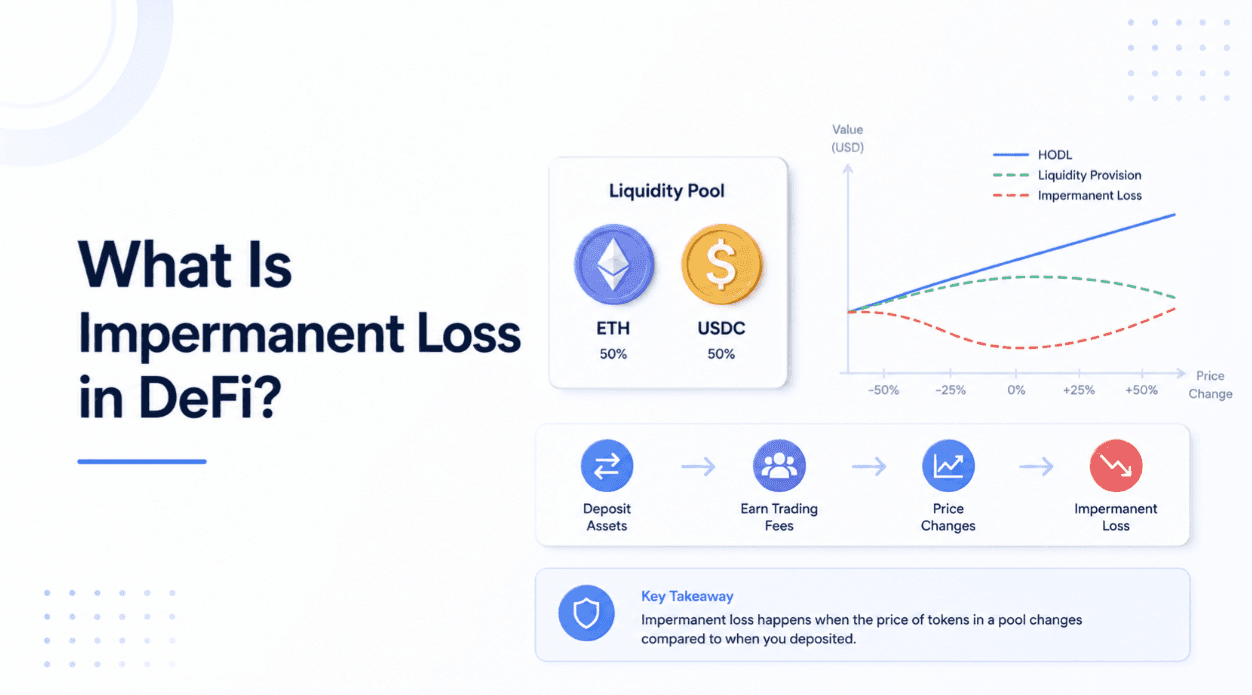
What Is Impermanent Loss in DeFi?
Impermanent loss quietly erodes the value of liquidity positions when token prices move. Here is why it happens, how big it gets, and when fees offset it.
Maria Fernandez · May 9, 2026→

Yield Farming and Liquidity Mining Explained
Yield farming chases returns by moving crypto between DeFi protocols. We break down where the yield comes from, how APY can mislead, and the risks behind big numbers.
David Turner · May 23, 2026→