Slashing Explained: How Staking Actually Loses Money
DeFi Protocols & RWA On-Chain Analyst · October 27, 2026 · 9 min read
Published October 27, 2026 · Reviewed to our editorial standards. This article is informational and not financial advice.
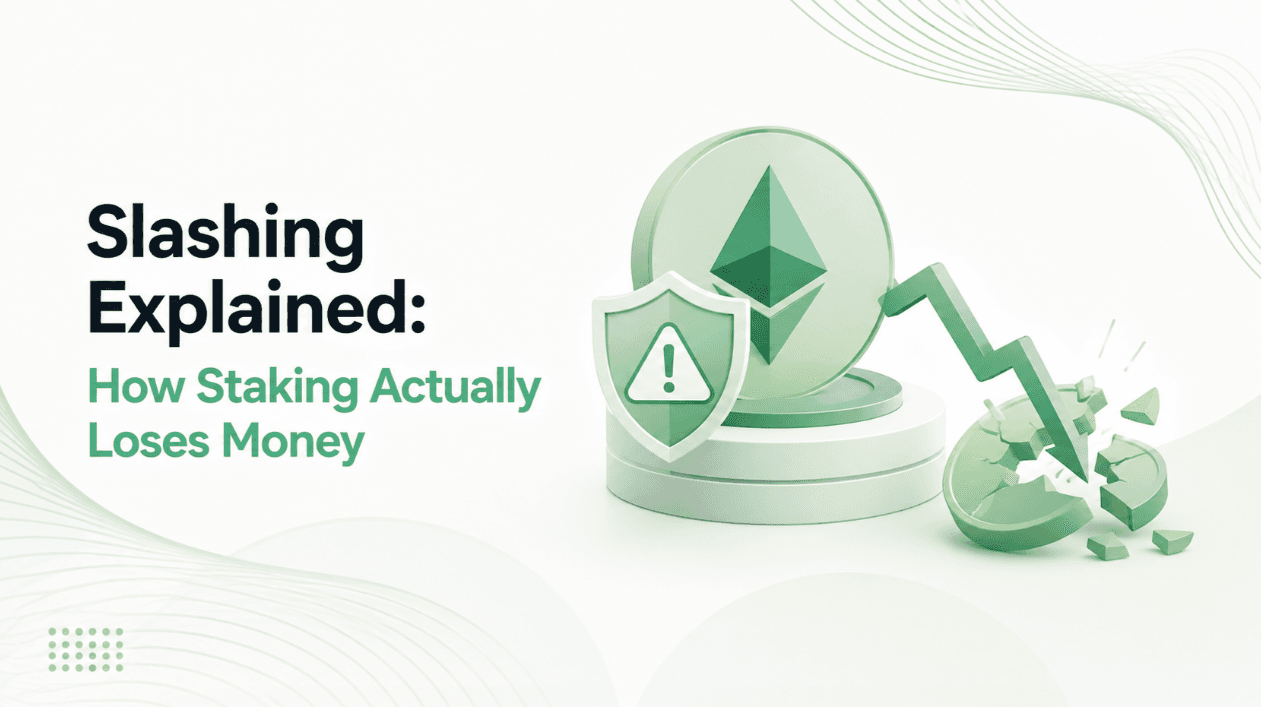
Slashing is the penalty a proof-of-stake network imposes on a validator that provably breaks the rules. It is not a fee, not a market loss and not what happens when your machine goes offline for an afternoon — those are different, milder things that get confused with it constantly.
Understanding the difference matters, because one of them is a small ongoing cost and the other ends with your validator ejected from the network.
Offline is not slashing
A validator that is offline simply fails to earn. The network applies small penalties roughly equal to what it would have earned by attesting, so a day of downtime costs about a day of rewards. Unpleasant, recoverable, not an emergency.
The picture only changes if a very large share of the network is offline simultaneously, when a separate mechanism accelerates penalties on absent validators until the chain can finalise again. That is a systemic condition, not something one badly configured machine triggers.
What actually gets you slashed
Provable, contradictory signatures. On Ethereum the offences are signing two different blocks for the same slot, and attesting in ways that contradict your own earlier attestations — surrounding or double votes. Both are things an honest validator cannot do by accident and a careless setup can do easily.
The overwhelmingly common cause is running the same validator key on two machines at once. Someone builds a backup node, restores the keys, and starts it while the original is still running. Both sign, the signatures conflict, and the network cannot tell the difference between redundancy and an attack — nor is it supposed to.
The correlation penalty is the part that matters
A slashed validator takes an immediate penalty, is scheduled for forced exit, and continues to accrue penalties until it leaves — a process that takes weeks rather than hours.
The severity, though, depends on company. The correlation penalty scales with how many validators were slashed around the same time: an isolated incident costs a modest fraction of the stake, while a large simultaneous event can approach the entire balance.
That design is deliberate and elegant. One operator's mistake is treated as a mistake. Thousands of validators failing together looks like a coordinated attack on finality, and is priced accordingly. It is also the reason validator client diversity matters: a bug in a client running most of the network could slash everyone using it at once, turning a software defect into a correlated catastrophe.
What this means for delegators
If you stake through a service, their slashing is your loss — which is why an operator's record deserves more scrutiny than their fee. Check it on the chain's own validator explorer rather than on a marketing page, and ask what happens if an event occurs: some providers cover slashing losses contractually, others do not.
Ask about correlation too. An operator running thousands of validators on a single client, in a single datacentre, has a correlated failure mode however good their record is. Our best staking providers table records slashing history and infrastructure examinations for each provider.
Restaking multiplies the surface
Restaked capital is exposed to the base chain's slashing rules plus whatever penalty conditions each secured service defines. Those conditions are newer, less tested, and were mostly not chosen by you individually.
Several restaking slashing regimes are still being phased in, which the honest protocols disclose. Read that disclosure as what it is: the penalty mechanics you are exposed to have not yet been through a real stress event. Restaking explained covers the full picture.
Other networks, other rules
Slashing is not one mechanism. Ethereum's version punishes conflicting signatures and has years of production behind it; other proof-of-stake networks define their own offences, penalty sizes and, in some cases, punish extended downtime as well as active misbehaviour.
Read the specific rules for any network you stake on rather than assuming Ethereum's apply. Newer chains and Bitcoin-adjacent staking designs have the least history behind their penalty mechanics, which means less certainty about how they behave under stress — and that uncertainty is part of what the higher advertised rate is paying you for.
The historical record is reassuring
Slashing events on Ethereum have been rare and small, and the published cases follow the same pattern: an operator ran duplicate signing infrastructure, usually during a migration or a disaster-recovery test, and a handful of validators were ejected.
Nothing resembling the worst case — a large correlated event triggered by a client bug — has occurred on the network. That is partly good engineering and partly the community's sustained effort on client diversity, which is why the topic gets more attention than a purely technical detail would otherwise warrant.
How to avoid it
- Never run the same validator key on two machines — build failover for the node, never for the signing key.
- Use anti-slashing protection in your client and keep its database intact across restarts and migrations.
- Run a minority-share client where practical, so a client bug does not correlate your failure with everyone else's.
- Separate withdrawal keys from signing keys, and keep withdrawal keys offline.
- When delegating, check the operator's on-chain record and their published slashing terms.
Slashing is rare in absolute terms — the great majority of validators never experience it — and it is concentrated almost entirely in avoidable configuration mistakes. That is good news, because it means the risk responds to care.
Which is the real summary: slashing is not a market risk you accept in exchange for yield. It is an operational risk you manage, and the tools for managing it are well understood and largely free.
Frequently asked questions
What causes slashing in Ethereum staking?+
Provably contradictory signatures — signing two blocks for the same slot, or attestations that contradict your earlier ones. In practice it is almost always caused by running the same validator key on two machines.
Is being offline the same as being slashed?+
No. Downtime costs roughly what you would have earned, and is recoverable. Slashing takes a penalty, forces your validator to exit and scales with how many others were slashed at the same time.
How much does slashing cost?+
An isolated event costs a modest fraction of the stake. A large correlated event — many validators slashed together — can approach the whole balance, because the network prices it as a possible attack on finality.
Can I be slashed if I use a staking service?+
Yes — the operator's misbehaviour is your loss. Check their on-chain slashing record and whether they contractually cover such losses before delegating.
Written by
Maria FernandezDeFi Protocols, Real-World Assets, On-Chain Analytics, Stablecoins, Spanish-Language Coverage
Maria Fernandez is an On-Chain Research Analyst at **CRYPTO·COINBEAT**, specializing in real-world asset (RWA) tokenization, decentralized finance, and stablecoin ecosystems. Originally from Mexico City and now based in Miami, Maria brings a unique Latin American perspective to blockchain research, combining deep technical analysis with insights into emerging digital asset markets across the Americas. Before joining **CRYPTO·COINBEAT**, Maria spent several years researching decentralized finance protocols, producing in-depth analysis on lending platforms, governance systems, and the growing adoption of tokenized real-world assets. Her early research into institutional RWA integration and decentralized collateral models helped explain one of the fastest-growing sectors within the blockchain industry. Maria's analytical approach combines on-chain transaction analysis, protocol revenue metrics, liquidity monitoring, and governance activity to evaluate the long-term health of DeFi ecosystems. She works extensively with blockchain analytics platforms, including Dune Analytics, Nansen, and Flipside Crypto, and has created numerous public dashboards that simplify complex blockchain data for investors and researchers alike. Her coverage of stablecoin market events and liquidity shifts has helped readers better understand risk during periods of heightened market volatility. She holds a B.Sc. in Industrial Engineering from ITAM (Instituto Tecnológico Autónomo de México) and a Graduate Certificate in FinTech from MIT Sloan. Passionate about blockchain education, Maria regularly contributes both English- and Spanish-language research, helping make advanced on-chain analysis more accessible to a global audience while supporting the continued growth of crypto adoption throughout Latin America.
Keep Reading
Ethereum Layer-2 Scaling: How Rollups Make ETH Cheaper and Faster
Rollups move execution off Ethereum’s base layer while keeping its security. Here is how optimistic and zk-rollups work and where they differ.
Maria Fernandez · May 3, 2026→
Proof of Stake and ETH Staking Explained
Ethereum secures itself with staked ETH instead of mining. Here is how validators, rewards and slashing work, and what staking really involves.
David Turner · May 16, 2026→
Ethereum Gas Fees Explained: Why Transactions Cost What They Do
Gas is how Ethereum prices computation. Here is what you are really paying for, why fees swing so hard, and how to keep them down.
David Turner · May 25, 2026→