APY and APR in Crypto: Why the Numbers Rarely Mean What They Say
DeFi Protocols & RWA On-Chain Analyst · November 14, 2026 · 9 min read
Published November 14, 2026 · Reviewed to our editorial standards. This article is informational and not financial advice.
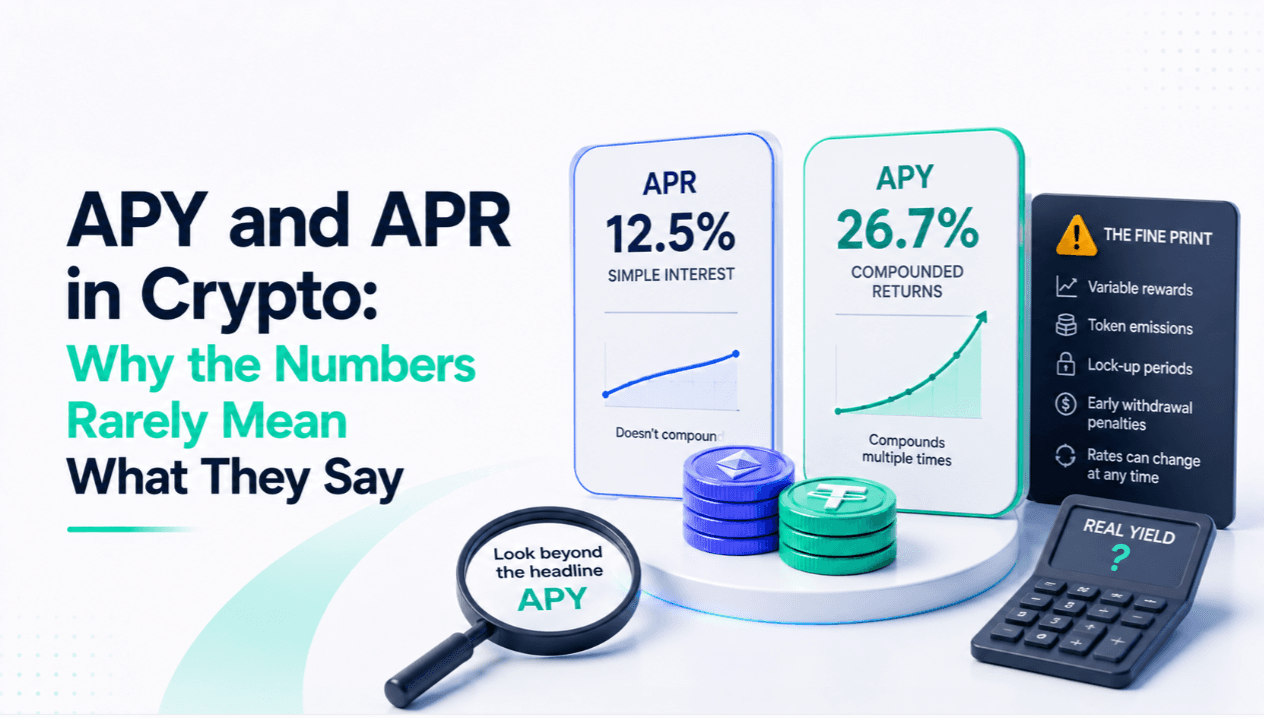
Two protocols quote you a rate. One says 8% APR, the other says 8% APY. They are not offering the same thing, and in crypto the gap between the two conventions is only the beginning of the problem.
Here is what each term means, why the crypto versions are less reliable than their banking equivalents, and how to convert an advertised figure into something you can actually compare.
The definitions, briefly
APR is the simple annual rate, ignoring compounding: 1% a month is 12% APR. APY assumes the returns are reinvested at the stated frequency, so the same 1% a month compounds to roughly 12.68% APY.
The gap widens as rates rise and as compounding gets more frequent. At low single digits it is small; at 50% it is enormous, which is why the more aggressive the advertised rate, the more likely it is quoted as APY.
Problem one: the compounding may not be real
APY is a projection, not a measurement. It answers 'what would I earn if this rate held for a year and I reinvested at every opportunity' — and both halves of that are assumptions.
Some positions compound automatically: a value-accruing staking token, an auto-compounding vault. Others require you to claim and redeploy manually, which costs gas each time and may not be worth doing on a small position. If you do not actually compound, the APY is a number describing someone else's behaviour.
Problem two: the rate is a snapshot
Lending rates are set by utilisation and move continuously. A pool showing 12% because a large borrower just drew from it may show 3% tomorrow when they repay. Annualising an hourly rate produces a headline figure that has never been earned for a year by anyone.
This is not deception — it is the honest way to display a floating rate — but it makes any single reading nearly meaningless. Look for a thirty-day or ninety-day average, which serious interfaces display alongside the current rate, and compare protocols on that.
Problem three: emissions priced at today's token
The largest distortion. A quoted 20% might be 4% in actual income and 16% in the protocol's own token, valued at its current price and assuming you sell instantly and cause no impact.
Token prices fall, emission schedules taper, and everyone farming the same pool sells into the same book. Rates advertised on that basis routinely deliver a fraction of the headline over any real holding period.
The fix is to split every advertised rate into income and emissions before comparing anything. Most interfaces disclose the breakdown; where one does not, treat the entire rate as emissions until shown otherwise.
Problem four: the denominator is a moving asset
A staking yield paid in the staked token is a real return in token terms and an unknown one in currency terms. Earning 4% on an asset that falls 40% is not a 4% return by any measure a person planning their finances would recognise.
Decide which unit you are measuring in, and be consistent. For a stablecoin position the two coincide, which is one reason stablecoin yields are easier to reason about than any other kind.
A note on ‘fixed’ rates
Some products quote a fixed rate for a defined term, usually by selling the variable yield to someone else who wants the exposure. That is a real financial arrangement and the certainty is genuine, within the term.
What it does not remove is the risk underneath. A fixed rate on a lending position is still a lending position, and fixing the yield fixes the return rather than the principal — a distinction worth being clear about before treating the quoted number as a deposit rate.
Converting an advertised rate into something comparable
- Establish whether it is APR or APY, and whether compounding actually happens automatically.
- Split it into income and emissions, and set the emissions aside.
- Find the thirty-day average rather than the current instantaneous figure.
- Subtract fees: protocol fees, performance fees and the gas cost of any manual compounding.
- State the result in the unit you care about, not in the token being paid out.
What survives that process is the number to compare across protocols. It is usually a lot smaller than the one on the front page, and it is the only one that reflects what you will actually keep.
The fees that come out afterwards
Advertised rates are frequently gross. A vault charging a management fee on assets and a performance fee on returns takes a meaningful share of a single-digit yield, and neither is necessarily reflected in the figure on the front page.
Network costs matter too, and they matter most to small positions. Claiming and redeploying rewards on a busy chain can cost more than a month of yield on a modest deposit, which turns the compounding assumption behind an APY figure into a loss-making activity.
Work out the break-even deposit size before committing: the amount below which fees and gas consume the return. It is often larger than people expect, and it is the honest reason many small positions never earn what they were quoted.
The benchmark that makes it concrete
Compare everything against two reference points: the base staking yield on an established network, and the return on short-dated government debt. Those are the sector's genuinely low-risk rates.
Anything meaningfully above them is being paid for risk — lending exposure, venue exposure, slashing conditions, a bridge. The size of the excess is the market's estimate of how much risk, and it is a surprisingly honest signal once you stop reading it as free money.
Crypto yield explained covers what each engine is being paid for, and our yield aggregators table records fee structures and emission dependence for the vaults that package them.
Frequently asked questions
What is the difference between APR and APY?+
APR is the simple annual rate with no compounding. APY assumes returns are reinvested at the stated frequency, so it is always the larger number for the same underlying rate.
Why do crypto yields change so quickly?+
Most are floating rates set by utilisation, and the displayed figure annualises the current instant. A single reading can differ dramatically from what the position averages over a month.
Are advertised DeFi yields real?+
Partly. The income component is real; the emissions component is paid in the protocol's own token at today's price and rarely delivers the headline over a real holding period.
What is a realistic crypto yield?+
Base staking on a major network and short-dated government debt are the reference points. Anything well above them is compensation for lending, venue, slashing or bridge risk.
Written by
Maria FernandezDeFi Protocols, Real-World Assets, On-Chain Analytics, Stablecoins, Spanish-Language Coverage
Maria Fernandez is an On-Chain Research Analyst at **CRYPTO·COINBEAT**, specializing in real-world asset (RWA) tokenization, decentralized finance, and stablecoin ecosystems. Originally from Mexico City and now based in Miami, Maria brings a unique Latin American perspective to blockchain research, combining deep technical analysis with insights into emerging digital asset markets across the Americas. Before joining **CRYPTO·COINBEAT**, Maria spent several years researching decentralized finance protocols, producing in-depth analysis on lending platforms, governance systems, and the growing adoption of tokenized real-world assets. Her early research into institutional RWA integration and decentralized collateral models helped explain one of the fastest-growing sectors within the blockchain industry. Maria's analytical approach combines on-chain transaction analysis, protocol revenue metrics, liquidity monitoring, and governance activity to evaluate the long-term health of DeFi ecosystems. She works extensively with blockchain analytics platforms, including Dune Analytics, Nansen, and Flipside Crypto, and has created numerous public dashboards that simplify complex blockchain data for investors and researchers alike. Her coverage of stablecoin market events and liquidity shifts has helped readers better understand risk during periods of heightened market volatility. She holds a B.Sc. in Industrial Engineering from ITAM (Instituto Tecnológico Autónomo de México) and a Graduate Certificate in FinTech from MIT Sloan. Passionate about blockchain education, Maria regularly contributes both English- and Spanish-language research, helping make advanced on-chain analysis more accessible to a global audience while supporting the continued growth of crypto adoption throughout Latin America.
Keep Reading
Crypto Lending and Borrowing in DeFi Explained
DeFi lending markets let anyone earn interest or borrow against crypto, governed entirely by code. Here is how collateral, rates, and liquidations actually work.
David Turner · May 2, 2026→
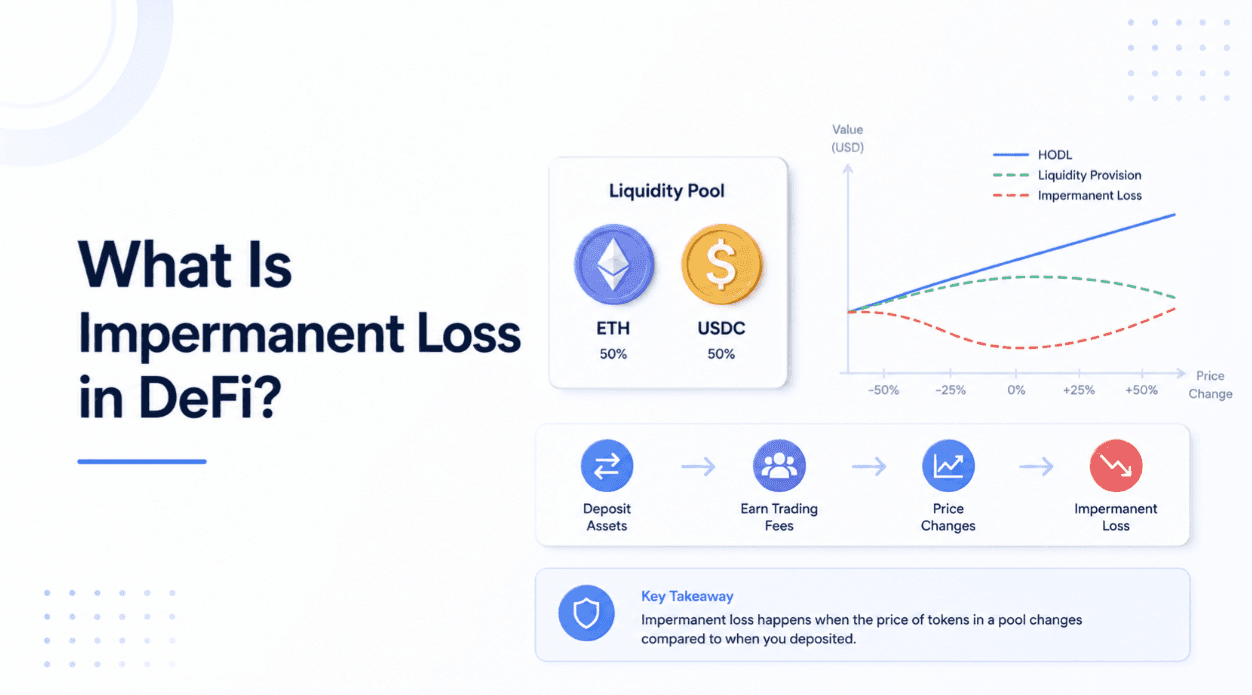
What Is Impermanent Loss in DeFi?
Impermanent loss quietly erodes the value of liquidity positions when token prices move. Here is why it happens, how big it gets, and when fees offset it.
Maria Fernandez · May 9, 2026→
Yield Farming and Liquidity Mining Explained
Yield farming chases returns by moving crypto between DeFi protocols. We break down where the yield comes from, how APY can mislead, and the risks behind big numbers.
David Turner · May 23, 2026→