Crypto Yield: Every Way to Earn, and What Each One Risks
By Emily Carter
Policy Correspondent · October 21, 2026 · 12 min read
Published October 21, 2026 · Reviewed to our editorial standards. This article is informational and not financial advice.
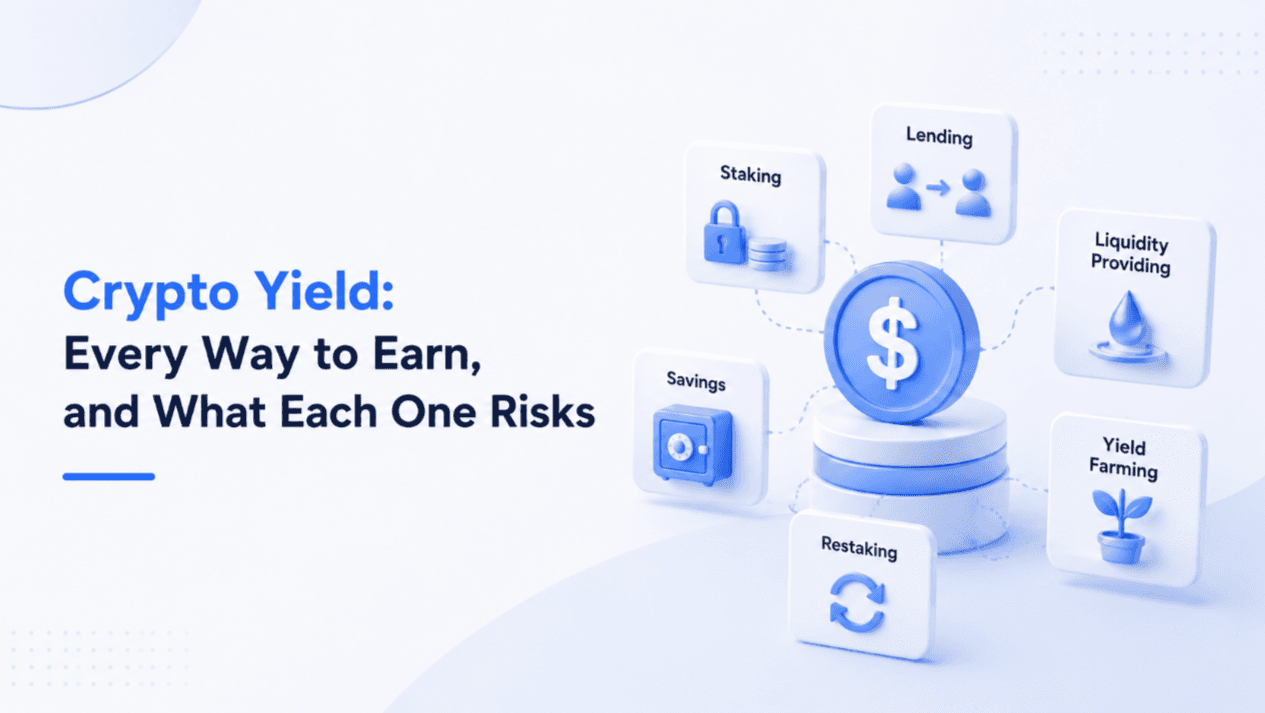
Yield in crypto is quoted as a single number, which is the most misleading way to present it. Two products advertising six per cent can be as different as a government bond and an unsecured loan to a stranger, because the number describes the reward and says nothing about the engine producing it.
There are six engines in general use. This is what each one is, what makes it stop, and how they stack when a product uses several at once.
Engine one: consensus rewards from staking
The base yield of a proof-of-stake network. You lock capital, run or delegate a validator, and the protocol pays you for helping to produce and attest blocks. The payment comes from newly issued tokens plus a share of transaction fees.
This is the closest thing to a native risk-free rate in crypto, and it is not risk-free. The reward is paid in the token you staked, so it is only a real return if you wanted that exposure anyway. Behaving badly — or having your operator behave badly — is punished by slashing, and exiting is not instant.
The yield falls as more of the supply is staked, because issuance is shared among more validators. That is a design feature, not a market failure, and it means a headline staking rate drifts down over time rather than staying put.
Engine two: liquid staking, which adds a claim
Instead of locking capital directly, you deposit into a protocol that stakes on your behalf and gives you a token representing the position. The token accrues the staking reward and can be traded or used elsewhere while the underlying stake stays locked.
You have added a layer: smart contract risk, operator selection risk, and the possibility that the token trades below the value of what it represents when people want out faster than the exit queue allows. In June 2022, stETH traded several per cent below ETH for weeks for exactly that reason.
The yield is the same staking reward, minus a protocol fee. What you paid for it is liquidity, and what you accepted for that liquidity is a discount that appears at the worst moment.
Engine three: restaking, which adds slashing conditions
Already-staked capital is pledged again to secure additional services, each paying a fee. The extra return is real, and so is the extra exposure: your capital now backs penalty rules you did not individually choose, on services with far less production history than the base chain.
The unwinding is also layered. Exiting can mean leaving the restaking layer before the staking layer, and each has its own queue — which is why liquid restaking tokens discount more sharply under stress than plain liquid staking tokens do.
April 2026 supplied the category's cautionary case, and not through slashing: an attacker minted roughly $292m of unbacked rsETH through Kelp DAO's cross-chain adapter. The restaking contracts held; the bridge around them did not, and the damage spread into lending markets that had accepted the token as collateral.
Engine four: lending
You deposit an asset, borrowers pay to use it, and the rate is set by how much of the pool is borrowed. High utilisation means a high rate and also means you cannot withdraw until borrowers repay or new deposits arrive.
Loans are over-collateralised, so ordinary defaults are absorbed by liquidations. The failure mode is a collateral asset that becomes worthless faster than liquidators can act — or one that was never worth what the protocol thought. Aave carried between $177m and $236m of bad debt in April 2026 for precisely that reason.
Custodial lending platforms offer the same shape with an important difference: you cannot see who is borrowing, and 2022 demonstrated at length what that opacity is worth when it matters.
Engine five: market making and fees
Provide assets to a trading pool and collect a share of the fees traders pay. Genuine income from genuine activity — the most economically ordinary yield in the sector.
The cost is impermanent loss, which is neither impermanent nor a loss in the usual sense: it is the gap between holding the pair and providing it, and it grows as the two assets diverge. Fees have to exceed that gap for the position to have been worth taking, and frequently they do not.
Engine six: incentives, which are not yield
A protocol pays depositors in its own token to attract capital. It is a marketing budget quoted as an annual rate, and it ends when emissions end or when the token's price falls, whichever comes first.
Points programmes are the same idea one step removed: a promise of a future allocation, on terms not yet fixed, priced by the market as if it were income. Take incentives if you want, sell them promptly, and never build a plan around them.
Risks stack, and products hide the stacking
A vault advertising twelve per cent might be lending a liquid restaking token, which is itself staking exposure plus restaking exposure plus a bridge. That is four failure points behind one number, and each has independently caused losses.
The useful discipline is to count the layers before reading the rate. Every layer is a contract that can be exploited, an operator who can misbehave, a queue that can lengthen and a price feed that can be wrong.
- Name the engine producing the return, in one sentence.
- Count the layers between your deposit and the thing generating the yield.
- Establish the exit path and the longest realistic queue on it.
- Check whether the yield is paid in the asset you deposited or in something else.
- Ask what fraction of the rate is emissions rather than income.
What a sensible allocation looks like
For most people: base staking on a network you already hold, through an operator with a clean record; a modest liquid staking position if you need the capital to remain usable; lending only in over-collateralised markets whose collateral list you have read.
Restaking, leveraged loops and points farming belong to the part of a portfolio you can afford to write off. Not because they are frauds — most are not — but because the layers underneath them are young, and the events of 2026 showed exactly how far damage travels once it starts.
Our best staking providers, liquid staking and lending protocols tables score each of these on the record rather than the rate card.
Frequently asked questions
What is the safest way to earn yield on crypto?+
Base staking on an established network through an operator with a clean slashing record, or holding a well-attested stablecoin. Both are simple, single-layer positions with a visible source of return.
Why do some protocols advertise such high yields?+
Usually because most of the rate is token emissions rather than income, or because the position stacks several risks. A rate far above what the sector's base engines produce is a description of risk.
Is staking yield free money?+
No. It is paid in the token you staked, so it is a real return only if you wanted that exposure. It also carries slashing risk, exit queues and, in liquid form, a discount when everyone wants out at once.
What is the difference between staking and restaking?+
Staking secures one network and has years of production history. Restaking pledges that same capital to secure additional services, each with its own penalty rules, in exchange for extra fees — more return and more exposure.
Written by
Emily CarterFormer regulatory analyst · J.D.
Emily Carter is a legal and regulatory writer specializing in cryptocurrency, blockchain policy, and digital asset compliance. Before joining CRYPTO·COINBEAT, she worked as a regulatory analyst in the United States, tracking developments in federal financial legislation, anti-money laundering (AML) requirements, and emerging policies shaping the digital asset industry. She earned her Juris Doctor (J.D.) degree and combines legal expertise with a talent for translating complex regulatory topics into clear, accessible language. Her work focuses on cryptocurrency taxation, DeFi regulation, exchange compliance, stablecoins, and the evolving role of U.S. agencies in overseeing digital assets. At CRYPTO·COINBEAT, Emily writes educational guides and policy explainers designed for both newcomers and experienced crypto users. She is committed to helping readers understand how regulatory changes affect investors, businesses, and the broader blockchain ecosystem.
Keep Reading
Crypto Lending and Borrowing in DeFi Explained
DeFi lending markets let anyone earn interest or borrow against crypto, governed entirely by code. Here is how collateral, rates, and liquidations actually work.
David Turner · May 2, 2026→
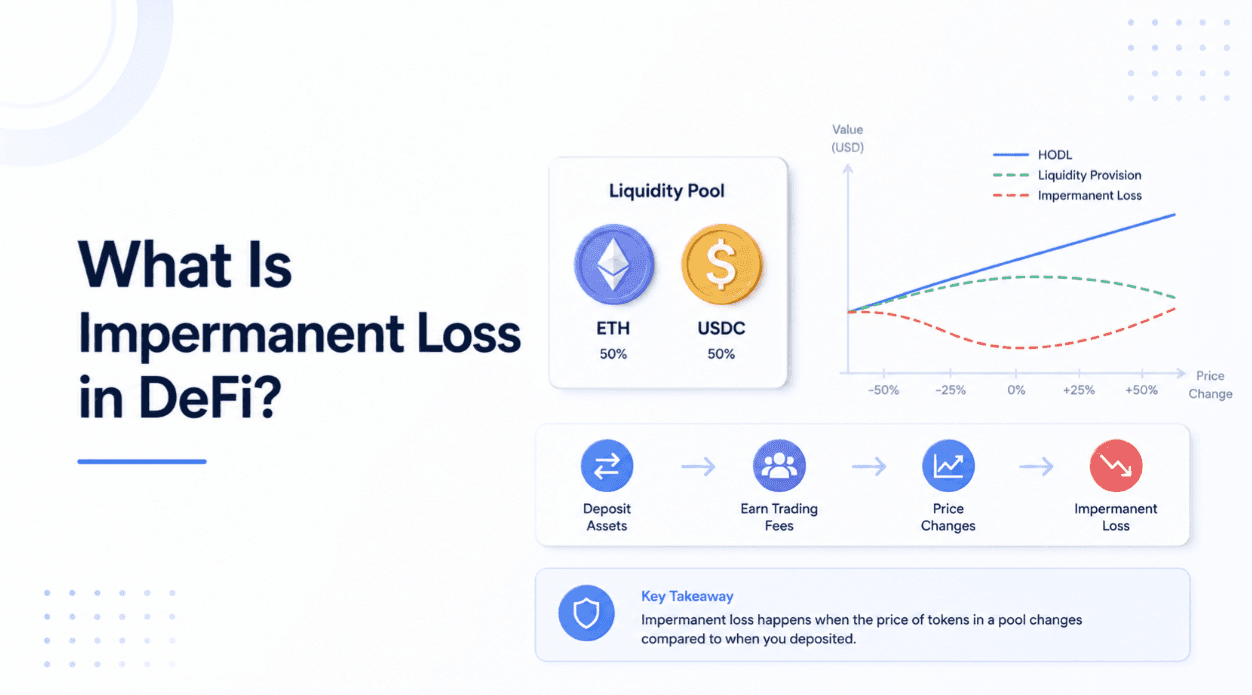
What Is Impermanent Loss in DeFi?
Impermanent loss quietly erodes the value of liquidity positions when token prices move. Here is why it happens, how big it gets, and when fees offset it.
Maria Fernandez · May 9, 2026→
Yield Farming and Liquidity Mining Explained
Yield farming chases returns by moving crypto between DeFi protocols. We break down where the yield comes from, how APY can mislead, and the risks behind big numbers.
David Turner · May 23, 2026→