How to Borrow Against Crypto Without Getting Liquidated
By David Turner
Senior Crypto Markets Reporter at CryptoCoinBeat. · November 6, 2026 · 11 min read
Published November 6, 2026 · Reviewed to our editorial standards. This article is informational and not financial advice.
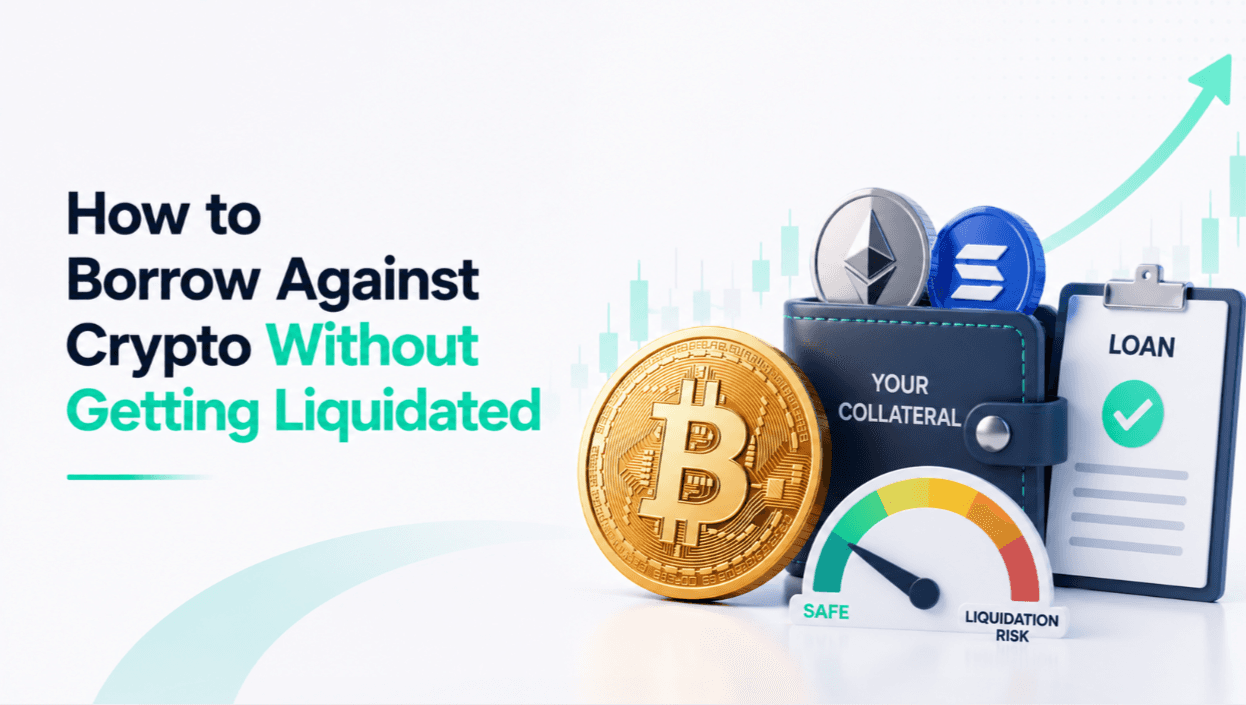
Borrowing against crypto is the most useful thing lending protocols do. You keep the asset, you get liquidity, and in many jurisdictions you have not triggered a disposal — which is why it is popular with people who do not want to sell.
It is also the fastest way to lose an asset you intended to keep for years. The difference between those two outcomes is entirely a matter of how much you borrow against how much, and that is a number you choose.
The three numbers that govern everything
Loan-to-value is what you have borrowed divided by what you posted. Post $10,000 of ether, borrow $4,000, and your LTV is 40%. This is the number you control.
The liquidation threshold is the LTV at which the protocol starts selling your collateral, set per asset — often around 75% to 85% for major assets and lower for volatile ones. This is the number the protocol controls.
The gap between them is your buffer, and it is measured in price movement. That third number is the only one that matters when the market moves, and almost nobody calculates it.
Doing the drawdown maths
Your collateral can fall by roughly one minus your LTV divided by the threshold, before liquidation begins. Work through it once and you will never size a loan carelessly again.
- 70% LTV against an 80% threshold: a 12.5% fall liquidates you. That is an ordinary Tuesday in crypto.
- 50% LTV against an 80% threshold: a 37.5% fall liquidates you. That is a bad month, and they happen most years.
- 33% LTV against an 80% threshold: a 58% fall liquidates you. That is a full bear market.
- 25% LTV against an 80% threshold: a 69% fall liquidates you. That is close to the worst drawdown on record for major assets.
Now look at your asset's actual history. Ether has fallen more than 60% from a local high several times; smaller assets have fallen 80% or more repeatedly. If your buffer is smaller than a drawdown the asset has already produced, you are not borrowing conservatively — you are betting that history stops.
What liquidation actually costs
More than the position. Liquidators are paid a bonus — typically 5% to 10% of the repaid amount — to do the work, and that bonus comes out of your collateral. You lose the asset at the worst price of the cycle and pay a penalty for the privilege.
And it is a disposal. Whatever tax deferral motivated the loan is undone at the moment of liquidation, at a price you did not choose, which is the least favourable version of the transaction you were trying to avoid.
The mistakes that produce liquidations
Borrowing at the top of the allowed LTV, because the protocol allowed it. The maximum is not a recommendation; it is the point past which the protocol will not lend, which is a different thing entirely.
Using volatile collateral to borrow more of the same asset, which is a leveraged long position with extra steps. Using a liquid staking token without accounting for its discount — liquidation prices on market quotes, so a liquidity discount can close a position that was never truly under-collateralised.
And not watching the borrow rate. Variable rates rise with utilisation, and interest accruing on a position you have forgotten about raises your LTV quietly while you do nothing at all.
How to build a position that survives
Start at 25% to 35% LTV on major assets and lower on anything else. Keep a reserve of the borrowed asset ready to repay with, so that adding a repayment is a five-minute job rather than a scramble. Set a price alert well above your liquidation level — not at it.
Prefer stable borrowing against volatile collateral rather than the reverse, so only one side of the trade is moving. Check the protocol's oracle for your collateral, because a price feed reading a thin local market is a real liquidation risk independent of the wider market — October 2025 demonstrated that at scale on a major venue.
And understand the pool you are in. A shared-pool protocol exposes every depositor to every listed asset; an isolated-market protocol contains a bad listing to that market. April 2026 turned that architectural difference into $177–236m of bad debt on one side and about $1m on the other, which is covered in Aave vs Morpho.
Custodial lending is a different product
Centralised lenders offer the same shape with an important structural difference: they hold your collateral and you cannot see what they do with it. Several rehypothecated customer assets and failed in 2022, taking the collateral with them.
Some have long records and honoured withdrawals through that period. Even so, the opacity is the product's defining feature, and it is why our lending table caps custodial platforms below on-chain protocols regardless of their rate cards.
What to do with the borrowed money
The purpose of the loan changes how much risk it carries. Borrowing to fund an expense you would otherwise have sold for is a deferral with a defined end. Borrowing to buy more of the same asset is leverage, and the collateral and the purchase fall together.
Have a repayment plan before you draw the loan: what repays it, from where, and by when. A crypto-backed loan with no repayment plan is not a loan, it is a slow sale conducted on the protocol’s terms rather than yours.
The short version
Decide what drawdown you want to survive, work backwards to the LTV that survives it, and borrow that much or less. Monitor the position monthly, keep repayment funds ready, and treat the protocol's maximum as a boundary rather than a target.
Done that way, a crypto-backed loan is a genuinely useful instrument. Done the other way, it is a mechanism for converting a long-term holding into a forced sale at the bottom.
Frequently asked questions
What LTV is safe for a crypto-backed loan?+
For major assets, 25% to 35% gives you a buffer that survives a 55% to 70% drawdown against a typical 80% threshold. Anything above 50% is liquidated by an ordinary bad month.
What happens when a crypto loan is liquidated?+
The protocol sells enough collateral to repay the debt and pays the liquidator a bonus, typically 5% to 10%, out of your collateral. It is also a taxable disposal at a price you did not choose.
Is borrowing against crypto taxable?+
In many jurisdictions taking a loan is not a disposal, which is why the strategy is used to defer gains. Liquidation is a disposal, so the deferral ends at the worst possible price.
Can interest alone cause liquidation?+
Yes. Variable borrow rates rise with utilisation, and accrued interest increases your loan-to-value even if the collateral price never moves.
Written by
David TurnerCryptocurrency Markets, Blockchain Technology, Tokenomics Analysis, Digital Asset Regulation, DeFi, Web3 Industry Cover
David Turner is a U.S.-based Markets Reporter at CRYPTO·COINBEAT, covering cryptocurrency markets, blockchain innovation, and the rapidly evolving digital asset ecosystem across North America. Raised in California and educated in economics and digital media, David combines strong analytical skills with years of experience reporting on financial markets and emerging technologies. He began his journalism career covering equity markets, Federal Reserve policy, and fintech developments for several financial news outlets before specializing in cryptocurrency. As blockchain technology gained mainstream adoption, David shifted his focus to Bitcoin, Ethereum, decentralized finance, and digital asset regulation. Prior to joining CRYPTO·COINBEAT, he reported extensively on crypto exchanges, institutional investment, stablecoins, and the expanding Web3 economy. At **CRYPTO·COINBEAT**, David delivers data-driven reporting designed to help readers understand the fast-moving digital asset industry. His coverage frequently explores U.S. crypto legislation, tokenomics, blockchain adoption, market sentiment, and the impact of macroeconomic events on cryptocurrency markets. He is particularly recognized for his in-depth analysis of token supply models, vesting schedules, liquidity trends, and the long-term sustainability of blockchain projects. David earned a B.A. in Economics from the University of California, Los Angeles (UCLA), and completed additional coursework in data journalism and financial analysis. He also authors the daily market briefing, **"Opening Bell Crypto,"** providing traders and investors with concise analysis of overnight market activity, key industry developments, and emerging investment trends.
Keep Reading
Crypto Lending and Borrowing in DeFi Explained
DeFi lending markets let anyone earn interest or borrow against crypto, governed entirely by code. Here is how collateral, rates, and liquidations actually work.
David Turner · May 2, 2026→
What Is Impermanent Loss in DeFi?
Impermanent loss quietly erodes the value of liquidity positions when token prices move. Here is why it happens, how big it gets, and when fees offset it.
Maria Fernandez · May 9, 2026→

Yield Farming and Liquidity Mining Explained
Yield farming chases returns by moving crypto between DeFi protocols. We break down where the yield comes from, how APY can mislead, and the risks behind big numbers.
David Turner · May 23, 2026→