Gnosis Pay vs Crypto.com Card: Two Opposite Designs
By Emily Carter
Policy Correspondent · October 7, 2026 · 9 min read
Published October 7, 2026 · Reviewed to our editorial standards. This article is informational and not financial advice.
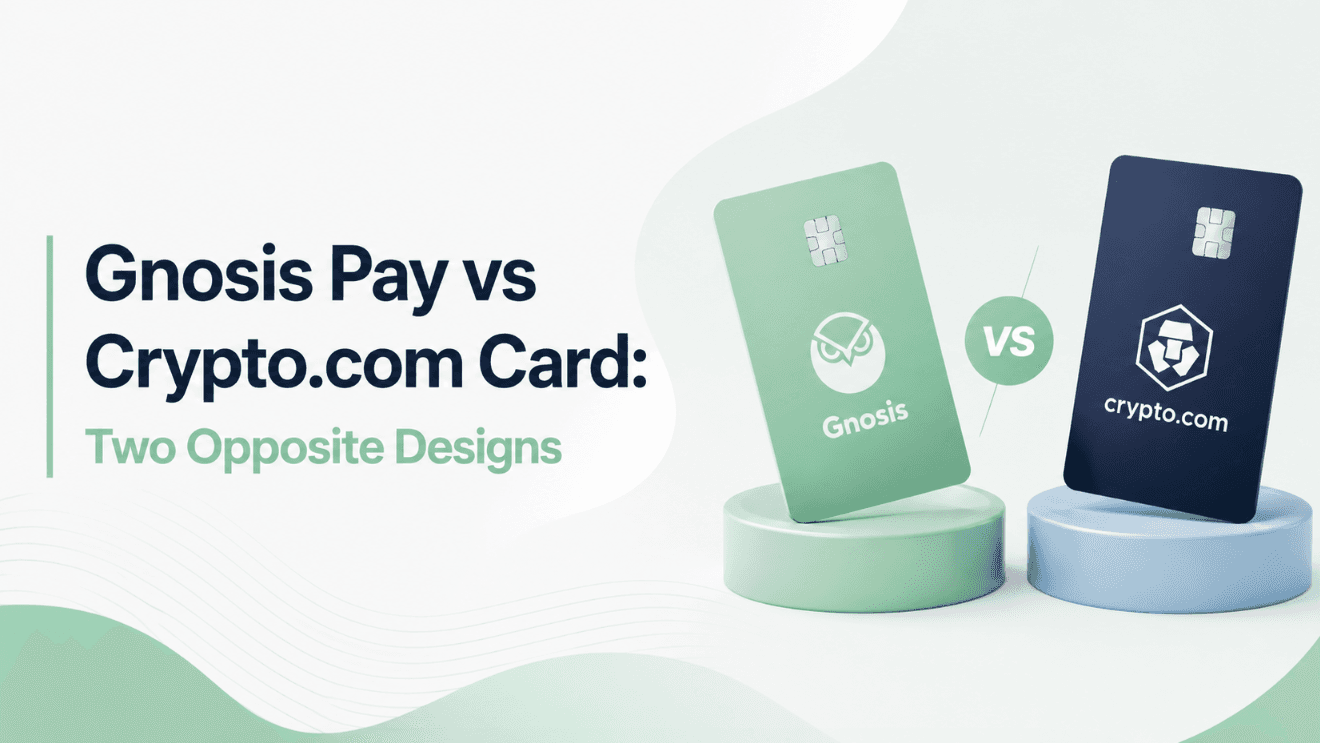
Most crypto card comparisons are tables of cashback percentages, which is the least interesting thing about them. The percentage changes at the issuer's discretion; the structure underneath does not, and the structure is what decides whether your money is available on a bad week.
Gnosis Pay and the Crypto.com card sit at opposite ends of that structural question, which makes them a useful pair to compare. One is custodial with rewards attached to a token position. The other is self-custodial with rewards as an afterthought.
Where the money sits
With the Crypto.com card, you fund an account on the platform and the platform settles your purchases from it. Between the moment you deposit and the moment you spend, the balance is an entry in their ledger — an obligation they owe you rather than an asset you hold.
Gnosis Pay works the other way. The card is bound to a smart contract account you control on Gnosis Chain, and settlement pulls from that account at the moment of purchase. The issuer sees the account and can block the card, but the balance is not in their custody in the ordinary sense.
That difference is invisible on a normal Tuesday and decisive during an incident. Custodial balances have been frozen during platform trouble; a balance in an account you hold keys to keeps behaving like your money regardless of what happens to the card programme.
What each one settles in
Crypto.com lets you fund from a wide range of assets, converting at spend time. That flexibility is genuinely useful, and it has a cost: each purchase settled from a volatile asset is a disposal in most tax systems, and the conversion carries a spread you do not see itemised.
Gnosis Pay settles from a euro-denominated e-money token issued by a regulated European issuer, with sterling and other currencies depending on your region. Because that token tracks the currency you are billed in, there is effectively no conversion spread and almost no gain to report — the mechanics are set out in spending crypto without a tax event.
If you want to spend bitcoin directly and do not mind the paperwork, the Crypto.com model does that and Gnosis Pay does not. If you want a card that behaves like a bank card funded from crypto rails, the comparison runs the other way.
Rewards, and what they cost to earn
Crypto.com's headline cashback rates are tiered, and the higher tiers require staking CRO for a fixed period. That is the part worth pausing on: the reward is not free, it is paid for by taking a price position in the platform's own token and locking it up.
Model it honestly. If the stake required for a tier is worth several thousand pounds and the token falls thirty per cent during the lock, the cashback on ordinary spending will not come close to covering the loss. The tiers have also been restructured before, with rates cut while stakes remained locked.
Gnosis Pay ran an equivalent programme tied to holding GNO, which ended on 31 March 2026 with a replacement pending a governance vote. So its rewards case is currently weaker than its custody case, and the card works without either. Neither card should be chosen for its rewards; both should be chosen for what they do when you are not thinking about them.
Availability and everyday reliability
Crypto.com's card programme covers more regions and has the deeper support operation, which counts for something when a transaction is declined at a till. Gnosis Pay's coverage is narrower and its support is smaller, in the way that early products usually are.
Both run on Visa rails, so acceptance at the point of sale is identical — the merchant sees an ordinary card. The differences show up around the edges: pre-authorisations at hotels and fuel stations, refunds, and how quickly a frozen card gets unfrozen.
The failure modes are different
A custodial card fails as a platform: withdrawals pause, balances become claims, and you wait. A self-custodial card fails as a programme: the card stops working, but the money in the account is still yours to move to another wallet the same afternoon.
Neither is immune to the more common failure, which is a banking or issuing partner ending the relationship. Cards in this category have gone dark at short notice more than once, which is why the standing advice is to keep only spending money on any crypto card and carry a conventional fallback.
The paperwork each one leaves behind
A card selling a volatile asset at every purchase generates a disposal per transaction, and a year of coffee and groceries becomes several hundred rows to reconcile. A card settling from a currency-pegged balance generates a handful of events — the top-ups — and near-zero gains on each.
That is not a footnote for anyone in a jurisdiction that taxes disposals. Whichever card you choose, export transaction history monthly rather than reconstructing it in filing season, when the data is harder to get and the memory of what each purchase was has gone.
Which one to pick
- Spending a mixed crypto portfolio and want wide regional coverage: Crypto.com, with the tax record-keeping that implies.
- Want a euro or sterling card funded from on-chain balances you keep custody of: Gnosis Pay.
- Chasing the top cashback tier: model the required stake as a leveraged token position, because that is what it is.
- Cannot tolerate the card going dark for a fortnight: hold a bank card as backup regardless of which you choose.
Our best crypto cards table scores both on all-in cost, custody model, regional coverage and programme stability, which are the four axes this comparison actually turns on.
Frequently asked questions
Is Gnosis Pay really self-custodial?+
The spending balance sits in a smart account you hold keys to, and settlement pulls from it at purchase time. The issuer can freeze the card, but it does not hold the balance the way a platform account does.
Do I have to stake CRO to use the Crypto.com card?+
No — the entry tier requires no stake, but the higher cashback rates do. Treat any required stake as a locked position in a volatile token, not as a deposit.
Which card is cheaper to use?+
Usually the one settling from a token pegged to your billing currency, because it avoids the conversion spread charged when a volatile asset is sold at the till.
Can either card be used anywhere Visa is accepted?+
At the point of sale, yes — the merchant sees an ordinary Visa card. Regional availability of the card itself differs, and Crypto.com currently covers more markets.
Written by
Emily CarterFormer regulatory analyst · J.D.
Emily Carter is a legal and regulatory writer specializing in cryptocurrency, blockchain policy, and digital asset compliance. Before joining CRYPTO·COINBEAT, she worked as a regulatory analyst in the United States, tracking developments in federal financial legislation, anti-money laundering (AML) requirements, and emerging policies shaping the digital asset industry. She earned her Juris Doctor (J.D.) degree and combines legal expertise with a talent for translating complex regulatory topics into clear, accessible language. Her work focuses on cryptocurrency taxation, DeFi regulation, exchange compliance, stablecoins, and the evolving role of U.S. agencies in overseeing digital assets. At CRYPTO·COINBEAT, Emily writes educational guides and policy explainers designed for both newcomers and experienced crypto users. She is committed to helping readers understand how regulatory changes affect investors, businesses, and the broader blockchain ecosystem.
Keep Reading
Crypto Volatility and Risk Management: A Practical Framework
Volatility is the price of admission to crypto. Managing it — rather than fearing it — is what separates survivors from casualties.
Maria Fernandez · April 25, 2026→
Dollar-Cost Averaging in Crypto: A Practical Guide
Buying fixed amounts on a fixed schedule removes the pressure of timing the market. Here is how DCA works in crypto.
David Turner · May 5, 2026→

Crypto Market Cycles: What Drives Bull and Bear Markets
Crypto moves in cycles of expansion and contraction. Understanding the forces behind them beats trying to time them.
Maria Fernandez · May 23, 2026→