How to Spend Crypto Without Creating a Tax Event
DeFi Protocols & RWA On-Chain Analyst · October 5, 2026 · 8 min read
Published October 5, 2026 · Reviewed to our editorial standards. This article is informational and not financial advice.
In most jurisdictions, spending cryptocurrency is a disposal. The purchase itself is not the taxable event — converting the asset to settle it is, and that produces a gain or loss against your cost basis on every transaction, however small.
Someone using a crypto card daily can generate several hundred disposals a year. Each one technically requires a cost basis, a proceeds figure and a calculation. There are three ways to make that manageable, and they differ enormously in how much they help. None of this is tax advice, and the rules differ by country and change between years — confirm anything consequential with a professional where you file.
Method one: spend a stablecoin
The disposal still happens, but the gain is near zero because the asset's value has barely moved between acquisition and spending. The calculation becomes trivial and the tax owed is negligible.
This is the simplest improvement available and it costs nothing: hold a spending balance in a stablecoin, top it up deliberately when you choose to realise a gain, and let the card draw from that. You have converted hundreds of messy disposals into a handful of decisions you control the timing of.
Method two: borrow instead of selling
Some cards operate in a credit mode: the purchase draws against your crypto as collateral rather than selling it. In many jurisdictions a loan is not a disposal, so no gain is realised and nothing is reportable at the point of spending.
The cost is the published interest rate and the risk profile of a collateralised loan — a sharp price fall can trigger liquidation, which is itself a disposal, and at the worst possible price. Keep the loan-to-value well below the liquidation threshold, and understand that you have traded a tax event for a market risk.
Method three: time your disposals deliberately
If you are going to realise gains anyway, choosing when is worth real money. Many jurisdictions have annual allowances, different rates by holding period, and loss offsets that only apply within a tax year.
Converting a lump sum to a stablecoin at a moment you choose lets you use those rules; spending a volatile asset piecemeal all year does not, because the disposals happen whenever you buy lunch. This is where the largest savings usually sit, and it requires nothing but planning.
What does not work
- Assuming small transactions are exempt. Some jurisdictions have de minimis rules and most do not; verify rather than hope.
- Moving between your own wallets to "reset" a basis. Transfers between your own accounts are generally not disposals and do not change the basis.
- Treating a swap between two crypto assets as non-taxable. In most jurisdictions it is a disposal of the first asset, whether or not fiat was involved.
- Relying on the exchange to calculate it. Venues provide data, not a filing, and they see only the activity that happened on them.
Keep the records as you go
Whatever method you use, export transaction history monthly rather than annually. Reconstructing a year of card spending from statements is the single most tedious job in crypto tax, and it is entirely avoidable with a folder and a recurring reminder.
Record the date, the asset, the amount, the fiat value at the time and the fee. Our tax guide covers the wider picture, and our best crypto cards table records which cards offer a credit mode rather than selling on every purchase.
Two jurisdictional wrinkles worth knowing
First, holding period frequently changes the rate. Several jurisdictions tax gains on assets held beyond a threshold — a year in many cases — at a materially lower rate or not at all, which means the order in which you dispose of lots can change the bill significantly.
Second, cost basis method matters. Where the rules permit specific identification, choosing which lot you are disposing of lets you realise a loss deliberately or preserve a long-held position; where they impose an averaging or first-in-first-out rule, that choice is not available and your planning has to happen at the acquisition stage instead.
Both of these are jurisdiction-specific and both are worth confirming once, because they apply to every disposal you make thereafter.
The practical setup
For most people: hold savings in volatile assets and never spend them directly, keep a stablecoin balance for the card, and top it up two or three times a year at moments you choose. That produces a handful of documented disposals instead of hundreds, uses whatever allowances apply, and takes ten minutes a quarter.
One caution on the borrowing route: interest accrues whether or not the market moves, so a loan taken to avoid a disposal becomes expensive if you carry it for years. Model the interest against the tax you deferred rather than treating deferral as free, because at a high enough rate the loan costs more than the gain would have.
And keep the two decisions separate. Whether to realise a gain is a tax question; whether to borrow against collateral is a risk question. Answering the second with the first is how people end up over-leveraged in a falling market for reasons that started out as sensible bookkeeping.
For larger holdings where the tax on realising gains is significant, a credit-mode card is worth modelling seriously — with the liquidation risk sized so that a bad month cannot force a sale at the worst moment. Run the numbers on your own spending before committing to either approach.
Frequently asked questions
Is spending crypto taxable?+
In most jurisdictions, yes — spending is a disposal, so each purchase creates a gain or loss against your cost basis. The purchase is not taxed; the conversion of the asset to settle it is.
Does spending a stablecoin avoid tax?+
It does not avoid the disposal, but the gain is near zero because the asset's value has barely moved, so the amount owed and the paperwork both shrink to almost nothing.
Is borrowing against crypto taxable?+
In many jurisdictions a loan is not a disposal, so borrowing against collateral to spend does not realise a gain. The trade-off is liquidation risk, which would itself be a disposal at a bad price.
Do I need to report every small crypto purchase?+
Some jurisdictions have de minimis exemptions and many do not. Check the rules where you file rather than assuming small amounts are ignored, and keep monthly records either way.
Written by
Maria FernandezDeFi Protocols, Real-World Assets, On-Chain Analytics, Stablecoins, Spanish-Language Coverage
Maria Fernandez is an On-Chain Research Analyst at **CRYPTO·COINBEAT**, specializing in real-world asset (RWA) tokenization, decentralized finance, and stablecoin ecosystems. Originally from Mexico City and now based in Miami, Maria brings a unique Latin American perspective to blockchain research, combining deep technical analysis with insights into emerging digital asset markets across the Americas. Before joining **CRYPTO·COINBEAT**, Maria spent several years researching decentralized finance protocols, producing in-depth analysis on lending platforms, governance systems, and the growing adoption of tokenized real-world assets. Her early research into institutional RWA integration and decentralized collateral models helped explain one of the fastest-growing sectors within the blockchain industry. Maria's analytical approach combines on-chain transaction analysis, protocol revenue metrics, liquidity monitoring, and governance activity to evaluate the long-term health of DeFi ecosystems. She works extensively with blockchain analytics platforms, including Dune Analytics, Nansen, and Flipside Crypto, and has created numerous public dashboards that simplify complex blockchain data for investors and researchers alike. Her coverage of stablecoin market events and liquidity shifts has helped readers better understand risk during periods of heightened market volatility. She holds a B.Sc. in Industrial Engineering from ITAM (Instituto Tecnológico Autónomo de México) and a Graduate Certificate in FinTech from MIT Sloan. Passionate about blockchain education, Maria regularly contributes both English- and Spanish-language research, helping make advanced on-chain analysis more accessible to a global audience while supporting the continued growth of crypto adoption throughout Latin America.
Keep Reading
KYC and AML in Crypto Explained
KYC verifies who you are; AML is the broader effort to stop illicit money moving through crypto. Together they shape how regulated platforms operate.
Emily Carter · April 27, 2026→

Is Cryptocurrency Legal? A Country-by-Country Guide
Cryptocurrency is legal to own and trade in most countries, restricted in some, and banned in a few. Status depends on local law and changes over time.
Maria Fernandez · May 9, 2026→
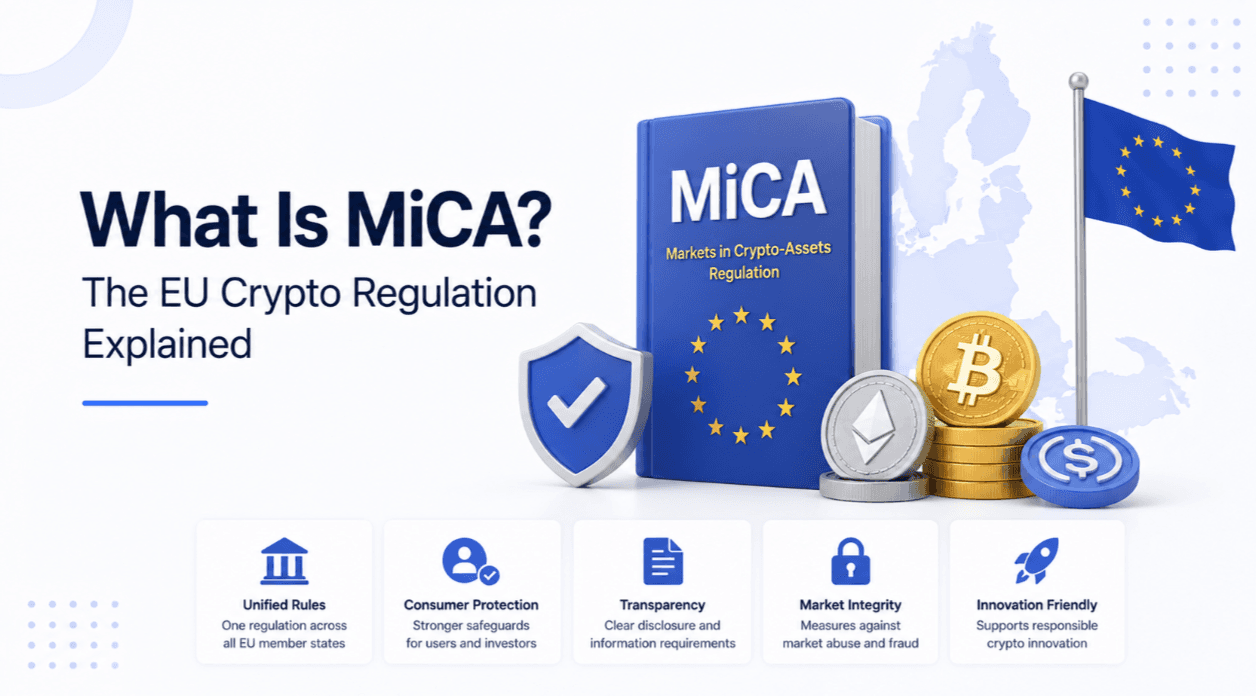
What Is MiCA? The EU Crypto Regulation Explained
MiCA is the European Union's dedicated framework for crypto-assets, creating one set of rules across member states for issuers, stablecoins and service providers.
Emily Carter · May 23, 2026→