How to Evaluate a Yield Vault in Ten Minutes
By Emily Carter
Policy Correspondent · November 16, 2026 · 10 min read
Published November 16, 2026 · Reviewed to our editorial standards. This article is informational and not financial advice.
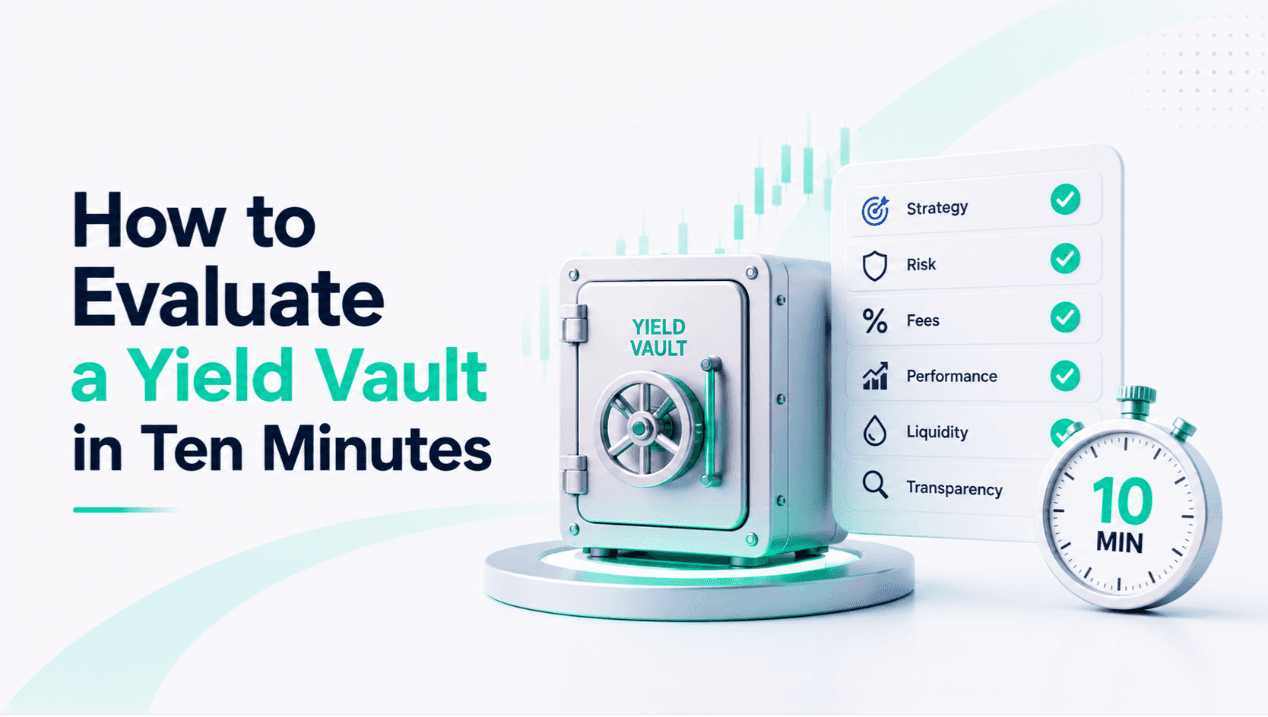
A yield vault takes your deposit, runs a strategy with it and returns the proceeds minus fees. The good ones are genuinely useful: professional strategy management, automatic compounding, gas costs shared across depositors.
The bad ones are opaque wrappers around risk you would decline if you could see it. Here is a repeatable check that separates them, in about the time it takes to make coffee.
Minute one to three: what does it actually do?
Find the strategy description. Not the marketing summary — the specific statement of which protocols the capital enters, what positions it takes and where the return comes from. Serious vaults publish this plainly.
If you cannot state the strategy in one sentence after reading, the disclosure has failed and that is the finding. 'Optimised yield across DeFi' is not a strategy description; 'supplies USDC to lending markets and rotates to the highest utilisation weekly' is.
Then ask whether you would take that position yourself if the vault did not exist. If not, the vault is not making the risk acceptable — it is only making it less visible.
Minute three to five: count the dependencies
Every protocol the strategy touches is a contract that can be exploited, a governance process that can act, and a price feed that can be wrong. Count them, and count the assets too: a strategy holding a liquid restaking token is holding staking plus restaking plus a bridge.
Three or fewer dependencies is a comprehensible position. Six is a chain where you cannot reason about the failure modes, and the April 2026 losses travelled precisely along chains like that one — from a bridge, through a restaking token, into lending markets, and out to depositors who had never heard of the adapter that broke.
Minute five to seven: read the fees properly
Three layers are common: a management fee on assets, a performance fee on returns, and sometimes a withdrawal fee. A 2% management and 20% performance structure takes a large bite out of a single-digit yield.
Check whether performance fees carry a high-water mark. Without one, a vault that loses 20% and then gains 20% charges you a performance fee for getting back to where you started, which is not performance by any ordinary meaning of the word.
Then check whether the advertised APY is quoted before or after fees. Both conventions exist, and the difference is exactly the amount you were trying to measure.
Minute seven to nine: split income from emissions
Find out what share of the return is real income — lending interest, trading fees, staking rewards — and what share is the protocol's own token being distributed. The emissions portion ends when the schedule does.
A vault whose yield is mostly emissions is a temporary opportunity, and there is nothing wrong with taking it as long as you know that is what you took. A vault that does not disclose the split has told you which kind it is.
Minute nine to ten: check the exit
Can you withdraw immediately, or does the strategy hold positions that must be unwound first? Locked staking, long exit queues and illiquid positions all mean the vault's exit is slower than its deposit, and that asymmetry only reveals itself when many people leave at once.
Look for a withdrawal queue, a buffer of liquid assets, and any provision allowing the vault to pause withdrawals. That last clause exists in more products than people realise, and it is worth knowing about before you rely on the money.
Check who can change things
A vault contract that can be upgraded by a single key is a vault whose strategy can become a different strategy without notice. Look for a multisig with named signers, a timelock delaying changes, and a published record of past upgrades.
The timelock is the important one, because it converts a silent change into an announced one and gives depositors time to leave. Its absence is not proof of bad intent, but it means your only protection is the manager’s continued goodwill — which is not a security model.
Check the same for the underlying protocols, since a strategy is only as immutable as the things it deposits into. Our best DeFi protocols table records upgrade controls and audit history for the major venues these vaults build on.
The disqualifying findings
- No specific strategy disclosure, only category language.
- An advertised rate with no breakdown between income and emissions.
- Performance fees with no high-water mark.
- Upgradeable contracts with no timelock, meaning the strategy can change without warning.
- A dependency chain you cannot follow to its end, particularly one crossing a bridge.
Any one of these is enough to walk away. There are plenty of vaults that fail none of them.
What the good ones look like
Published strategy, named curators or managers with a track record, contracts audited and timelocked, fees disclosed with a high-water mark, income and emissions split out, and an honest description of the exit path including its worst case.
That combination exists across the established vault protocols, and it is what our yield aggregators table scores: strategy disclosure, dependency depth, fee load and emission share, with sources for each.
Ten minutes is not an audit and does not pretend to be. It is a filter, and the great majority of what goes wrong in yield products is caught by a filter this simple — which is the uncomfortable part.
Frequently asked questions
How do I know if a DeFi vault is safe?+
You cannot verify safety in a short check, but you can establish what it does, what it depends on, what it charges and how you exit. Most failures are visible in those four answers.
What is a high-water mark on a performance fee?+
A rule preventing the manager charging performance fees until previous losses are recovered. Without one, a vault that falls and recovers charges you for round-tripping to where you began.
How many protocols should a yield strategy depend on?+
Three or fewer keeps the failure modes comprehensible. Longer chains — especially any crossing a bridge — are where the sector's largest losses have travelled.
Should I use a yield vault at all?+
They are useful for shared gas costs, automatic compounding and professional strategy management. The test is whether you would take the underlying position yourself if the wrapper did not exist.
Written by
Emily CarterFormer regulatory analyst · J.D.
Emily Carter is a legal and regulatory writer specializing in cryptocurrency, blockchain policy, and digital asset compliance. Before joining CRYPTO·COINBEAT, she worked as a regulatory analyst in the United States, tracking developments in federal financial legislation, anti-money laundering (AML) requirements, and emerging policies shaping the digital asset industry. She earned her Juris Doctor (J.D.) degree and combines legal expertise with a talent for translating complex regulatory topics into clear, accessible language. Her work focuses on cryptocurrency taxation, DeFi regulation, exchange compliance, stablecoins, and the evolving role of U.S. agencies in overseeing digital assets. At CRYPTO·COINBEAT, Emily writes educational guides and policy explainers designed for both newcomers and experienced crypto users. She is committed to helping readers understand how regulatory changes affect investors, businesses, and the broader blockchain ecosystem.
Keep Reading
Crypto Lending and Borrowing in DeFi Explained
DeFi lending markets let anyone earn interest or borrow against crypto, governed entirely by code. Here is how collateral, rates, and liquidations actually work.
David Turner · May 2, 2026→
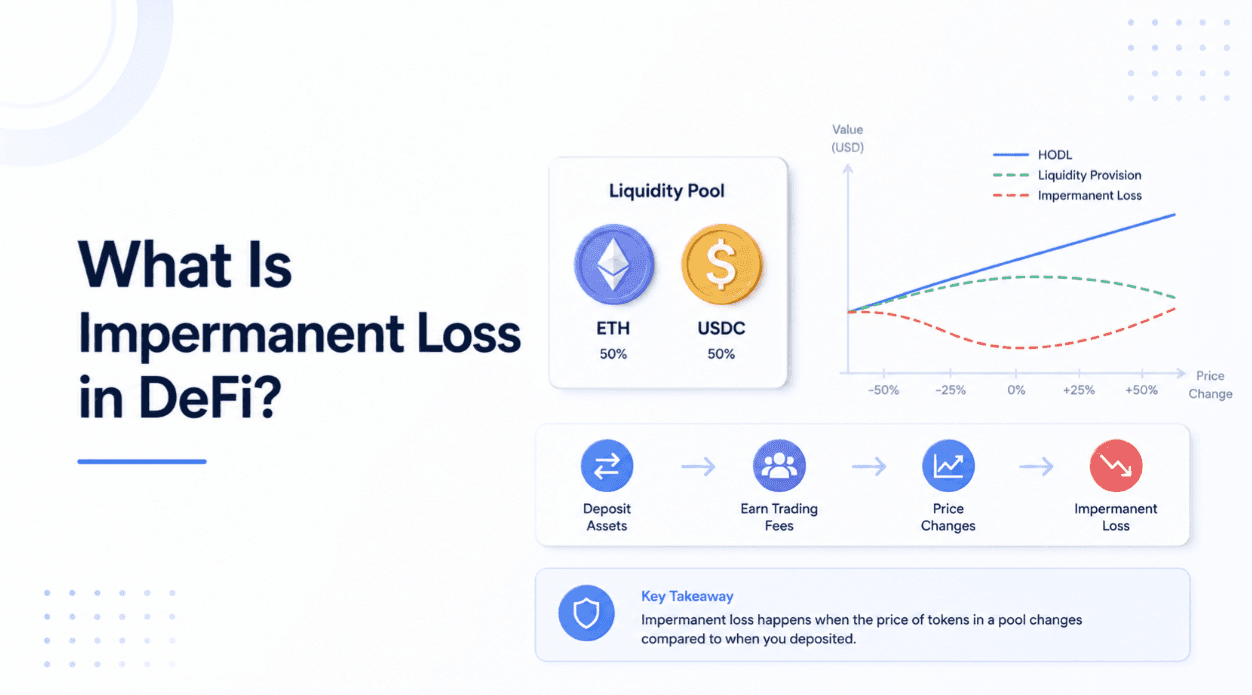
What Is Impermanent Loss in DeFi?
Impermanent loss quietly erodes the value of liquidity positions when token prices move. Here is why it happens, how big it gets, and when fees offset it.
Maria Fernandez · May 9, 2026→
Yield Farming and Liquidity Mining Explained
Yield farming chases returns by moving crypto between DeFi protocols. We break down where the yield comes from, how APY can mislead, and the risks behind big numbers.
David Turner · May 23, 2026→