Stablecoins Explained: What Actually Backs a Digital Dollar
By David Turner
Senior Crypto Markets Reporter at CryptoGrows. · September 21, 2026 · 11 min read
Published September 21, 2026 · Reviewed to our editorial standards. This article is informational and not financial advice.
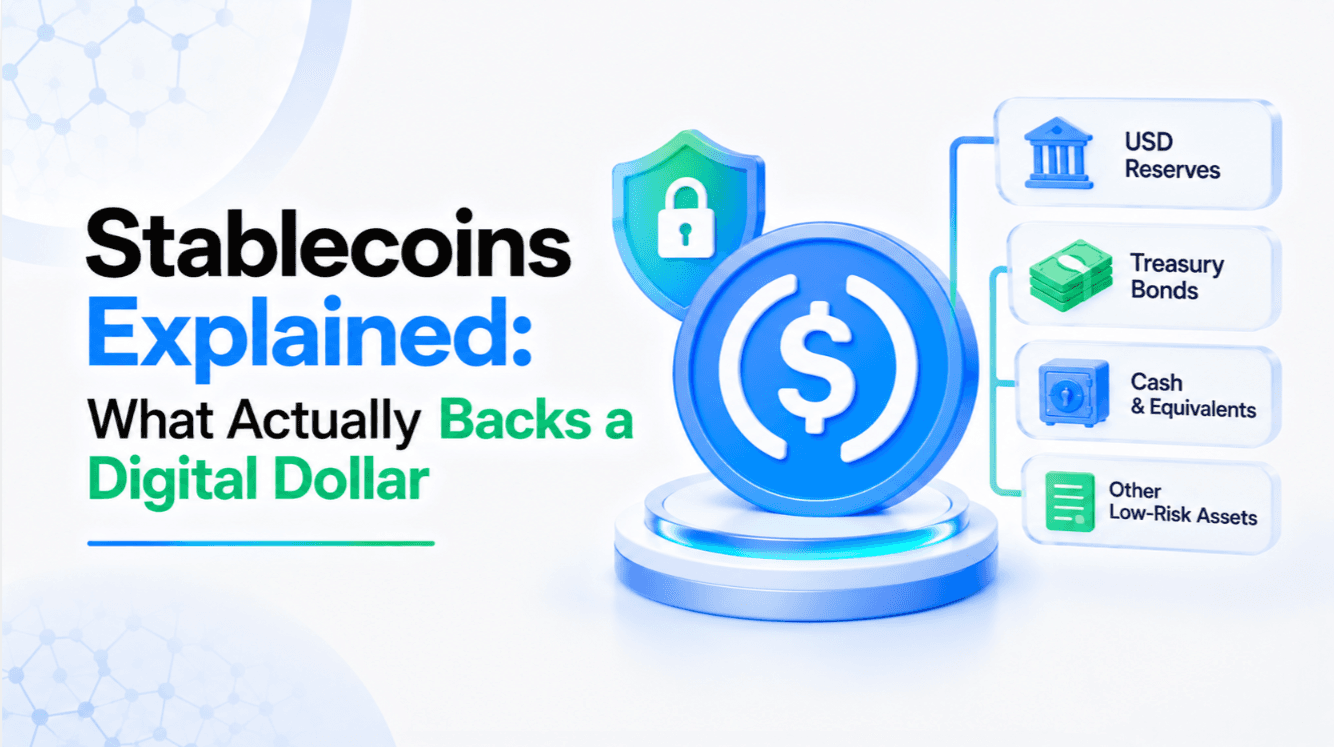
Stablecoins are the plumbing of crypto. They settle most trading volume, they carry most cross-border value moving on public chains, and they are the asset people actually hold between decisions. A market that could not agree on much has agreed on the dollar.
What varies enormously is what stands behind each one. A stablecoin is a promise that a token equals a dollar, and the promises differ so much that treating them as one asset class is the first mistake. Here is how each design works and what breaks it.
Design one: reserve-backed
The issuer holds dollars and short-dated government debt, and mints one token per dollar received. USDC, USDT, PYUSD and RLUSD all work this way. The token is a claim on that reserve, redeemable at par by whoever the issuer's terms say can redeem.
The strengths are obvious: if the reserve is real, liquid and honestly reported, the peg holds through anything the crypto market can generate. The weaknesses are inherited from traditional finance — where the reserve is banked, who checks it, and whether the issuer can be compelled to freeze balances.
March 2023 demonstrated both halves at once. USDC fell to roughly $0.87 when $3.3bn of its cash reserve sat at Silicon Valley Bank as the bank failed, and recovered within days once deposits were guaranteed. The reserve was real and identifiable, which is why the peg came back — and it was exposed to exactly the kind of banking risk a digital dollar is often assumed to escape.
Design two: crypto-collateralised
Instead of a bank account, the backing is on-chain assets locked in contracts, over-collateralised so a price fall does not immediately break the peg. DAI and its successor USDS are the long-running examples, and crvUSD is a newer one.
The advantage is verification: every unit of collateral is visible in real time and needs no attestation, because you can read it yourself. The disadvantage is that crypto collateral is volatile, so the system needs liquidation machinery that works during exactly the conditions that stress it — which is what failed on Black Thursday in March 2020, when congestion let keepers win collateral auctions at zero bids and left the system several million DAI short.
The modern complication is that a large share of the backing has moved into tokenised real-world assets, which reintroduces the off-chain counterparty risk the design existed to avoid. It also produced the revenue that funds the system. Whether that trade was right is the most consequential open argument in DeFi.
Design three: hedged, or delta-neutral
USDe is the prominent example. It is not reserve-backed at all: it holds spot collateral and offsets the price risk with short perpetual futures at centralised venues, with the funding rate as the yield. The token is a position, not a deposit.
In October 2025 that distinction became visible. During the largest liquidation cascade crypto has produced, the protocol held par on-chain and processed about $2bn of redemptions in 24 hours, while the token printed as low as $0.65 on Binance — because that venue's oracle read its own thin internal order book rather than deeper external liquidity. The design worked; the venue pricing it did not, and holders using it as collateral there were liquidated regardless.
The design that keeps failing
Algorithmic stablecoins backed by nothing but a companion token, which the protocol mints and burns to defend the peg, have failed repeatedly and catastrophically. The mechanism depends on the companion token retaining value, and it stops retaining value at precisely the moment the peg is under pressure.
There is no version of this that has survived a serious test. Treat any token whose backing consists of the issuer's own token as a leveraged bet on that issuer, priced at a dollar.
Attestation is not audit
For any reserve-backed token, the reporting is what you actually have. An attestation confirms specified figures at a point in time under agreed procedures; an audit examines financial statements as a whole. Most stablecoin reporting is the former, described in language that implies the latter.
USDC publishes monthly attestations by a major accounting firm alongside audited accounts from an issuer listed on the NYSE since June 2025. USDT publishes quarterly attestations and has never published a full financial-statement audit in its entire history. Both hold their pegs; they do not offer the same evidence, and our best stablecoins table scores exactly that gap.
Who can actually redeem
Read this before assuming a peg is guaranteed. At most centralised issuers, par redemption is available to verified institutional customers above a published minimum — not to a retail holder. Everyone else exits through the secondary market, where the price is whatever arbitrage makes it.
That works well and it is a different thing from a personal right to redeem. On-chain designs like USDS and crvUSD invert this: anyone can mint and redeem against the protocol at published parameters, which is why they score higher on redemption access even with far smaller supply.
How to choose one
- For trading and moving between venues: liquidity wins, which usually means USDT for reach and USDC where both are quoted.
- For holding a balance: reserve quality and disclosure win, which means USDC or a trust-issued token like PYUSD or RLUSD.
- For on-chain verification without trusting a report: USDS or DAI, accepting the real-world-asset exposure in the collateral mix.
- For yield: understand you are buying a strategy rather than a dollar, and read where the yield comes from before sizing the position.
Whichever you choose, hold it somewhere you control. A stablecoin balance on an exchange carries the issuer's risk and the venue's risk stacked on top of each other, which is the case for keeping savings in self-custody set out in custodial vs non-custodial wallets.
And regardless of which you hold, remember what a stablecoin is not. It is not a bank deposit, it is not insured, and in most cases you cannot demand redemption yourself. It behaves like cash right up until the day it does not — which is a rare day, and worth being prepared for.
Frequently asked questions
What backs a stablecoin?+
It depends on the design. Reserve-backed tokens like USDC and USDT hold cash and short-dated government debt; crypto-collateralised ones like DAI hold on-chain assets you can verify directly; hedged designs like USDe hold spot collateral offset by short futures. Algorithmic tokens backed only by a companion token have failed repeatedly.
Are stablecoins safe?+
The major reserve-backed ones have held their pegs through every crisis since 2017, with brief exceptions during banking stress. What they are not is insured deposits: you hold a claim on an issuer, and in most cases only institutions can redeem at par directly.
Why do stablecoins lose their peg?+
Usually because of what backs them rather than crypto volatility — USDC fell to $0.87 when part of its reserve sat at a failing bank, and USDe printed $0.65 on one exchange whose oracle read a thin internal book. Both recovered as the underlying cause resolved.
Which stablecoin is the safest to hold?+
On reserve quality and disclosure, USDC leads among the majors: monthly attestations by a major accounting firm and audited accounts from a listed issuer. USDT offers deeper liquidity with weaker reporting, which is the trade our stablecoins table scores.
Written by
David TurnerCryptocurrency Markets, Blockchain Technology, Tokenomics Analysis, Digital Asset Regulation, DeFi, Web3 Industry Cover
David Turner is a U.S.-based Markets Reporter at CRYPTO·COINBEAT, covering cryptocurrency markets, blockchain innovation, and the rapidly evolving digital asset ecosystem across North America. Raised in California and educated in economics and digital media, David combines strong analytical skills with years of experience reporting on financial markets and emerging technologies. He began his journalism career covering equity markets, Federal Reserve policy, and fintech developments for several financial news outlets before specializing in cryptocurrency. As blockchain technology gained mainstream adoption, David shifted his focus to Bitcoin, Ethereum, decentralized finance, and digital asset regulation. Prior to joining CRYPTO·COINBEAT, he reported extensively on crypto exchanges, institutional investment, stablecoins, and the expanding Web3 economy. At **CRYPTO·COINBEAT**, David delivers data-driven reporting designed to help readers understand the fast-moving digital asset industry. His coverage frequently explores U.S. crypto legislation, tokenomics, blockchain adoption, market sentiment, and the impact of macroeconomic events on cryptocurrency markets. He is particularly recognized for his in-depth analysis of token supply models, vesting schedules, liquidity trends, and the long-term sustainability of blockchain projects. David earned a B.A. in Economics from the University of California, Los Angeles (UCLA), and completed additional coursework in data journalism and financial analysis. He also authors the daily market briefing, **"Opening Bell Crypto,"** providing traders and investors with concise analysis of overnight market activity, key industry developments, and emerging investment trends.
Keep Reading
Crypto Lending and Borrowing in DeFi Explained
DeFi lending markets let anyone earn interest or borrow against crypto, governed entirely by code. Here is how collateral, rates, and liquidations actually work.
David Turner · May 2, 2026→
What Is Impermanent Loss in DeFi?
Impermanent loss quietly erodes the value of liquidity positions when token prices move. Here is why it happens, how big it gets, and when fees offset it.
Maria Fernandez · May 9, 2026→

Yield Farming and Liquidity Mining Explained
Yield farming chases returns by moving crypto between DeFi protocols. We break down where the yield comes from, how APY can mislead, and the risks behind big numbers.
David Turner · May 23, 2026→