USDC vs USDT: Reserves, Disclosure and Where Each Wins
By David Turner
Senior Crypto Markets Reporter at CryptoCoinBeat. · September 25, 2026 · 9 min read
Published September 25, 2026 · Reviewed to our editorial standards. This article is informational and not financial advice.
USDC and USDT together account for the overwhelming majority of stablecoin value in circulation, and the choice between them is genuinely a choice rather than a preference. They differ on the two axes that decide whether a stablecoin is sound — what backs it and who verifies that — and on the axis that decides whether it is useful, which is liquidity.
Neither is obviously correct for every purpose. Most people who think carefully about it end up holding both, for different jobs.
What each one holds
USDC's reserves sit in cash at regulated banks and short-dated US Treasuries held through a government money-market fund, with holdings published weekly at instrument level. The composition is deliberately dull: everything in it can be liquidated the same day.
USDT is majority short-dated US Treasuries by its issuer's own reporting, with a remainder that includes secured loans, precious metals, bitcoin and other investments. The composition is published quarterly. Those non-Treasury holdings are the substantive criticism: they are less liquid, and their valuation is harder for an outsider to check.
Who checks, and how often
USDC publishes monthly attestations signed by a major accounting firm, and since Circle listed on the NYSE in June 2025, audited financial statements of the issuer itself — examined on a schedule with legal consequences attached to getting them wrong.
USDT publishes quarterly attestations by an accounting firm. No full financial-statement audit has been published in the token's history, and that gap has persisted through a decade of the company being asked about it. It is not evidence of a problem; it is the absence of the strongest available evidence that there is not one.
How each behaved under stress
USDC fell to roughly $0.87 in March 2023 when $3.3bn of its reserve sat at Silicon Valley Bank as the bank failed, recovering within days once deposits were guaranteed. The token's weakness was where the cash was banked, not whether it existed.
USDT fell to roughly $0.95 in May 2022 during the Terra collapse, as holders sold pre-emptively rather than because anything in the reserve had changed. It recovered within days, and has held par through every subsequent crisis. Both tokens have a depeg on the record; neither has failed.
Liquidity, and why it keeps winning
USDT trades on more venues, more chains and in more pairs than anything else in crypto. For moving size between exchanges, quoting pairs on venues where it is the base asset, or operating in markets where local rails settle in it, nothing else is close.
That ubiquity is why the market has never punished the disclosure gap. Traders are exposed for hours; the depth saves them money on every trade, and the reserve question only matters on a day that has not arrived.
Redemption: neither is for you
Both offer par redemption to verified customers above published minimums, which in practice means institutions. As a retail holder your exit is the secondary market, where arbitrage keeps the price near a dollar because those institutions can redeem.
That is worth understanding rather than worrying about. It works, and it is a different thing from a personal right to redeem — which is why on-chain designs score higher on that specific axis in our best stablecoins table.
Freezes and control
Both issuers can freeze addresses at law-enforcement request, and both have done so. This is inherent to a centrally issued token and is the price of one that regulators and banks will engage with. If that property is unacceptable for your use case, the answer is a collateralised on-chain stablecoin rather than a different centralised issuer.
Chains, and the wrapper problem
Both tokens exist natively on many chains, and both also circulate as bridged representations that are not issued by the company at all. A bridged USDC on a small network is backed by whatever the bridge holds, not by Circle's reserve — and if that bridge fails, the issuer has no obligation to you.
Check whether the version you hold is native or wrapped before treating it as the same asset. On major networks both issuers mint natively; on newer chains a wrapper is common, and the risk you are carrying is the bridge's rather than the issuer's.
Yield on stablecoins, and what it costs
Neither issuer pays you interest — they keep the return their reserves earn, which is the business model. Any yield you see advertised on a stablecoin balance comes from lending it, and lending it means a borrower, a protocol or a company that can fail.
That is a defensible trade at a rate that compensates for it. It stops being defensible when the yield is presented as a property of the token rather than as payment for a separate risk you have taken on top of holding it.
How to split them
- Trading and transferring between venues: USDT, for depth and coverage, held for hours rather than months.
- Holding a balance for weeks or longer: USDC, for reserve quality and monthly attestation from a listed issuer.
- Anything on-chain where you post collateral: check which token the protocol prices better and which has deeper local liquidity, since that decides your liquidation risk more than the issuer does.
- Large balances: split across both, and consider a trust-issued alternative such as PYUSD or RLUSD as a third leg.
For the mechanics behind both designs — what a reserve actually contains, and why attestation is not the same as an audit — see stablecoins explained.
The honest summary is that this is not a safety-versus-danger decision. It is a disclosure-versus-liquidity decision between two tokens that have both survived everything the market has thrown at them, and the sensible response to a decision like that is not to pick a side but to hold both deliberately.
Frequently asked questions
Is USDC safer than USDT?+
On disclosure, clearly: monthly attestations by a major accounting firm plus audited accounts from an NYSE-listed issuer, against quarterly attestations and no full audit in USDT's history. Both have held their pegs through every major crisis, with one brief depeg each.
Why is USDT more widely used than USDC?+
Liquidity. It trades on more venues, more chains and in more pairs, and in several markets local rails settle in it. For traders moving size, that depth saves more than the disclosure gap costs.
Can USDC or USDT freeze my funds?+
Yes, both issuers can freeze addresses at law-enforcement request and both have done so. That is inherent to centrally issued tokens; collateralised on-chain stablecoins are the alternative if that property is unacceptable.
Should I hold both USDC and USDT?+
For meaningful balances, yes. They fail in different ways — USDC through the banks holding its reserve, USDT through confidence in a thinner disclosure — so splitting removes a single point of failure at no real cost.
Written by
David TurnerCryptocurrency Markets, Blockchain Technology, Tokenomics Analysis, Digital Asset Regulation, DeFi, Web3 Industry Cover
David Turner is a U.S.-based Markets Reporter at CRYPTO·COINBEAT, covering cryptocurrency markets, blockchain innovation, and the rapidly evolving digital asset ecosystem across North America. Raised in California and educated in economics and digital media, David combines strong analytical skills with years of experience reporting on financial markets and emerging technologies. He began his journalism career covering equity markets, Federal Reserve policy, and fintech developments for several financial news outlets before specializing in cryptocurrency. As blockchain technology gained mainstream adoption, David shifted his focus to Bitcoin, Ethereum, decentralized finance, and digital asset regulation. Prior to joining CRYPTO·COINBEAT, he reported extensively on crypto exchanges, institutional investment, stablecoins, and the expanding Web3 economy. At **CRYPTO·COINBEAT**, David delivers data-driven reporting designed to help readers understand the fast-moving digital asset industry. His coverage frequently explores U.S. crypto legislation, tokenomics, blockchain adoption, market sentiment, and the impact of macroeconomic events on cryptocurrency markets. He is particularly recognized for his in-depth analysis of token supply models, vesting schedules, liquidity trends, and the long-term sustainability of blockchain projects. David earned a B.A. in Economics from the University of California, Los Angeles (UCLA), and completed additional coursework in data journalism and financial analysis. He also authors the daily market briefing, **"Opening Bell Crypto,"** providing traders and investors with concise analysis of overnight market activity, key industry developments, and emerging investment trends.
Keep Reading
Crypto Lending and Borrowing in DeFi Explained
DeFi lending markets let anyone earn interest or borrow against crypto, governed entirely by code. Here is how collateral, rates, and liquidations actually work.
David Turner · May 2, 2026→
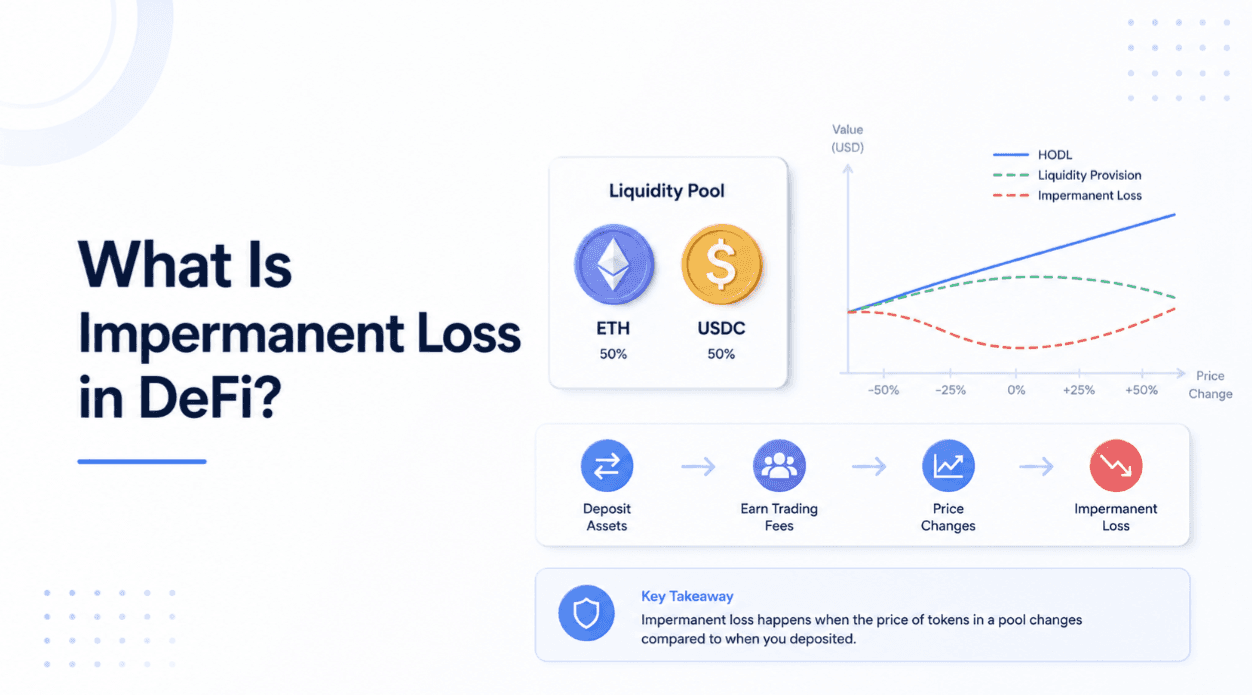
What Is Impermanent Loss in DeFi?
Impermanent loss quietly erodes the value of liquidity positions when token prices move. Here is why it happens, how big it gets, and when fees offset it.
Maria Fernandez · May 9, 2026→
Yield Farming and Liquidity Mining Explained
Yield farming chases returns by moving crypto between DeFi protocols. We break down where the yield comes from, how APY can mislead, and the risks behind big numbers.
David Turner · May 23, 2026→