Why Stablecoins Depeg: Six Cases and What Each Taught
DeFi Protocols & RWA On-Chain Analyst · September 23, 2026 · 10 min read
Published September 23, 2026 · Reviewed to our editorial standards. This article is informational and not financial advice.
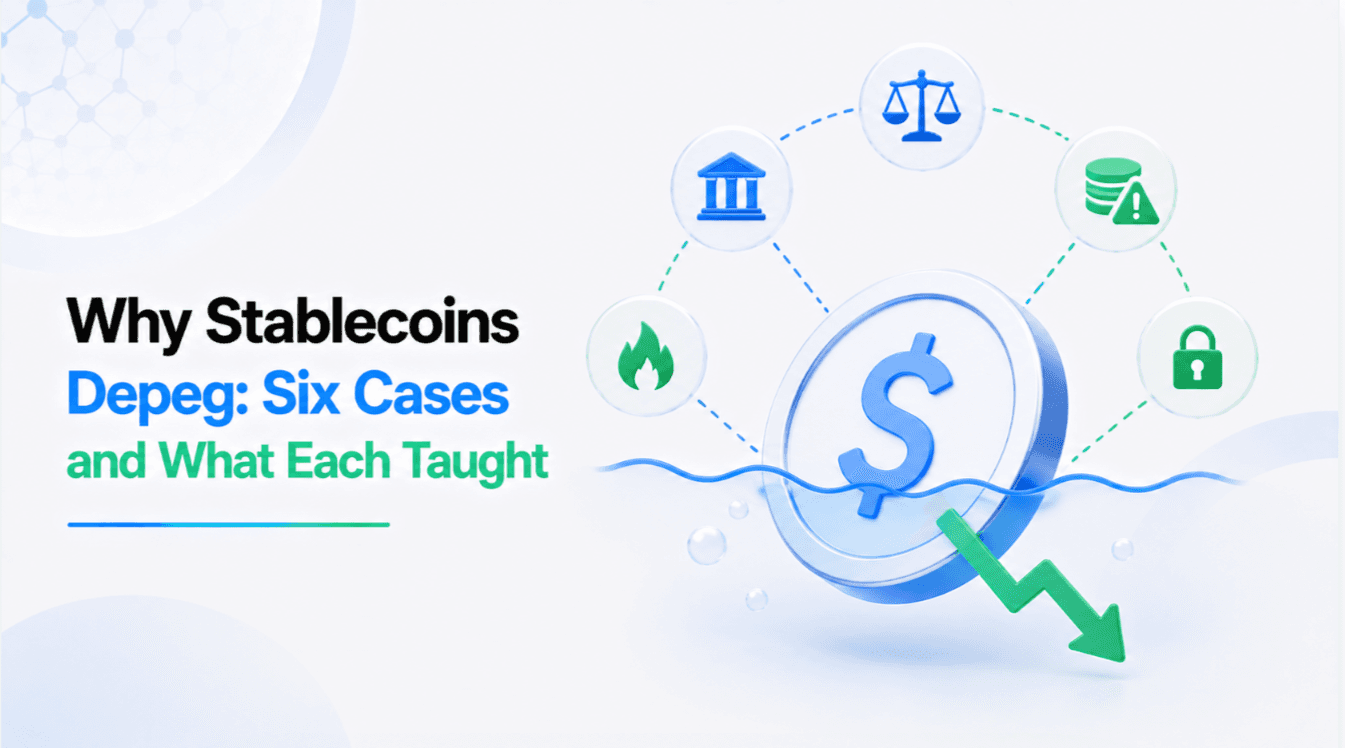
A depeg is not one phenomenon. Six notable cases in recent years each broke for a different reason, and reading them together is the fastest way to understand which risks apply to the token in your wallet.
The pattern worth noticing: in most cases the mechanism worked and something around it failed — a bank, an oracle, a rumour, a liquidity pool. Only once did the design itself have no floor.
Terra, May 2022: no floor at all
UST was algorithmic, backed by minting and burning a companion token rather than by reserves. When confidence broke, the mechanism issued more of a token whose price was collapsing, which accelerated the collapse. Tens of billions of dollars of value disappeared within days.
The lesson is categorical: a stablecoin backed by its issuer's own token has no floor, because the value of the backing falls with the thing it is meant to support. This is the failure that killed the design category.
USDT, May 2022: contagion without cause
In the aftermath of Terra, USDT traded down to roughly $0.95 as holders sold pre-emptively. Nothing about its reserves had changed, redemptions continued, and the price recovered within days.
The lesson is that a peg is partly a confidence phenomenon. A token with weaker disclosure carries less confidence in reserve, so it moves further on rumour than one with monthly attestations, even when both are fully backed.
USDC, March 2023: the bank, not the token
USDC fell to about $0.87 when $3.3bn of its cash reserve sat at Silicon Valley Bank as the bank failed. Redemptions were paused over the weekend because the banking system was closed, and the peg was restored within days once deposits were guaranteed.
The lesson is that a fully reserved token inherits the risk of wherever the reserve is banked. Full backing is necessary and does not remove the question of who holds the cash — and that question follows banking hours.
DAI, March 2023: collateral contagion
DAI moved with USDC during the same weekend, because a large share of its collateral was USDC. The mechanism functioned exactly as designed; it simply tracked what it was backed by.
The lesson is to read what a collateralised stablecoin actually holds. A token can be perfectly over-collateralised and still inherit every risk of its collateral, which is why the composition matters more than the ratio.
FDUSD, April 2025: reputation as backing
FDUSD fell to roughly $0.87 intraday after a prominent figure publicly claimed the issuer was insolvent. The issuer denied it, honoured redemptions — reportedly $26m within days — filed a defamation claim, and the peg recovered within the week.
The lesson is that thinner documentation makes an issuer vulnerable to assertion. A well-documented reserve is not just protection against being wrong; it is protection against being accused.
USDe, October 2025: the venue, not the protocol
During the largest liquidation cascade in crypto history, USDe printed as low as $0.65 on Binance while holding par on-chain, where mint and redemption kept working and about $2bn was redeemed in 24 hours. The cause was that venue's oracle reading its own thin internal order book rather than deeper external liquidity, and roughly $1bn of forced liquidations followed.
The lesson is that where a price is quoted matters as much as what backs the token. If you post a stablecoin as collateral somewhere, the venue's pricing method is part of your risk, and a protocol holding par is no help while an exchange liquidates you at $0.65.
The case that has not happened yet
Every episode above resolved because someone could redeem. The scenario nobody has tested at scale is a large reserve-backed issuer facing sustained redemption pressure while its assets are held in instruments that cannot be sold quickly enough — a run in the traditional sense rather than a price wobble on an exchange.
That is why reserve composition matters more than the headline backing ratio. Cash and short-dated government debt can be liquidated in a day; secured loans, corporate paper and other investments cannot, and the difference only becomes visible when everyone asks at once. It is also why regulatory frameworks now specify what a reserve may contain rather than merely requiring one to exist.
What the six have in common
- Five of six recovered, and the one that did not had no reserve to recover to.
- The mechanism usually worked; the surrounding infrastructure — a bank, an oracle, a pool, a rumour — did not.
- Redemption access decided the speed of recovery in every case where redemption existed.
- Leverage turned survivable price movements into permanent losses for individual holders.
What to do with this
Hold the token whose failure mode you can live with, and never hold a stablecoin on leverage — the recurring way people lose money in these events is not the depeg but a liquidation during one. Check what backs the token, who verifies it, and where the price you depend on is quoted.
One more habit worth adopting: know which chain your stablecoins are on and what the bridge risk is if you move them. A token that is fully backed on Ethereum may be a wrapped representation elsewhere, and the wrapper's failure is not the issuer's problem — the mechanics are covered in our bridge coverage.
Our best stablecoins table scores exactly those axes, and our stablecoins explained guide covers the designs in more detail. The practical summary: diversify across two issuers with different reserve models, and treat any yield above the risk-free rate as compensation for a risk you should be able to name.
Frequently asked questions
What causes a stablecoin to depeg?+
Rarely the token itself. Recent cases were caused by a failing bank holding the reserve, an exchange oracle reading a thin order book, contagion from collateral, or public claims about an issuer's solvency. Only algorithmic designs with no reserve have failed permanently.
Has USDC ever depegged?+
Yes, to about $0.87 in March 2023, when $3.3bn of its reserve was held at Silicon Valley Bank as the bank failed. The peg recovered within days once deposits were guaranteed and redemptions resumed.
Is a depeg permanent?+
Almost never, where a real reserve exists. Five of the six major cases recovered within days; the exception was Terra, whose backing was its own companion token and therefore had no floor.
How do I protect myself from a depeg?+
Hold across two issuers with different reserve models, avoid leverage on stablecoin positions, and check where the price you depend on is quoted — a venue with a thin internal order book can liquidate you at a price that exists nowhere else.
Written by
Maria FernandezDeFi Protocols, Real-World Assets, On-Chain Analytics, Stablecoins, Spanish-Language Coverage
Maria Fernandez is an On-Chain Research Analyst at **CRYPTO·COINBEAT**, specializing in real-world asset (RWA) tokenization, decentralized finance, and stablecoin ecosystems. Originally from Mexico City and now based in Miami, Maria brings a unique Latin American perspective to blockchain research, combining deep technical analysis with insights into emerging digital asset markets across the Americas. Before joining **CRYPTO·COINBEAT**, Maria spent several years researching decentralized finance protocols, producing in-depth analysis on lending platforms, governance systems, and the growing adoption of tokenized real-world assets. Her early research into institutional RWA integration and decentralized collateral models helped explain one of the fastest-growing sectors within the blockchain industry. Maria's analytical approach combines on-chain transaction analysis, protocol revenue metrics, liquidity monitoring, and governance activity to evaluate the long-term health of DeFi ecosystems. She works extensively with blockchain analytics platforms, including Dune Analytics, Nansen, and Flipside Crypto, and has created numerous public dashboards that simplify complex blockchain data for investors and researchers alike. Her coverage of stablecoin market events and liquidity shifts has helped readers better understand risk during periods of heightened market volatility. She holds a B.Sc. in Industrial Engineering from ITAM (Instituto Tecnológico Autónomo de México) and a Graduate Certificate in FinTech from MIT Sloan. Passionate about blockchain education, Maria regularly contributes both English- and Spanish-language research, helping make advanced on-chain analysis more accessible to a global audience while supporting the continued growth of crypto adoption throughout Latin America.
Keep Reading
Crypto Lending and Borrowing in DeFi Explained
DeFi lending markets let anyone earn interest or borrow against crypto, governed entirely by code. Here is how collateral, rates, and liquidations actually work.
David Turner · May 2, 2026→
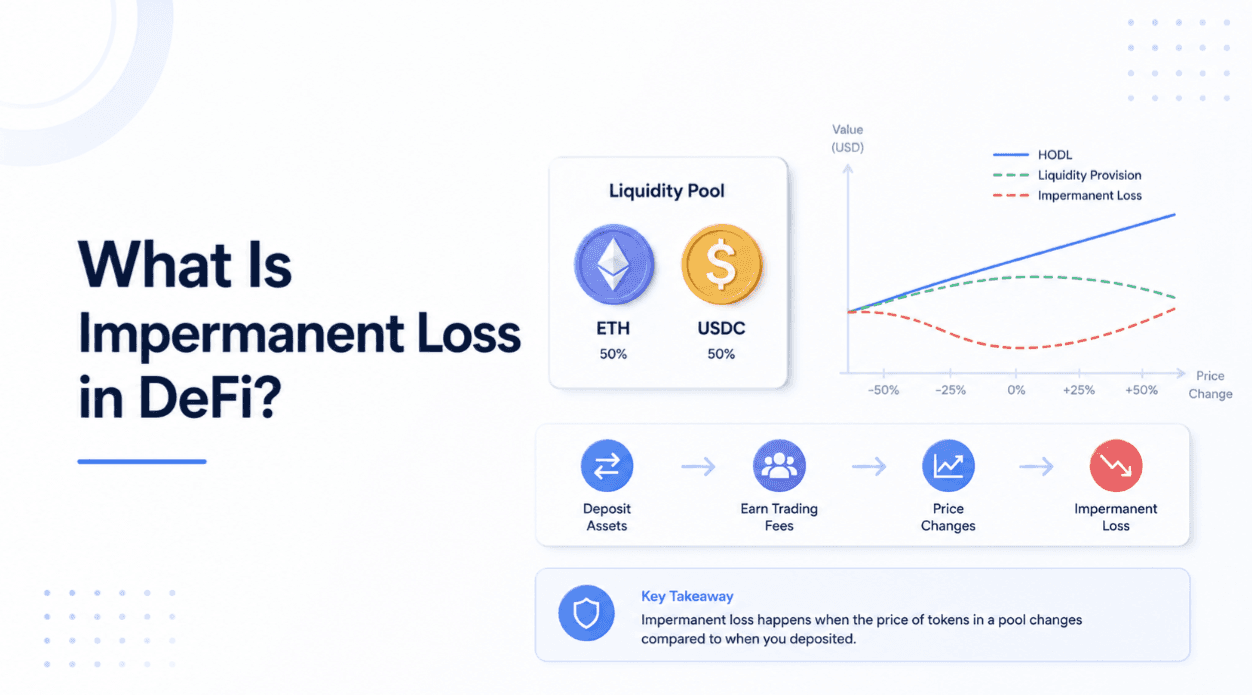
What Is Impermanent Loss in DeFi?
Impermanent loss quietly erodes the value of liquidity positions when token prices move. Here is why it happens, how big it gets, and when fees offset it.
Maria Fernandez · May 9, 2026→
Yield Farming and Liquidity Mining Explained
Yield farming chases returns by moving crypto between DeFi protocols. We break down where the yield comes from, how APY can mislead, and the risks behind big numbers.
David Turner · May 23, 2026→