Yield-Bearing Stablecoins: Where the Return Comes From
By David Turner
Senior Crypto Markets Reporter at CryptoCoinBeat. · October 9, 2026 · 10 min read
Published October 9, 2026 · Reviewed to our editorial standards. This article is informational and not financial advice.
A stablecoin that pays you is a different product from one that does not, even when both are worth a dollar. The plain kind holds reserves and keeps the income; the yield-bearing kind passes some of it on, or generates it some other way entirely.
There are four engines in common use, and they are not interchangeable. Tell them apart and you can size a position sensibly. Fail to, and you are holding something whose risk you cannot describe in the part of your portfolio meant to be boring.
Engine one: Treasury income passed through
The simplest design. The issuer holds short-dated government debt, as plain stablecoins do, and distributes the interest instead of keeping it. Tokenised money-market and Treasury funds work this way, as do savings wrappers around on-chain reserves.
The yield tracks short-term rates, so it falls when central banks cut and rises when they raise. The risk is mostly the issuer's operational and legal standing rather than the assets, which are about as dull as financial instruments get.
Practical constraint: many of these products are restricted to qualified or non-retail investors, or gated by jurisdiction. And in Europe, tokens regulated as e-money are prohibited from paying interest, which is why several issuers offer the yield through a separate wrapper rather than the token itself.
Engine two: lending your dollars out
Deposit into a lending market and borrowers pay you for the use of the balance. The rate is set by utilisation: heavy borrowing demand pushes it up, quiet markets push it toward nothing.
The risk is credit and liquidity. Loans are over-collateralised, so ordinary defaults are absorbed, but a violent move can leave positions underwater faster than liquidators can clear them, and a fully utilised pool cannot be withdrawn from until borrowers repay. Both have happened.
This is the engine behind most double-digit advertised rates on lending platforms, and the one where the gap between advertised and realised return is widest once you account for the weeks you could not withdraw.
Engine three: the funding-rate carry trade
A hedged position: hold spot, short the perpetual future, collect the funding that longs pay shorts. When markets are bullish, funding is positive and the trade pays well. The position is delta-neutral, so the dollar value does not swing with the price of the underlying.
It is a real trade run by real desks, and it has two failure modes. Funding turns negative in a sustained downturn, so the yield becomes a cost. And the hedge lives on exchanges, so it carries venue risk: custody, margin engines and outages all sit between you and the position.
October 2025 demonstrated the second point sharply. Ethena's USDe held its dollar value in the wider market while trading down toward $0.65 in a thin book on a single venue, liquidating positions collateralised against that venue's own quote. The token's backing was intact; the price feed on one exchange was not.
Engine four: incentives, which are not yield at all
A protocol distributes its own token to depositors and quotes the result as an annual rate. It is a marketing expense denominated in something whose price the market decides, and it stops when the emission schedule ends or the token falls.
There is nothing wrong with taking it, as long as you sell the incentive promptly and never model it as durable income. The mistake is planning around a rate that exists to buy your deposit for a few months.
Rebasing, wrapping, and why your balance may not move
Yield reaches you in one of two ways, and the difference matters for both accounting and safety. A rebasing token increases the number of units in your wallet, so the balance grows while each unit stays worth a dollar. A wrapper token keeps the unit count fixed and lets the redemption value climb instead.
The wrapper design is generally easier to work with: it composes cleanly with lending markets and exchanges, which frequently mishandle rebasing balances, and it produces a single gain on exit rather than a stream of small accruals. If a protocol offers both forms of the same asset, check which one the venue you intend to use actually supports before depositing.
The questions to ask before depositing
- Which engine is producing this return, in one sentence?
- What is the scenario where it goes to zero, and how fast does it arrive?
- Can I withdraw during that scenario, or does the exit close first?
- Is the yield paid in the same dollar unit, or in a token whose price can fall?
- Who has custody of the assets doing the work — a chain, an exchange, or a company?
If any answer is unclear, the position is bigger than it looks, because unmeasured risk always sizes itself.
How to size it
Treat yield-bearing stablecoins as a category between cash and credit, not as cash. The extra return over a plain stablecoin is roughly the market's price for the extra risk, so a token paying eight per cent when Treasuries pay four is not free money — it is a judgement that the difference is worth taking.
A workable split for most people: keep the balance you might need within a week in a plain, well-attested stablecoin, and only put money you can leave alone into a yield product whose engine you can name. Our best stablecoins table scores reserve quality, attestation depth and redemption access, and why stablecoins depeg covers what happens when one of these engines stalls.
Frequently asked questions
Are yield-bearing stablecoins safe?+
They are safer than volatile assets and riskier than a plain stablecoin. The extra return is compensation for lending, trading or venue risk, and each engine has a scenario where the yield stops and withdrawal gets hard.
Why can't European stablecoins pay interest?+
Tokens regulated as e-money under MiCA are prohibited from paying interest to holders, so issuers serving that market offer yield through separate products rather than on the token itself.
What is the funding-rate carry trade?+
Holding spot while shorting the perpetual future, collecting the funding longs pay shorts. It is delta-neutral, pays well in bullish markets, and turns into a cost when funding goes negative.
Is a 15% stablecoin yield realistic?+
Only from lending at peak demand or from token incentives, and neither lasts. A rate far above short-term government debt is a description of the risk, not a description of the product.
Written by
David TurnerCryptocurrency Markets, Blockchain Technology, Tokenomics Analysis, Digital Asset Regulation, DeFi, Web3 Industry Cover
David Turner is a U.S.-based Markets Reporter at CRYPTO·COINBEAT, covering cryptocurrency markets, blockchain innovation, and the rapidly evolving digital asset ecosystem across North America. Raised in California and educated in economics and digital media, David combines strong analytical skills with years of experience reporting on financial markets and emerging technologies. He began his journalism career covering equity markets, Federal Reserve policy, and fintech developments for several financial news outlets before specializing in cryptocurrency. As blockchain technology gained mainstream adoption, David shifted his focus to Bitcoin, Ethereum, decentralized finance, and digital asset regulation. Prior to joining CRYPTO·COINBEAT, he reported extensively on crypto exchanges, institutional investment, stablecoins, and the expanding Web3 economy. At **CRYPTO·COINBEAT**, David delivers data-driven reporting designed to help readers understand the fast-moving digital asset industry. His coverage frequently explores U.S. crypto legislation, tokenomics, blockchain adoption, market sentiment, and the impact of macroeconomic events on cryptocurrency markets. He is particularly recognized for his in-depth analysis of token supply models, vesting schedules, liquidity trends, and the long-term sustainability of blockchain projects. David earned a B.A. in Economics from the University of California, Los Angeles (UCLA), and completed additional coursework in data journalism and financial analysis. He also authors the daily market briefing, **"Opening Bell Crypto,"** providing traders and investors with concise analysis of overnight market activity, key industry developments, and emerging investment trends.
Keep Reading
Crypto Lending and Borrowing in DeFi Explained
DeFi lending markets let anyone earn interest or borrow against crypto, governed entirely by code. Here is how collateral, rates, and liquidations actually work.
David Turner · May 2, 2026→
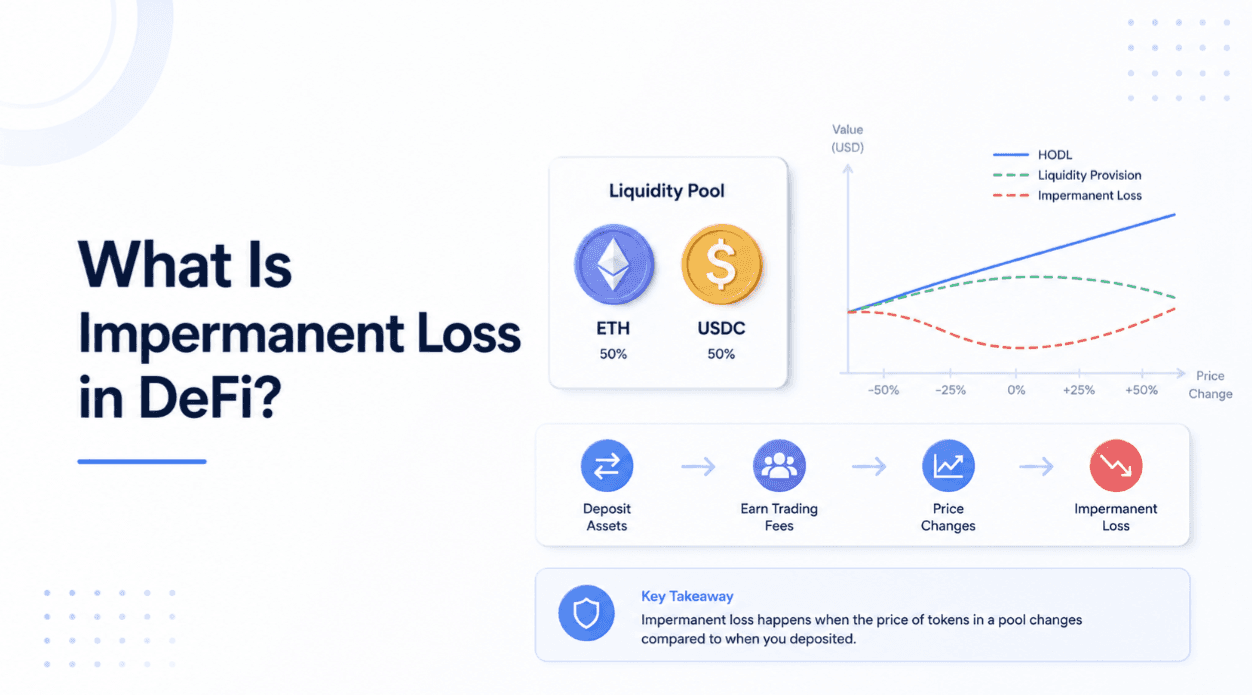
What Is Impermanent Loss in DeFi?
Impermanent loss quietly erodes the value of liquidity positions when token prices move. Here is why it happens, how big it gets, and when fees offset it.
Maria Fernandez · May 9, 2026→
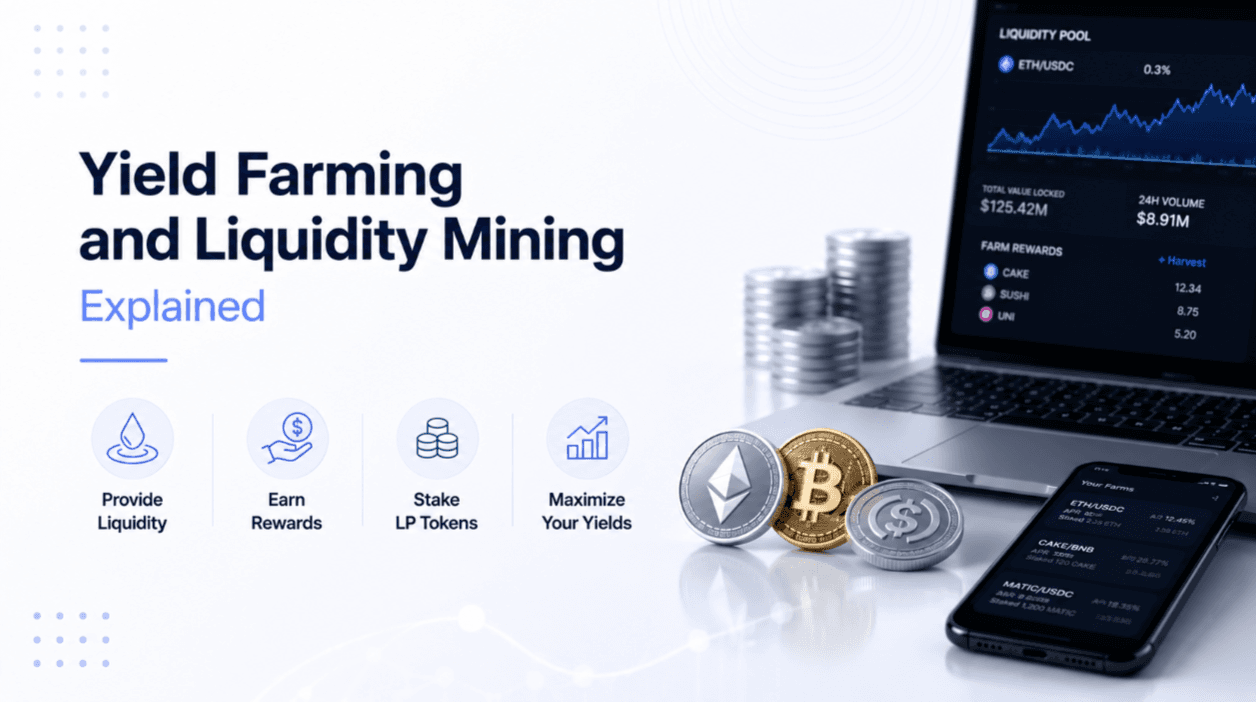
Yield Farming and Liquidity Mining Explained
Yield farming chases returns by moving crypto between DeFi protocols. We break down where the yield comes from, how APY can mislead, and the risks behind big numbers.
David Turner · May 23, 2026→