DAI vs USDC: Two Ways to Back a Dollar
By David Turner
Senior Crypto Markets Reporter at CryptoCoinBeat. · October 19, 2026 · 10 min read
Published October 19, 2026 · Reviewed to our editorial standards. This article is informational and not financial advice.
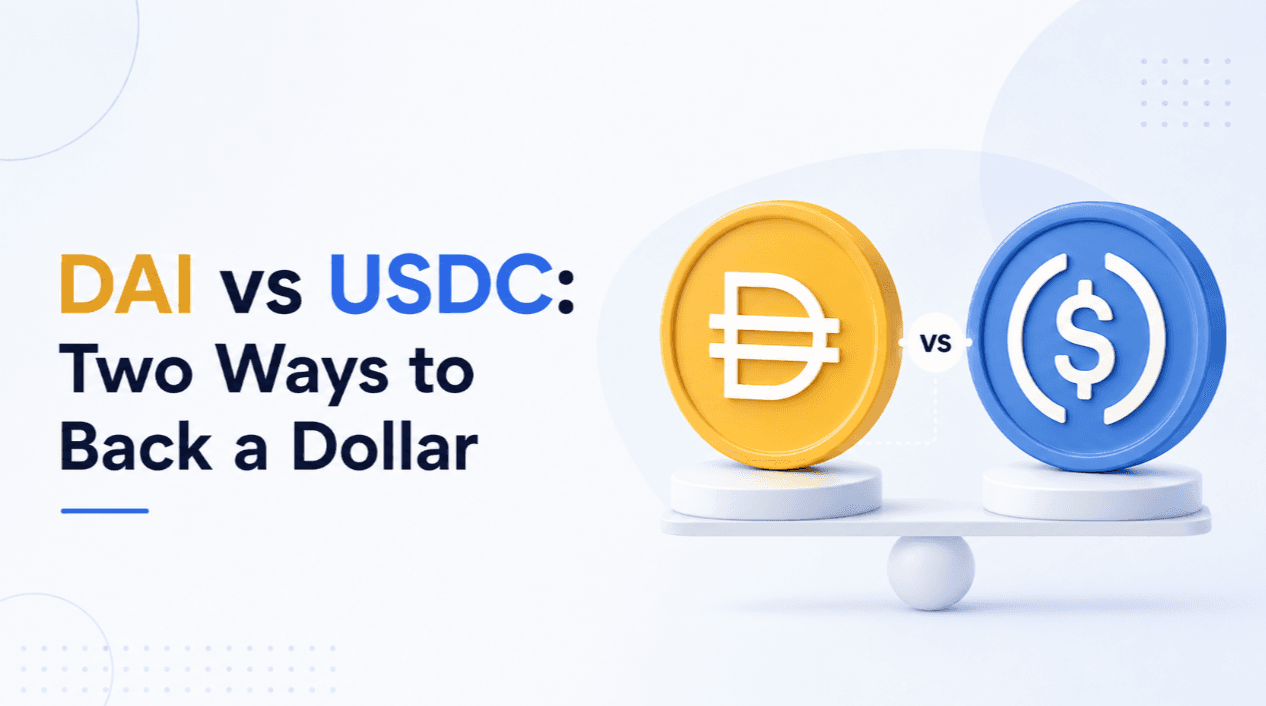
DAI and USDC are held for the same purpose and built on opposite premises. USDC is a claim on a company holding reserves in the banking system. DAI is a token minted against collateral locked in smart contracts, with no company promising to redeem it.
The interesting part is that the difference is smaller in practice than in theory, for a reason worth understanding before choosing between them.
How USDC is backed
Circle takes dollars, holds them in cash and short-dated government debt, and issues tokens against them. Reserves sit largely in a government money market fund with a major custodian, and monthly attestation reports from a large accounting firm confirm the balances.
Redemption is direct: verified customers send tokens back and receive dollars. That channel is what keeps the market price at par — arbitrageurs buy below a dollar and redeem at a dollar, and the gap closes.
Circle became a publicly listed company in 2025, which adds a layer most crypto issuers lack: audited financial statements, quarterly filings and the disclosure obligations that come with a stock exchange listing.
How DAI is backed
DAI is minted by locking collateral worth more than the DAI created — typically 120% to 170% depending on the asset — into a smart contract. If the collateral falls toward the debt, the position is liquidated automatically and the DAI is repaid from the proceeds.
There is no redemption desk. The price holds because anyone with a position has a standing incentive to buy DAI below a dollar to repay their debt cheaply, and because the system adjusts borrowing rates and a savings rate to push supply and demand back toward par.
The protocol behind DAI rebranded to Sky in 2024, introducing USDS alongside DAI with a savings rate paid to holders who deposit it. The mechanism is the same; the naming and the yield wrapper are new.
The uncomfortable overlap
For years, a substantial share of DAI's collateral was USDC, held in a module that let anyone swap one for the other at a fixed rate. That module is what kept DAI pegged tightly, and it also meant DAI inherited USDC's risk in proportion to how much of it sat in the vaults.
March 2023 made this concrete. When USDC fell toward $0.87 during the Silicon Valley Bank failure, DAI fell with it — not because on-chain collateralisation failed, but because a large part of that collateral was the token in trouble. Holders who owned both for diversification found they owned one exposure twice.
The collateral mix has since broadened to include tokenised real-world assets and other holdings, which reduces but does not eliminate the linkage. Check the current composition rather than assuming either the old or the new story.
Different failure modes
USDC's risks are institutional: a banking partner failing, a regulator acting, a company decision. They arrive from outside the chain, they are usually visible in advance to someone, and they can be resolved by institutions — as the SVB deposits were.
DAI's risks are mechanical: a collateral asset falling faster than liquidations can clear, an oracle reporting a bad price, a governance decision that changes parameters badly. Black Thursday in March 2020 delivered the first two at once, when network congestion let some liquidation auctions clear at near zero.
Neither set is obviously worse. They are uncorrelated, which is the actual argument for holding both — provided the collateral overlap is small enough that they really are.
Censorship and access
USDC can be frozen at the address level, and has been, in response to legal process and to hacks. Whether that is a feature or a defect depends entirely on whether you expect to be on the receiving end; for most holders it has meant stolen funds occasionally being immobilised.
DAI has no comparable issuer-level control, but this is weaker than it sounds while any of its collateral consists of assets that can themselves be frozen. Censorship resistance is bounded by the least resistant thing in the backing.
Yield, and where it comes from in each
Both now have a savings mechanism attached, and the engines are different. Deposit USDS into its savings contract and the return comes from the fees borrowers pay plus income on the protocol's real-world holdings — a spread the protocol earns and passes on.
USDC pays nothing on the token itself; where a rate is offered, it comes from a platform lending your balance out or passing through Treasury income, and the risk belongs to that platform rather than to Circle. In Europe, tokens regulated as e-money cannot pay interest at all, which is why the yield always arrives through a separate wrapper.
In both cases, name the engine before accepting the rate — the reasoning is set out in yield-bearing stablecoins.
Which to hold
- Holding a balance and prioritising transparency and redemption: USDC, with monthly attestation and a direct exit at par.
- Prioritising on-chain verifiability and no company in the middle: DAI or USDS, after reading the current collateral mix.
- Holding both for diversification: check the overlap first, or the diversification is nominal.
- Using either as collateral: check how the protocol prices it and how deep the local pool is.
- Spending from a card or paying invoices: whichever your provider and counterparties actually support, since acceptance beats theory here.
Our best stablecoins table scores both on reserve quality, attestation, peg record and redemption access, and USDC vs USDT covers the other comparison most people make.
Frequently asked questions
Is DAI safer than USDC?+
It is differently exposed rather than safer. DAI avoids single-company risk but carries liquidation, oracle and governance risk, and it has historically held a large share of its collateral in USDC.
Why did DAI depeg in March 2023?+
Because a substantial portion of its collateral was USDC, which had fallen toward $0.87 after Silicon Valley Bank failed. The on-chain mechanism worked; the collateral behind it was the asset in trouble.
Can DAI be frozen like USDC?+
There is no issuer-level freeze on DAI itself, but assets inside its collateral pool can be frozen by their own issuers, which bounds how censorship-resistant the token really is.
What is USDS and how does it relate to DAI?+
USDS is the token introduced when the protocol behind DAI rebranded to Sky in 2024. The collateral mechanism is the same, with a savings rate available to holders who deposit it.
Written by
David TurnerCryptocurrency Markets, Blockchain Technology, Tokenomics Analysis, Digital Asset Regulation, DeFi, Web3 Industry Cover
David Turner is a U.S.-based Markets Reporter at CRYPTO·COINBEAT, covering cryptocurrency markets, blockchain innovation, and the rapidly evolving digital asset ecosystem across North America. Raised in California and educated in economics and digital media, David combines strong analytical skills with years of experience reporting on financial markets and emerging technologies. He began his journalism career covering equity markets, Federal Reserve policy, and fintech developments for several financial news outlets before specializing in cryptocurrency. As blockchain technology gained mainstream adoption, David shifted his focus to Bitcoin, Ethereum, decentralized finance, and digital asset regulation. Prior to joining CRYPTO·COINBEAT, he reported extensively on crypto exchanges, institutional investment, stablecoins, and the expanding Web3 economy. At **CRYPTO·COINBEAT**, David delivers data-driven reporting designed to help readers understand the fast-moving digital asset industry. His coverage frequently explores U.S. crypto legislation, tokenomics, blockchain adoption, market sentiment, and the impact of macroeconomic events on cryptocurrency markets. He is particularly recognized for his in-depth analysis of token supply models, vesting schedules, liquidity trends, and the long-term sustainability of blockchain projects. David earned a B.A. in Economics from the University of California, Los Angeles (UCLA), and completed additional coursework in data journalism and financial analysis. He also authors the daily market briefing, **"Opening Bell Crypto,"** providing traders and investors with concise analysis of overnight market activity, key industry developments, and emerging investment trends.
Keep Reading
Crypto Lending and Borrowing in DeFi Explained
DeFi lending markets let anyone earn interest or borrow against crypto, governed entirely by code. Here is how collateral, rates, and liquidations actually work.
David Turner · May 2, 2026→
What Is Impermanent Loss in DeFi?
Impermanent loss quietly erodes the value of liquidity positions when token prices move. Here is why it happens, how big it gets, and when fees offset it.
Maria Fernandez · May 9, 2026→
Yield Farming and Liquidity Mining Explained
Yield farming chases returns by moving crypto between DeFi protocols. We break down where the yield comes from, how APY can mislead, and the risks behind big numbers.
David Turner · May 23, 2026→