Leverage Loops: The Fastest Way to Lose a Staking Position
DeFi Protocols & RWA On-Chain Analyst · November 18, 2026 · 10 min read
Published November 18, 2026 · Reviewed to our editorial standards. This article is informational and not financial advice.
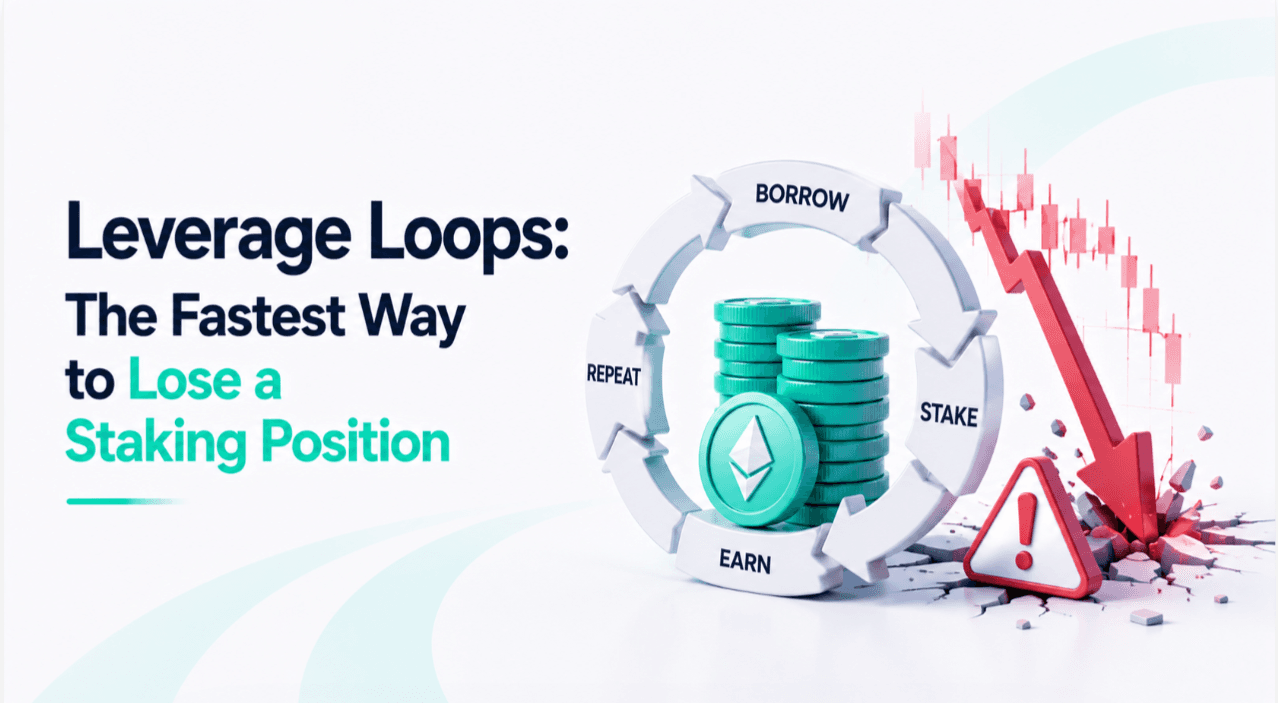
The trade is elegant and widely run. Deposit a liquid staking token as collateral, borrow ether against it, buy more of the staking token, deposit that, and repeat. Each cycle multiplies your exposure to the staking yield.
It works because the staking yield exceeds the borrow rate. When that spread is positive and stable, looping turns four per cent into something considerably more interesting, and thousands of people run it continuously.
It also concentrates three separate risks into one position, and they are correlated — which is the entire reason this article exists.
How the loop is built
Post 100 ETH of stETH as collateral, borrow 70 ETH at a conservative loan-to-value, convert to stETH, deposit again. Repeat and the total position converges toward roughly three times the original capital depending on the LTV you use.
You are now earning the staking yield on three units for every one you own, minus the borrow cost on two. If staking pays 4% and borrowing costs 2.5%, the leveraged return on your own capital is meaningfully higher than 4%.
The mechanics are sound. Protocols support it deliberately, and some products automate the whole loop into a single deposit — which makes the risk easier to take and no easier to understand.
Risk one: the borrow rate moves
Borrow rates are floating and set by utilisation. When many people run the same loop, borrowing demand rises and so does the rate — sometimes above the staking yield, at which point the spread inverts and every looped position is paying to exist.
This is self-inflicted by the crowd: the trade's popularity is the mechanism that ends it. Unwinding then requires selling the staking token to repay, which everyone else is doing simultaneously.
Risk two: the discount
Liquidation prices your collateral at its market quote, not at the value of the ether behind it. If the staking token trades below par because exit queues have lengthened, your loan-to-value rises even though nothing about the underlying stake has changed.
A leveraged position is far more sensitive to this than an unleveraged one, since the same discount applies across your whole multiplied exposure. A few per cent of discount can move a comfortable position to the edge of liquidation.
Risk three: slashing
A slashing event reduces the value backing the staking token. Small and isolated, it is a rounding error. Correlated across many validators — a client bug, a large operator's failure — it is a step change in the collateral's value, applied instantly to a position already stretched.
Restaked collateral adds further penalty conditions, several still being phased in, layered underneath a leveraged position. That is stacking a young risk beneath an amplified one.
Why they arrive together
This is the part that matters, and it is why the loop fails so completely when it fails. The three risks are not independent draws.
A market crash raises borrowing demand and rates. It sends people to the exit queue, which lengthens, which widens the staking token's discount. Widening discounts trigger liquidations of leveraged positions, which sell the token into an already thin market, which widens the discount further and liquidates the next tier.
June 2022 ran exactly this sequence: leveraged stETH holders unwinding into a market with no redemption available, each liquidation deepening the discount that caused the next. The mechanism has not changed. Withdrawals now exist, which bounds it, but the loop still runs.
If you run it anyway
- Use two loops at most. The marginal yield from the third is small and the liquidation buffer it costs is not.
- Size the position to survive a 10% collateral discount, not a 2% one.
- Check the protocol's oracle for your collateral — market price or a redemption-based feed changes everything.
- Keep repayment funds outside the loop, ready to deploy without unwinding.
- Monitor the borrow rate weekly; an inverted spread means unwind now rather than later.
- Never loop restaked collateral, which stacks untested penalty conditions beneath an amplified position.
Automated looping products
Several protocols now package the whole loop into a single deposit, rebalancing the leverage automatically and unwinding when parameters are breached. The engineering is often good and the risk is identical — packaging changes who operates the position, not what the position is.
There is one genuine benefit: an automated manager will deleverage faster than a person asleep in another timezone. And one genuine cost: automated unwinding at scale means every product using the same trigger sells at the same moment, which is the mechanism that makes a discount cascade rather than a discount.
Read the deleveraging rules before depositing. Where the triggers sit, whether they use market or redemption prices, and what happens if unwinding cannot complete are the three things that decide the product’s worst day.
The honest assessment
Looping is a leveraged carry trade on a spread that the trade's own popularity erodes, collateralised by an asset that discounts under stress, secured by capital that can be slashed. Each of those is manageable alone.
Together, in a falling market, they produce the outcome the trade was designed to avoid: a forced sale of a staking position at the worst price available. If you were staking because you wanted long-term exposure, the loop converts that into a position that can be taken from you.
Why liquid staking tokens discount covers the collateral behaviour, and how to borrow against crypto covers the drawdown maths that decides whether a position survives.
Frequently asked questions
What is leveraged staking?+
Depositing a liquid staking token as collateral, borrowing against it, buying more of the token and repeating. Each cycle multiplies exposure to the staking yield and to the borrow cost.
Why is looping risky if it is over-collateralised?+
Because its three risks — rate inversion, collateral discount and slashing — are correlated. A crash triggers all of them at once, and each liquidation deepens the discount that causes the next.
How much leverage is safe in a staking loop?+
Two loops at most, sized to survive a 10% discount on the collateral. Beyond that the marginal yield is small relative to the buffer it consumes.
Did leveraged staking cause the 2022 stETH discount?+
It amplified it substantially. Leveraged holders unwinding into a market with no redemption available deepened the discount, which forced further liquidations in sequence.
Written by
Maria FernandezDeFi Protocols, Real-World Assets, On-Chain Analytics, Stablecoins, Spanish-Language Coverage
Maria Fernandez is an On-Chain Research Analyst at **CRYPTO·COINBEAT**, specializing in real-world asset (RWA) tokenization, decentralized finance, and stablecoin ecosystems. Originally from Mexico City and now based in Miami, Maria brings a unique Latin American perspective to blockchain research, combining deep technical analysis with insights into emerging digital asset markets across the Americas. Before joining **CRYPTO·COINBEAT**, Maria spent several years researching decentralized finance protocols, producing in-depth analysis on lending platforms, governance systems, and the growing adoption of tokenized real-world assets. Her early research into institutional RWA integration and decentralized collateral models helped explain one of the fastest-growing sectors within the blockchain industry. Maria's analytical approach combines on-chain transaction analysis, protocol revenue metrics, liquidity monitoring, and governance activity to evaluate the long-term health of DeFi ecosystems. She works extensively with blockchain analytics platforms, including Dune Analytics, Nansen, and Flipside Crypto, and has created numerous public dashboards that simplify complex blockchain data for investors and researchers alike. Her coverage of stablecoin market events and liquidity shifts has helped readers better understand risk during periods of heightened market volatility. She holds a B.Sc. in Industrial Engineering from ITAM (Instituto Tecnológico Autónomo de México) and a Graduate Certificate in FinTech from MIT Sloan. Passionate about blockchain education, Maria regularly contributes both English- and Spanish-language research, helping make advanced on-chain analysis more accessible to a global audience while supporting the continued growth of crypto adoption throughout Latin America.
Keep Reading
Ethereum Layer-2 Scaling: How Rollups Make ETH Cheaper and Faster
Rollups move execution off Ethereum’s base layer while keeping its security. Here is how optimistic and zk-rollups work and where they differ.
Maria Fernandez · May 3, 2026→
Proof of Stake and ETH Staking Explained
Ethereum secures itself with staked ETH instead of mining. Here is how validators, rewards and slashing work, and what staking really involves.
David Turner · May 16, 2026→
Ethereum Gas Fees Explained: Why Transactions Cost What They Do
Gas is how Ethereum prices computation. Here is what you are really paying for, why fees swing so hard, and how to keep them down.
David Turner · May 25, 2026→