What Is a Multisig Wallet, and Who Actually Needs One
By Emily Carter
Policy Correspondent · September 11, 2026 · 8 min read
Published September 11, 2026 · Reviewed to our editorial standards. This article is informational and not financial advice.
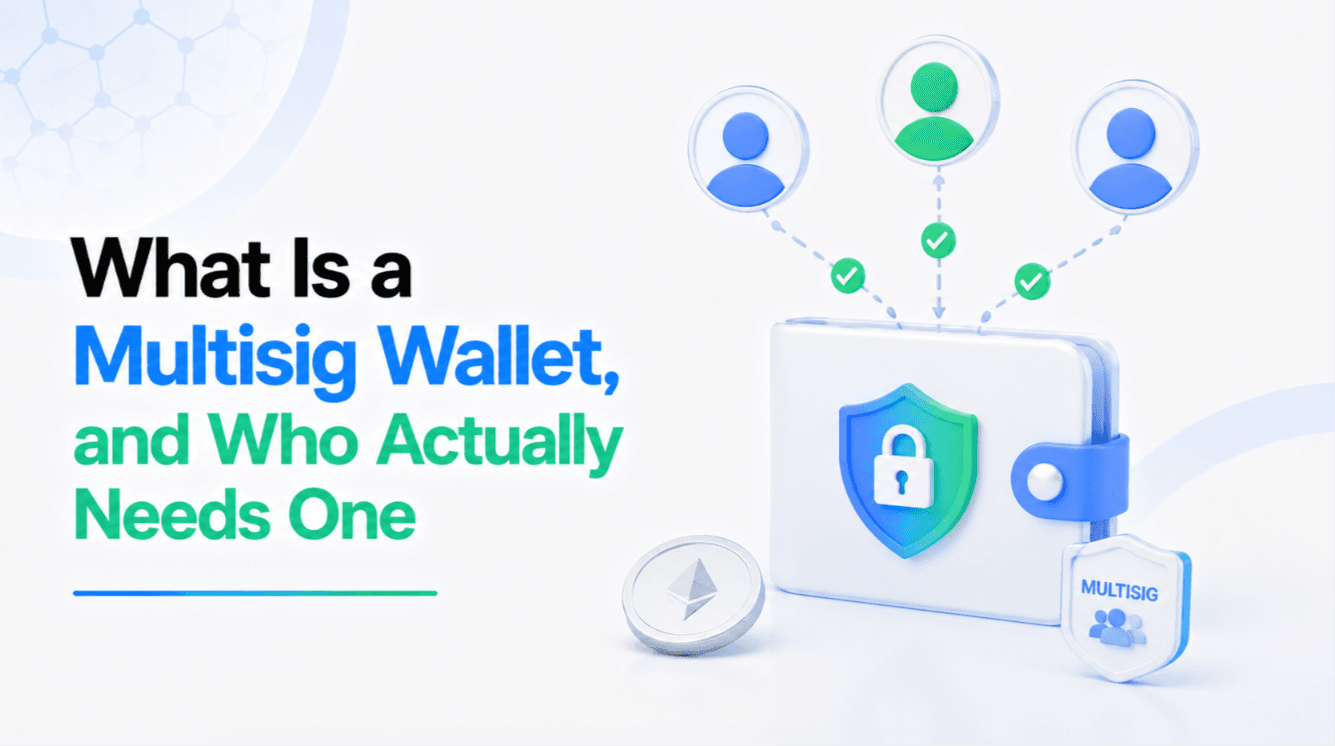
A multisig wallet requires more than one signature to move funds. Instead of one key controlling everything, a set of keys is configured with a threshold — two of three, three of five — and a transaction executes only when enough of them approve.
It removes the single point of failure that defines ordinary self-custody: one compromised device, one lost backup, one coerced person. It also introduces coordination, cost and a new set of ways to lock yourself out.
How the threshold decides everything
The threshold is the whole design. Two of three is the common choice for individuals and small treasuries: any single key can be lost or stolen without consequence, and two must be compromised simultaneously for funds to move.
Three of five suits organisations, tolerating two losses and requiring three parties to collude. Higher thresholds sound safer and are frequently worse, because the practical failure in multisig is not attack — it is being unable to assemble enough signers when you need to act.
Where the keys should live
Spreading keys across devices from different manufacturers, in different physical locations, held by different people, is what turns the arrangement from theatre into protection. Three keys in one drawer is a single point of failure with extra steps.
For a family setup, that might be one key on your hardware wallet, one with a partner, one in a deposit box. For a treasury, keys held by named individuals with documented roles, which is what our Safe review covers in the tooling that dominates this space.
What multisig does not protect against
February 2025 answered this in the most expensive way available. Attackers compromised a developer machine at Safe{Wallet} and served tampered JavaScript that showed Bybit's signers a routine transfer while altering the underlying transaction. Every required signature was collected, from people doing their jobs properly, and roughly $1.5bn left.
The contracts were not at fault. A multisig defends against a rogue or compromised signer; it cannot defend against every signer being shown the same lie. Which is why serious treasuries verify calldata on hardware devices rather than trusting any web interface — the lesson set out in how to read a transaction.
The costs people underestimate
- Gas: a smart-contract wallet costs more per transaction than a simple one, on every transaction, forever.
- Coordination: routine payments need several people available, which is fine until somebody is on a plane.
- Recovery complexity: every signer needs their own backup, so the number of things that must not be lost multiplies.
- Inheritance: whoever inherits must understand the arrangement, or the threshold becomes unreachable.
How a transaction actually gets executed
In a smart-contract multisig, one signer proposes a transaction, the others approve it, and once the threshold is met anyone can execute it. Proposals sit visible on-chain while they collect signatures, which is a feature for a treasury — every pending payment is auditable before it moves rather than after.
That visibility also sets expectations about speed. A payment needing three of five signatures across time zones is not an instant operation, which is why treasuries use modules and spending limits to let routine small payments proceed under looser rules while large ones require the full threshold.
Bitcoin multisig works differently
On Bitcoin there is no smart contract: multisig is native to the script, and coordination happens through partially signed transactions passed between devices. Desktop wallets built for Bitcoin handle this well, including across devices from different manufacturers — which is itself a security property, since a flaw in one vendor's firmware does not compromise the whole arrangement.
The practical difference for a holder is that Bitcoin multisig produces no ongoing contract to trust and no upgrade path to worry about, at the cost of tooling that assumes more of the user. For long-term Bitcoin savings held by a family or a small company, it remains the most robust arrangement available.
Who actually needs one
Treasuries, DAOs, businesses holding client funds, and any arrangement where no single person should be able to move money unilaterally — those are unambiguous cases, and multisig is the standard answer for them.
For an individual, the calculation is different. If a single hardware wallet plus a well-made metal backup covers your threat model, multisig adds cost and complexity without removing a risk you actually face. It becomes worth the burden at the point where a single compromised device or a single lost backup would be genuinely life-changing, or where inheritance requires someone else to hold a key.
Setting one up without locking yourself out
Two rules prevent almost every self-inflicted multisig failure. First, write down the configuration itself — which keys exist, where they are, what the threshold is, and which software reconstructs the wallet — and store that description separately from the keys. A multisig whose parameters are lost can be as unreachable as a lost seed, even with every key intact.
Second, test recovery before funding, exactly as with a single-signature wallet: rebuild the arrangement from the backups on different hardware and confirm you can produce a valid transaction. The failure people discover late is not a stolen key but a signer who cannot find theirs, or a configuration nobody can reproduce.
A reasonable middle path for large individual holdings is a two-of-three across two of your own devices and one held by a trusted person or professional. It survives a house fire, it survives a stolen device, and it gives your estate a route in — without requiring a committee to buy dinner.
Frequently asked questions
What does 2-of-3 multisig mean?+
Three keys exist and any two can authorise a transaction. One key can be lost or stolen without losing funds or losing access, which is why it is the most common configuration for individuals and small treasuries.
Is multisig safer than a hardware wallet?+
It removes the single point of failure a lone hardware wallet has, so for large holdings, yes. It also adds gas costs, coordination and more backups to maintain, which is why it is overkill for ordinary personal amounts.
Did multisig fail in the Bybit hack?+
No — the signatures were collected correctly. Attackers tampered with the Safe{Wallet} interface so signers approved a transaction different from the one displayed. A multisig protects against a rogue signer, not against every signer seeing the same falsified screen.
Can I use multisig for Bitcoin?+
Yes, and it is well supported: desktop wallets built for Bitcoin handle multisig with PSBT workflows across devices from different manufacturers, which is the standard approach for serious cold storage.
Written by
Emily CarterFormer regulatory analyst · J.D.
Emily Carter is a legal and regulatory writer specializing in cryptocurrency, blockchain policy, and digital asset compliance. Before joining CRYPTO·COINBEAT, she worked as a regulatory analyst in the United States, tracking developments in federal financial legislation, anti-money laundering (AML) requirements, and emerging policies shaping the digital asset industry. She earned her Juris Doctor (J.D.) degree and combines legal expertise with a talent for translating complex regulatory topics into clear, accessible language. Her work focuses on cryptocurrency taxation, DeFi regulation, exchange compliance, stablecoins, and the evolving role of U.S. agencies in overseeing digital assets. At CRYPTO·COINBEAT, Emily writes educational guides and policy explainers designed for both newcomers and experienced crypto users. She is committed to helping readers understand how regulatory changes affect investors, businesses, and the broader blockchain ecosystem.
Keep Reading
Ethereum Layer-2 Scaling: How Rollups Make ETH Cheaper and Faster
Rollups move execution off Ethereum’s base layer while keeping its security. Here is how optimistic and zk-rollups work and where they differ.
Maria Fernandez · May 3, 2026→
Proof of Stake and ETH Staking Explained
Ethereum secures itself with staked ETH instead of mining. Here is how validators, rewards and slashing work, and what staking really involves.
David Turner · May 16, 2026→
Ethereum Gas Fees Explained: Why Transactions Cost What They Do
Gas is how Ethereum prices computation. Here is what you are really paying for, why fees swing so hard, and how to keep them down.
David Turner · May 25, 2026→