Ethereum Staking Withdrawals: Queues, Delays and Costs
By Emily Carter
Policy Correspondent · October 31, 2026 · 10 min read
Published October 31, 2026 · Reviewed to our editorial standards. This article is informational and not financial advice.
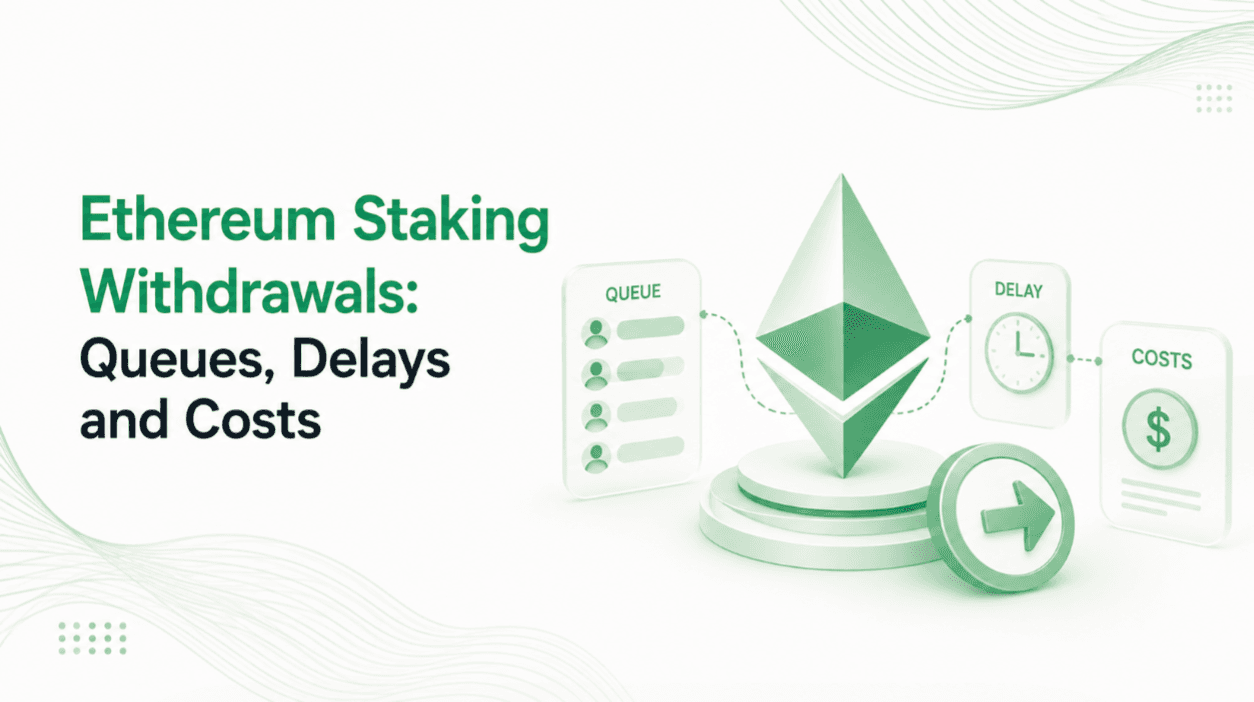
Staking ether is easy to enter and slower to leave, and the asymmetry is deliberate. A network that let validators exit instantly would let an attacker exit instantly too, so the protocol rate-limits departures.
That rate limit is the thing to understand before you deposit, because it decides whether a staked position is a long-term commitment or a liquid one.
Two different withdrawals
Partial withdrawals happen automatically. Rewards accumulated above a validator's effective balance are swept to the withdrawal address periodically, without any action from you and without leaving the validator set. This is how staking income actually arrives.
Full withdrawals are the exit. You broadcast a voluntary exit, the validator joins the exit queue, and once it has left, the entire balance is swept in a subsequent cycle. This is the one with the delay.
Both require withdrawal credentials pointing at an address you control. Validators created before that mechanism existed had to be updated, which is worth checking on any long-dormant validator before assuming an exit will work.
The churn limit, which sets the queue
The protocol allows only a limited amount of stake to enter or leave per epoch, scaled to the size of the validator set. Everyone exiting beyond that limit waits in an ordered queue, and the wait is simply the size of the queue divided by the rate at which it drains.
In quiet conditions this is days. When many validators leave at once — a market crash, a large operator consolidating, a protocol migration — it has extended to weeks. Entry queues have run long too: after the merge and again during periods of heavy inflow, new validators waited over a month to be activated.
The important property is that the queue lengthens under exactly the conditions that make people want to leave. It is not a constant to look up once; it is a variable that moves against you.
After the exit, the sweep
Leaving the validator set is not the same as having the money. Once exited, the balance waits for the withdrawal sweep, which processes addresses in order and takes a further period depending on the size of the validator set.
Budget for both stages. The realistic total from 'I want out' to 'funds in my wallet' is measured in days at minimum and can be considerably longer, and no amount of fee-paying accelerates it — there is no priority lane in the exit queue.
What consolidation changed
A 2025 protocol upgrade raised the maximum effective balance a validator can hold, allowing operators to consolidate many small validators into fewer large ones and compound rewards automatically rather than waiting for sweeps to redeploy them.
For large operators this is a significant simplification and it reduces the number of validators competing for queue capacity. For a single-validator staker it changes little day to day, beyond removing the need to manually restake accumulated rewards.
Liquid staking has a second exit
Holders of liquid staking tokens can either request a protocol withdrawal, which puts them behind the same queue with the protocol's own buffer in front of it, or sell the token on the market immediately.
The market exit is instant and priced. When queues are short the two routes cost about the same; when queues are long the market price falls below par and that gap is what you pay for skipping the line. Why liquid staking tokens discount covers the mechanics.
Protocols hold buffers of unstaked ether to serve small withdrawals instantly. Those buffers are sized for normal demand, and normal demand is not what you should be planning around.
Exiting through an exchange or provider
Custodial staking has its own exit, and it is not the protocol's. The platform decides how quickly it returns your capital, and that decision is constrained by the same underlying queue plus whatever internal buffer and policy sit on top of it.
Some platforms return funds instantly from their own reserves, which is genuinely convenient and means you are relying on their balance sheet rather than on the chain. Others simply pass the queue through. Ask which before you deposit, because the difference is invisible until you try to leave.
The costs nobody itemises
- Opportunity cost: capital in the exit queue earns nothing once the validator has stopped attesting.
- Discount cost, if you take the market exit instead of waiting.
- Gas cost for the exit transaction and any subsequent moves — small, but real.
- Tax cost, since exiting may realise gains on rewards accrued at different valuations.
- Re-entry cost, because if you change your mind the entry queue may also be long.
How to plan for it
Decide before depositing which portion of your holdings is genuinely long-term. Stake that directly for the full reward with no intermediary; keep anything you might need within a month in liquid form, whether that is unstaked ether or a deeply traded staking token.
If you delegate, ask the provider what their exit process is and how long it took the last time many customers requested it simultaneously. The answer to the second question is worth more than the answer to the first.
Our best staking providers table records exit terms alongside slashing history, and how to stake Ethereum covers which route suits which amount.
And check your withdrawal address before you need it, not after. A validator pointing at an address you no longer control is a problem with no good solution, and it is entirely avoidable with one check today.
Frequently asked questions
How long does it take to unstake ETH?+
Days at minimum: an exit queue whose length depends on how many validators are leaving, then a withdrawal sweep. Under heavy exit demand the queue has extended to weeks.
Do I need to do anything to receive staking rewards?+
No. Rewards above the validator's effective balance are swept automatically to your withdrawal address on a recurring cycle, without leaving the validator set.
Can I speed up an Ethereum exit?+
Not through the protocol — there is no priority lane. The only fast exit is selling a liquid staking token on the market, which costs whatever discount the market is quoting.
Why does the exit queue get longer during a crash?+
Because the protocol limits how much stake can leave per epoch, and a crash makes many validators want to leave at once. The constraint tightens precisely when demand for it peaks.
Written by
Emily CarterFormer regulatory analyst · J.D.
Emily Carter is a legal and regulatory writer specializing in cryptocurrency, blockchain policy, and digital asset compliance. Before joining CRYPTO·COINBEAT, she worked as a regulatory analyst in the United States, tracking developments in federal financial legislation, anti-money laundering (AML) requirements, and emerging policies shaping the digital asset industry. She earned her Juris Doctor (J.D.) degree and combines legal expertise with a talent for translating complex regulatory topics into clear, accessible language. Her work focuses on cryptocurrency taxation, DeFi regulation, exchange compliance, stablecoins, and the evolving role of U.S. agencies in overseeing digital assets. At CRYPTO·COINBEAT, Emily writes educational guides and policy explainers designed for both newcomers and experienced crypto users. She is committed to helping readers understand how regulatory changes affect investors, businesses, and the broader blockchain ecosystem.
Keep Reading
Ethereum Layer-2 Scaling: How Rollups Make ETH Cheaper and Faster
Rollups move execution off Ethereum’s base layer while keeping its security. Here is how optimistic and zk-rollups work and where they differ.
Maria Fernandez · May 3, 2026→
Proof of Stake and ETH Staking Explained
Ethereum secures itself with staked ETH instead of mining. Here is how validators, rewards and slashing work, and what staking really involves.
David Turner · May 16, 2026→
Ethereum Gas Fees Explained: Why Transactions Cost What They Do
Gas is how Ethereum prices computation. Here is what you are really paying for, why fees swing so hard, and how to keep them down.
David Turner · May 25, 2026→